
Advanced Specialty Training Program in Echocardiography and Multimodality Imaging
One-year Advanced Echocardiography Fellowship (Non-ACGME)
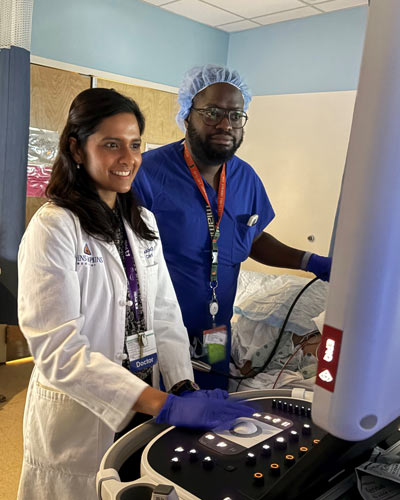
The Johns Hopkins Advanced Specialty Training Program in Echocardiography and Multimodality Imaging is a one-year, intensive fellowship designed to develop Level III expertise in adult echocardiography, with structured exposure to advanced applications including three-dimensional and strain imaging, contrast echocardiography, stress echocardiography, interventional/structural transesophageal echocardiography (TEE), and multimodality integration with cardiac CT and CMR. Training emphasizes interpretive rigor, technical proficiency, and leadership in laboratory operations, aligned with American Society of Echocardiography (ASE) standards and preparation for the National Board of Echocardiography (NBE) Advanced Echocardiography certification examination.
Program Highlights
- High-volume, complex clinical echocardiography across inpatient, outpatient, and procedural environments, supported by a large integrated health system and multiple lab sites.
- Comprehensive advanced echocardiography training, including TTE, TEE, stress echo, 3D echo/3D TEE, strain imaging, and contrast applications.
- Structural and intraprocedural imaging experience with real-time echo guidance for advanced interventions, including pre-, intra-, and post-procedure assessment.
- Multimodality pathways (optional/individualized) to support Level II training in cardiac CT and CMR, when feasible without compromising Level III echo requirements.
- Education, mentorship, and scholarship embedded in daily readouts, case conferences, guideline-based teaching, and an expectation of high-impact academic output.
- Leadership development in lab operations, quality, education, and team-based care delivery.
Clinical Training Experience
Fellows develop advanced competence across the full spectrum of echocardiography including:
- Comprehensive 2D and 3D transthoracic echocardiography (TTE) with advanced quantification of chamber size and function, valvular heart disease, hemodynamics, diastolic function, and pericardial pathology.
- Transesophageal echocardiography (TEE) performance and interpretation, including complex diagnostic studies, urgent inpatient examinations, and advanced multiplane and 3D TEE applications.
- Stress echocardiography, with emphasis on protocol selection, patient safety, hemodynamic assessment, and integration into clinical decision-making.
- Advanced echocardiographic techniques, including myocardial strain imaging and contrast echocardiography, with focus on appropriate indications, acquisition optimization, and standardized reporting.
Structural and Intraprocedural Echocardiography
Fellows receive advanced training in echocardiographic assessment and real-time guidance for structural and interventional cardiac procedures. The curriculum emphasizes comprehensive pre-procedural anatomic and hemodynamic evaluation, procedural imaging strategy selection, and intraprocedural two-dimensional and three-dimensional transesophageal echocardiographic guidance. Fellows develop expertise in device sizing, positioning, deployment assessment, and immediate post-procedural evaluation, as well as systematic identification of procedural complications. Training prioritizes effective real-time communication with interventional cardiology, cardiac surgery, and anesthesia teams, preparing fellows to function as expert imaging consultants in complex procedural environments.
Targeted Congenital and Complex Anatomy Exposure
The program incorporates targeted exposure to adult congenital and complex structural echocardiography to strengthen advanced anatomic interpretation skills. This experience emphasizes segmental analysis, chamber and great vessel relationships, shunt physiology, and post-surgical anatomy. Fellows refine the ability to integrate congenital principles into adult structural and interventional imaging, enhancing diagnostic accuracy and procedural planning in patients with atypical anatomy or prior repairs.
Multimodality Imaging Integration (Individualized)
Fellows may pursue individualized exposure toward Level II training in cardiac computed tomography and/or cardiac magnetic resonance imaging, contingent on feasibility and programmatic approval. Multimodality training emphasizes evidence-based test selection, strengths and limitations of each imaging modality, and quantitative assessment for structural heart disease, cardiomyopathies, and procedural planning. Fellows are trained to integrate findings across imaging platforms, fostering a comprehensive, physiology-driven approach to cardiovascular diagnosis and management.
Education and Conferences
The fellowship includes a structured educational curriculum with active fellow participation in teaching and case presentation.
- Weekly didactic sessions covering advanced echocardiography topics, including valvular heart disease, cardiomyopathies, diastology, strain imaging, three-dimensional techniques, congenital heart disease, and procedural imaging
- Regular echocardiography case conferences highlighting complex cases, guideline-based interpretation, and multimodality correlation
- Structured board-preparation curriculum focused on advanced echocardiography knowledge and examination readiness
- Multimodality imaging conferences integrating echocardiography, cardiac CT, and cardiac MRI perspectives
- Quality improvement and laboratory performance conferences addressing image quality, reporting consistency, and workflow optimization
Scholarship and Research
Fellows are expected to complete a scholarly project focused on echocardiography or multimodality imaging. Research opportunities span advanced quantification, myocardial mechanics, valvular heart disease, cardiomyopathies, pulmonary vascular disease, and structural heart imaging. Fellows receive mentorship in study design, data interpretation, and dissemination through abstracts and peer-reviewed publications.
Training Environment
The echocardiography laboratories provide comprehensive inpatient and outpatient services across multiple clinical sites, supporting a broad case mix that includes advanced transthoracic and transesophageal echocardiography, stress testing, three-dimensional imaging, and procedural guidance. The environment supports high-volume clinical exposure alongside academic and educational missions.
Eligibility
Applicants must have completed an ACGME-accredited general cardiology fellowship prior to program start. The program is designed for individuals pursuing advanced clinical expertise, academic imaging careers, or leadership positions in echocardiography laboratories. We offer two fellowship positions per academic year and solicit applications approximately two years in advance. The application cycle opens on November 1 and closes on January 1, with selected candidates notified by January 15.
Advanced Specialty Training Program in Adult Echocardiography and Multimodality Imaging Program Information
- ASTP Program Director - Monica Mukherjee, MD, MPH
- ASTP Medical Training Program Administrator - Sophia Nayden