
Community Impact Reports
Suburban Hospital’s footprint has long been rooted in community health. In living out its mission to improve the health of the community and the world by setting the standard of excellence in medical education, research and clinical care, the services provided by our staff expand beyond the walls of the hospital and deep into Montgomery County, nurturing a healthy, vibrant and resilient community. The following describes Suburban’s process for community health improvement, which guides and informs our work to achieve significant and lasting change.
Community Health Needs Assessment

The Patient Protection and Affordable Care Act of 2010 requires nonprofit hospitals to complete community health needs assessments (CHNAs) every 3 years. A CHNA is a systematic, stakeholder-driven process that uses scientifically valid health indicators and comparative information to determine the most significant health needs of residents in a defined geographic area.
The 2025 Montgomery County Hospital Collaborative Community Health Needs Assessment (MCHC CHNA) is the second collaborative CHNA among Suburban and the other five Montgomery County hospitals. The collaborative nature of the CHNA serves to leverage resources and capacities for a more comprehensive needs assessment.
The 2025 MCHC CHNA identified seven health factors (organized in three main domains) contributing to poor health outcomes in our community:
Easy Access to Comprehensive Care
All residents deserve access to high-quality, culturally and linguistically responsive care, including access to:
- Primary Care Services
- Substance Use Treatment & Recovery Services
- Specialty & Extended Care
- Mental Health Services
- Health Insurance Coverage
Promotion of Healthy Living and Well-Being
Communities thrive when people are supported to live well through:
- Physical activity
- Nutritious Eating
- Chronic disease self-management
- Injury & Disease Prevention
- Safe Environments
Support for Essential Community Services
Our environments shape our health - safe spaces and responsive services help communities thrive through:
- Affordable Housing
- Healthy Food Access
- Human Services Access
- Transportation
- System Navigation
These seven health factors are recognized as root causes that impact a person’s health, well-being, and quality of life. For further information on how Suburban and the other five hospital plan to address each identified unmet need, please review the Montgomery County Hospital Collaborative Improvement Plan below.
Community Health Implementation Strategy
Developed every three years in response to the latest CHNA and adopted by the Board of Trustees, the 2025 Montogomery County Regional Collaborative Community Health Improvement Plan represents the first-ever collaborative CHIP, including each of the four Montgomery County healthcare systems and Montgomery County Department of Health and Human Services. This plan represents more than a strategic roadmap; it is a shared commitment to improving the health and well-being of the communities we serve. By engaging in a joint CHIP, we raise the bar to deliver outcomes we could not achieve alone. This collaborative process allows us to leverage experiences, perspectives, resources, capacities, and partnerships to set and achieve defined and achievable outcomes through the implementation of evidence-based strategies.
To learn more about the CHIP process, the populations addressed, and the specific approaches to health improvement that align with CHNA health priorities, read the 2025 Montgomery County Hospital Collaborative Improvement Plan.
We Welcome Your Feedback.
Community members are invited to submit their comments and/or questions in response to Suburban’s 2022 CHNA and/or implementation strategy to [email protected] or by calling 301-896-3572.
Community Benefit
Community benefit initiatives and programs at Suburban Hospital address local community health needs identified by our community health needs assessment. Community benefit includes the following:
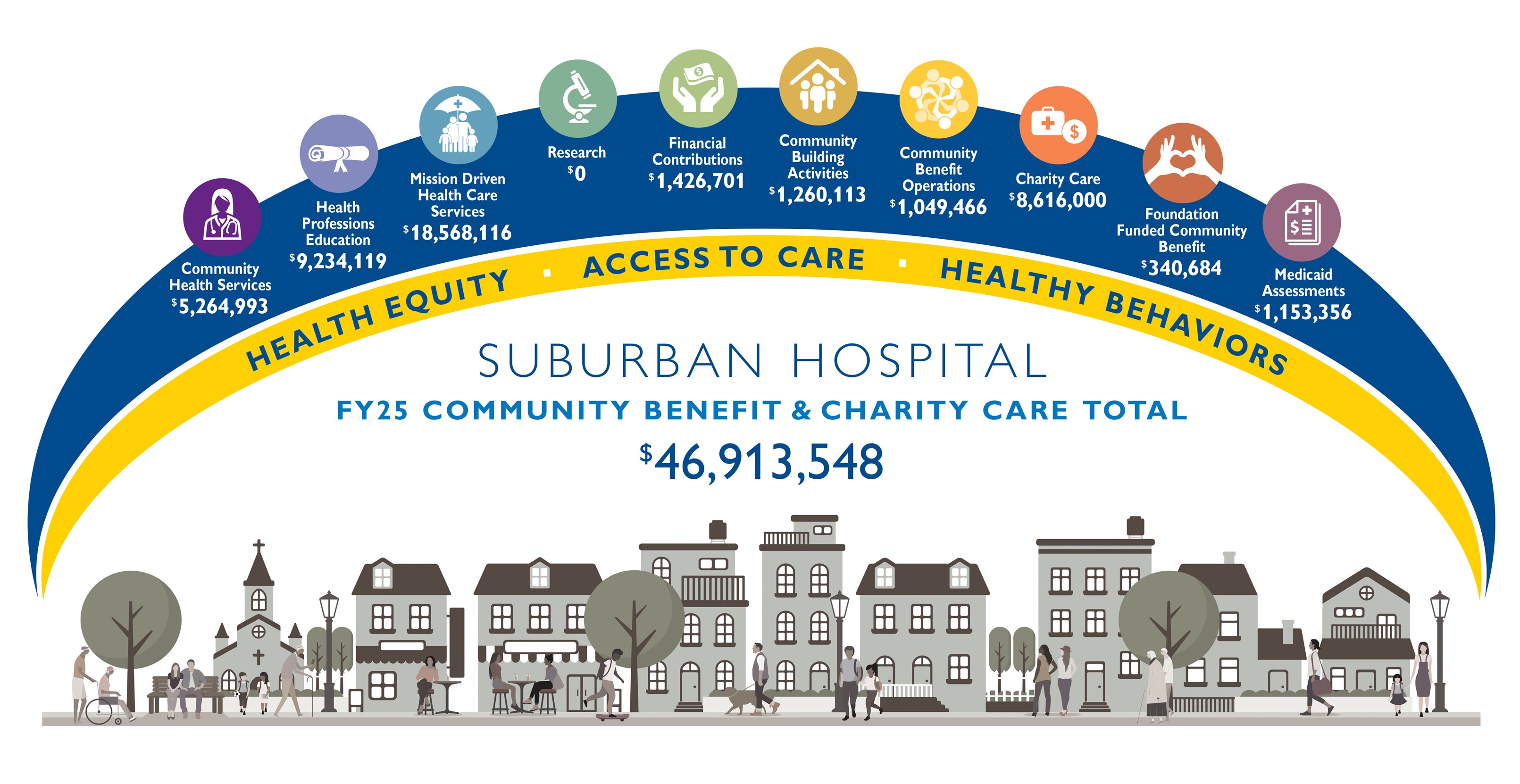
Community Health Services
Programs or activities that help improve the health of the community—like free screenings, health fairs, vaccination clinics, or disease prevention programs.
Health Professional Education
Training and education for people working in healthcare—such as doctors, nurses, or students—to help them learn new skills or improve the care they provide.
Mission-Driven Health Services
Healthcare services offered because they are important to the organization’s mission, even if they don’t make money—like mental health clinics, substance use treatment, or services in underserved areas.
Research
Studies and investigations done to improve health and healthcare—like testing new treatments, understanding diseases, or finding better ways to deliver care—especially when the findings will benefit the public or specific communities.
Financial Contributions
Money or donations given by a healthcare organization to support community groups, nonprofits, or health-related causes.
Community Building Activities
Efforts to improve the overall well-being of a community, not just health—like supporting safe housing, education, job programs, or neighborhood improvements.
Charity Care
Free or discounted healthcare provided to patients who cannot afford to pay for services.
Foundation Funded Community Benefit
Community programs or services paid for by a hospital or health system’s charitable foundation (rather than the hospital’s operating budget).
Access Suburban Hospital's 2025-2026 Community Impact Report (PDF).
The Johns Hopkins Health System Community Benefit

Access The Johns Hopkins Health System's most recent community benefit report.