
The Johns Hopkins Institute for Cell Engineering represents the cell engineering efforts at the Johns Hopkins University School of Medicine, where faculty, fellows, postdocs, and students and staff study some of the most exciting challenges in science today.
Bringing together researchers who aim to engineer cells to improve human health, the Institute provides a multidisciplinary environment at the Johns Hopkins University School of Medicine that stimulates collaboration in hopes of accelerating progress. Our four basic research programs focus on a wide range of conditions including Parkinson's disease, ALS, cancer, diabetes, heart failure, stroke and spinal cord injury among many more.
The Institute for Cell Engineering at Johns Hopkins
Hear from our experts as they discuss the application and development of new cell technologies that may ultimately form the basis for new cell-based therapies to treat human diseases.

Research Programs
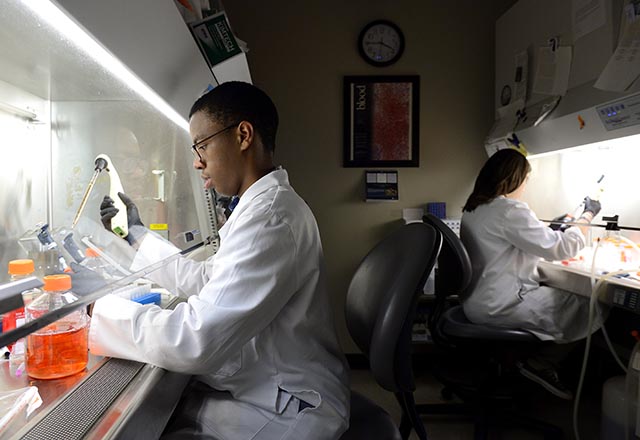
Our four basic research programs, Immunobiology, Neuroregeneration, Stem Cell Biology and Vascular Biology, focus on a wide range of conditions including Parkinson’s disease, ALS, diabetes, heart failure, cancer, stroke and spinal cord injury.

News



Training Opportunities
A number of graduate programs are available to prospective graduate students interested in training at the Johns Hopkins School of Medicine including:
- Biochemistry, Cellular and Molecular Biology
- Biological Chemistry
- Cellular and Molecular Medicine
- Immunology
- Neuroscience
- Pathobiology
For Researchers
-
Core Facility Service Centers at Johns Hopkins Medicine
This is a searchable database of all research resources available at Johns Hopkins Medicine.
-
JHU Institutional Stem Cell Research Oversight Committee (ISCRO)
The ISCRO at Johns Hopkins oversees all research using human embryonic stem cells, all somatic cell nuclear transfer involving human cells, human induced pluripotent stem cells and human embryonic germ cells. Find more information on the ISCRO site.
For Patients
-
Find a Johns Hopkins Doctor
Use this database to search for a doctor by name, specialty, disease, health conditions and other search terms.
-
Make an Appointment
Johns Hopkins Medicine provides a wide range of comprehensive and cost-effective health care services. Use this link to find more information about how to make an appointment.
-
Find a Clinical Trial
Use this database to search for the latest clinical trials available at Johns Hopkins.