Skip Navigation


Print This Page
Share this page: More
 

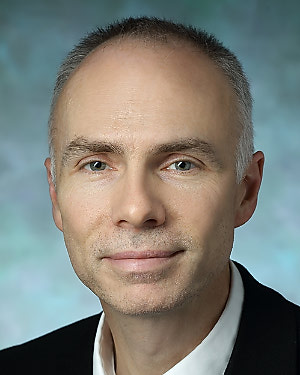
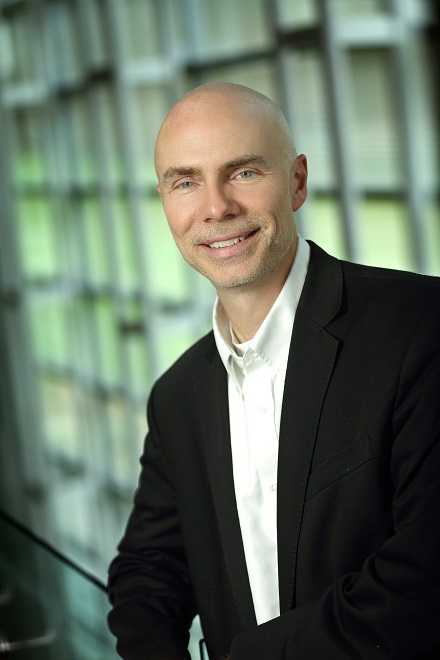
Jef Boeke

Jef Boeke
Jef Boeke

Jef Boeke of
Molecular Biology and Genetics
and the HiT Center
on microarrays 101 and scientific nomenclature:


Tell us, in a nutshell, about the microarrays that are revolutionizing research.

BOEKE: Microarrays aren’t particularly complicated. They’re basically microscope slides with thousands of tiny dots of DNA attached. The slides are flooded with molecules—probes—that attach to certain of the DNA sequences. Usually, probes are fluorescently labeled so the DNA dot they bind to lights up. Since each DNA sequence is different and specifically arranged, we know exactly which sequences are reacting.


The HiT Center has been working on other microarrays, those not DNA-based, right?

BOEKE: Yes, and it’s one of the really exciting features of the technology. The arrays run the course from pure molecules—DNA, proteins, even carbohydrates—to more complex samples such as tissue extracts or whole bacteria. There really is no limit to what you can place on these chips.


Beyond the research that you, Heng Zhu and others conduct, what else does the HiT offer on the microarray front?

BOEKE: The core facility—open to anyone—that processes RNA or DNA samples for probing microarrays. It offers “catalog” arrays, which have preset sequences, and custom-made arrays. Also, we have a team of analysts. While most people understand the concept of how microarrays work, they may not appreciate how immense the volume can be or how messy results can get. So our analysis team helps sort the data and separate true positives from false ones.


How does the future of microarrays look? Will they become a standard component of almost every lab, similar to the way polymerase chain reaction has?

BOEKE: Certainly I’d guess that most labs at JHU already have some experience with arrays, directly or indirectly. And the data are already out there for anyone to see. The equipment required is not all that pricey, but getting into it in a big way requires a commitment to juggling big datasets, thinking statistically and employing mathematical rigor. This is not every biologist’s cup of tea. But I’d certainly encourage any student to go out and play with big data sets—everybody else is doing it! 


Jef Boeke tells about coining the term "retrotransposon.":


You coined the term retrotransposon almost a quarter-century ago when publishing seminal research about this mobile element of the genome; research that showed there was, in fact, an RNA intermediate in the transposition process. Could you talk about your foray into wordsmithing?

BOEKE:  When you’re writing a paper, you need shortcuts to communicate efficiently, and I realized we needed a name for this thing: There are retroviruses and there are transposons, and this is a transposon that has a life cycle like a retrovirus. So I put retrotransposon in one of the paragraphs in the paper and it stuck. I did a literature search recently on retrotransposon while writing a review article, and there are thousands upon thousands of citations that contain that word; there also are regular meetings on the topic, so that’s kind of fun.


So much fun that you did it again, more recently, by coming up with the catchy name “TIP chip.” What is that, exactly?

BOEKE:  The TIP [transposon insertion profiling] chip essentially is an old dog we’ve taught a new trick to. It’s basically a small square of glass—a microscope slide—that holds millions of different tiny little snippets of DNA and allows for precise identification of the positions of retrotransposons in the genomes of different people. Someday, it will allow us to make a map for any individual: We will be able to take your DNA sample and my DNA sample and point to maybe 50 or maybe 500 retrotransposons that are different between you and me and might underlie our different phenotypes. Two junior faculty at the school of medicine, Kathleen Burns and Sarah Wheelan, played critical roles in making this technology work, as well as Lisa Huang, a grad student.


Could you explain in more detail exactly how TIP chip technology works?

BOEKE: Think of the genome as a book made up of chapters, which are chromosomes, and sentences that are genes. The four letters of DNA—A, G, C and T—make up the words, of course, and you have millions of different words that stretch from the first word of the first chapter to the last word of the last chapter, all arrayed in a specific design on the surface of this little slide of glass. What we’ve done is come up with a way to put a fluorescent tag on all of the sequences that are right next door to one of these mobile elements called retrotransposons. And because DNA is double stranded and the sequences are very specific at the different locations, these fluorescent pieces of DNA will find their counterparts on the chip—so the Watson strand of the labeled DNA will find the Crick strand on the slide of glass and light up a little spot. By looking at the pattern of these little spots, we can understand the map of where these various elements are inserting in an individual. 


Why is it important to know that?

BOEKE:  We believe that these insertions of transposons may underlie human phenotypes and possible human disease states. Earlier studies suggested that the frequency with which you have transposon insertions as opposed to changes of one letter are relatively small, and to some scientists, insignificant. As a result, most people studying genetic diseases tend to focus on the coding regions of the genes—maybe 5 percent of the length of the gene—and ignore long stretches that are in between these coding regions or “exons.” Some of our work has suggested that when these transposable elements land in the noncoding regions known as “introns,” they can have profound effects on expression of a gene. We think this is an important, potential additional source of human variation that has been missed, to a large extent.


To understand the mechanism by which these travelling salesmen of the genome move, and the effects they have on genes when they get where they’re going, you are now artificially introducing retrotransposons into transgenic mice. Backing up a moment: Do you know why they move?

BOEKE:  I would say it’s because they can. There are two schools of thought about the “function” of transposable elements. One is that they are, as I say facetiously, the genome’s little helper. They somehow perform a function for the host organism. Transposable elements have turned into something useful for the biology of the organism. The technical term for this is “exaptation.”
The counterpoint is that transposable elements are fundamentally selfish DNAs, organisms that have invaded many genomes, and essentially “we” are in conflict with “them.” Not only we humans, but everything from E. coli to elephants—all God’s creatures—have mobile sequences in our genomes.


Where do you weigh in on this debate?

BOEKE:  It’s probably true that the vast majority of insertions are fundamentally deleterious to the organism. The transposon jumps because the host is, at some level, trying to get rid of it by various means. If it doesn’t continue to jump, it will become extinct. I fundamentally subscribe to the view that these mobile elements should be thought of as their own organism and their mission in life is to be fruitful and multiply.


The thought of us all harboring these “selfish DNA” aliens sounds like fodder for a bio-horror flick. 

BOEKE:  Nature is—what is the phrase?—red in tooth and claw. It's not always pretty.


Related Articles:


© The Johns Hopkins University, The Johns Hopkins Hospital, and Johns Hopkins Health System. All rights reserved.

Privacy Policy and Disclaimer