
Johns Hopkins Medicine Adds Specialized Urology Expertise to the Greater Washington Area
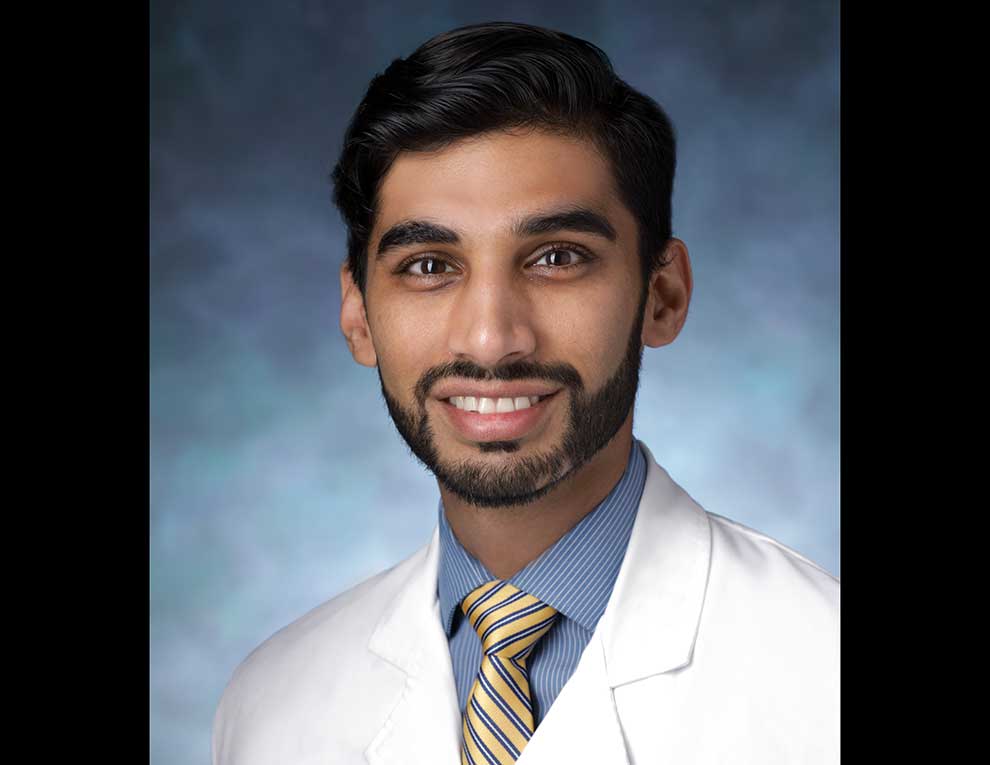
Mahir Maruf is one of just a few urologists in the region with fellowship training in the HoLEP procedure for patients with enlarged prostates.
Key Points
- Holmium laser enucleation of the prostate (HoLEP) is a minimally invasive treatment for patients with benign prostatic hyperplasia (BPH).
- It removes a large volume of prostate tissue, so symptoms don’t return.
- Urologist Mahir Maruf is bringing HoLEP and other urology care to the Greater Washington area.
Urologist Mahir Maruf brings the holmium laser enucleation of the prostate (HoLEP) procedure to the Greater Washington area. The minimally invasive treatment for patients with benign prostatic hyperplasia (BPH) removes more tissue than transurethral resection of the prostate (TURP), reducing the risk that symptoms will return.
Maruf, who joined the Johns Hopkins Brady Urological Institute in September, is one of just a few urologists in the Greater Washington area with fellowship training in HoLEP. He sees patients at the Camalier Building in Bethesda and performs surgical procedures at Suburban Hospital.
“TURP has been the standard of care for decades, and it’s a really good procedure,” says Maruf. “But HoLEP removes a significantly larger amount of tissue. I think anyone considering a TURP should highly consider a HoLEP if they have access to it.”
HoLEP uses laser beam pulses to hollow out the prostate and push the excess tissue into the bladder, where a morcellator is used to pulverize it for removal. It is recommended for patients with prostates larger than 80 grams, but because it requires specialized training and tools, it is not yet widely available.
Maruf is now bringing Johns Hopkins Medicine-trained expertise in the procedure to the Greater Washington area. After a residency at the University of Michigan Medical School, where he learned the procedure, he pursued specialized fellowship training in minimally invasive surgery and endourology at the Johns Hopkins University School of Medicine with guidance from Naren Nimmagadda, who has been performing HoLEPs at The Johns Hopkins Hospital for several years.
The surgery takes about three hours. It can be either outpatient or with an overnight stay, depending on prostate size and patient health.
After the HoLEP, patients may temporarily experience irritation, incontinence or increased urgency to urinate. These symptoms typically ease quickly and improve within a month. Some patients experience retrograde ejaculation.
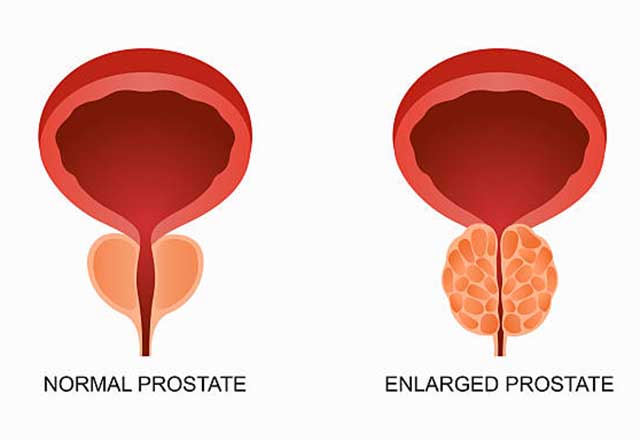 A normal and an enlarged prostate.
Patients with BPH typically have difficulty urinating or have to urinate several times during the night. Symptoms worsen over time as the prostate continues to enlarge, says Maruf.
“My philosophy is that people should be evaluated early,” says Maruf. “They don’t necessarily have to do anything right away, but I want them to be aware of the symptoms. And when it does become bothersome, we can do something about it.”
For Clinicians Clinical Connection
Clinicians, discover the latest in research and clinical innovation from Johns Hopkins experts. Access educational videos, articles, CME courses and other resources from our world-renowned institution.