
Proton Therapy Provides Targeted Treatment for Some GI Cancers
The treatment reduces radiation exposure to nearby healthy tissue.
Key Points
- Proton therapy delivers a precise beam to tumors, largely sparing nearby health tissue.
- It is an attractive option for younger people and those who have already undergone radiation therapy.
- Because it is so precise, it requires identical setups each day, with bowels free of stool or gas.
Proton therapy is gaining traction as an effective complement to photon radiation for treatment of gastrointestinal cancers, says Rachit Kumar, a radiation oncologist with the Johns Hopkins Kimmel Cancer Center.
The therapy, which uses a precise beam to target tumors, delivers minimal radiation to surrounding healthy tissues compared to more traditional photon therapy — making it an appealing choice for cancers that are close to vital organs. Kumar often recommends it for patients who are relatively young, or have had radiation treatments in the past, because reduced radiation exposure in general minimizes the risk of future cancers.
The American Cancer Society recently reported a sharp increase in rectal cancer diagnoses in patients as young as 20. In these patients, says Kumar, proton therapy would spare the nearby bladder and intestines from radiation.
The Johns Hopkins Proton Therapy Center, which opened at Sibley Memorial Hospital in 2019, provides some of the most advanced proton radiation treatment in the region, says Kumar, who treats patients at Sibley Memorial Hospital and Suburban Hospital.
Initially, it was used primarily for cancers of the head and neck, near the lungs or eyes, and in pediatric patients. In the past few years, Kumar says, it has become increasingly popular for treating cancers of the liver, anus, rectum and intestinal tract.
“I’m using it quite a bit for patients with liver tumors,” he says. “The liver can take a fair amount of radiation, but for patients who have already had multiple courses of treatment to the liver, we want to spare as much normal liver as possible so that it can continue to function well.”
Kumar notes that the precision of the proton beam makes it less forgiving than photon radiation when targeting structures that move and change, such as when gas or stools modify the GI tract from one day of radiation to the next.
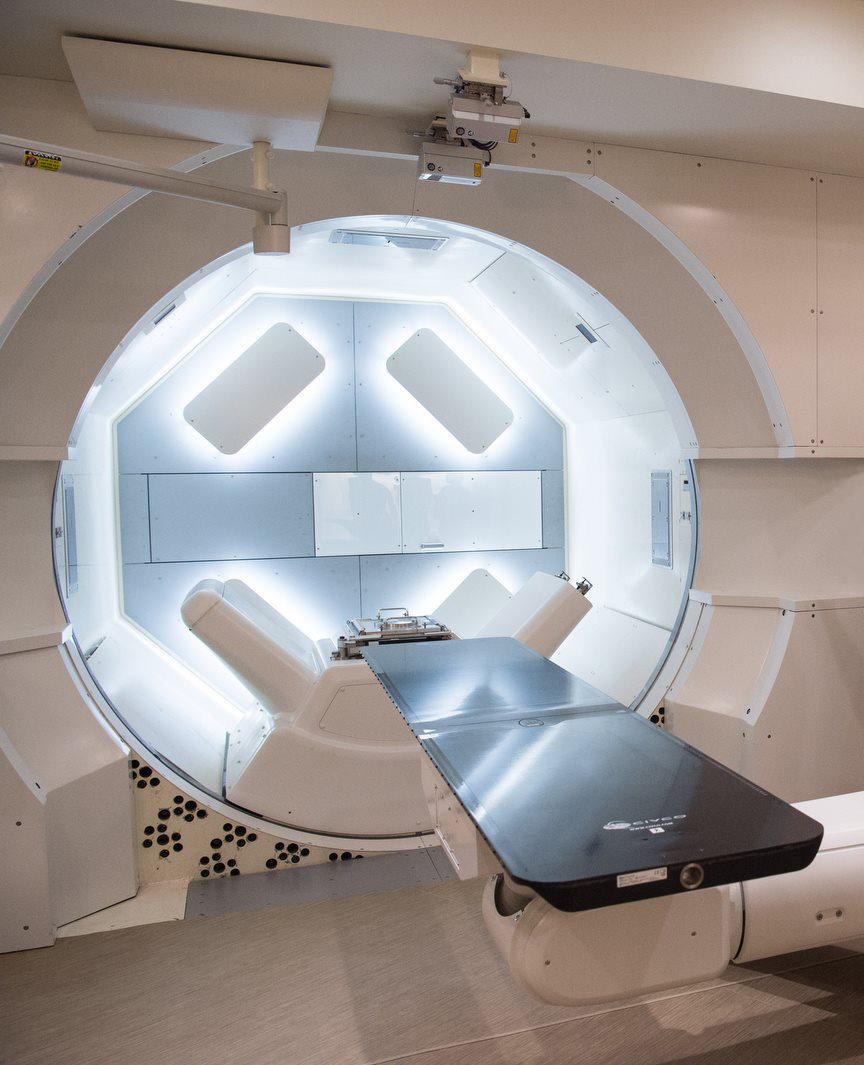
To combat that problem, patients are often asked to have a bowel movement or take an enema before treatment. He also notes that the proton machine has a built-in CT scanner that helps clinicians see internal structures.
From a patient’s perspective, proton and photon treatments feel similar, says Kumar. At each session, the patient is positioned on a table as the machine moves around them. Radiation courses vary depending on the goal of treatment, the target tissue and its proximity to nearby normal tissues. For example, in patients with a single liver tumor, the entire course of radiation with proton therapy may be completed in five treatments, whereas for a patient with a new diagnosis of anal or rectal cancer, proton therapy may require six weeks of daily treatment.
Oncologists have been using proton therapy for GI cancers for about 20 years, says Kumar, and research is starting to confirm its benefits over photon radiation in specific cases.
“We know that one of the potential benefits for proton therapy is, simply, that as patients live longer, there could be downstream improvement in outcomes,” he says. “For GI cancers, we don’t yet have the long-term outcomes to show that, but we do know that in other parts of the body, longer term, we do see those benefits.”
Medically reviewed by Rachit Kumar, M.D.
For Clinicians Clinical Connection
Clinicians, discover the latest in research and clinical innovation from Johns Hopkins experts. Access educational videos, articles, CME courses and other resources from our world-renowned institution.