
New Pediatric Sedation Service Expands Access for Young Patients
The service provides a valuable option for patients who would benefit from sedation but do not need the resources of an operating room or intensive care unit.

Key Points
- Pediatric patients at Johns Hopkins Medicine can now receive sedation with a specialized service outside the emergency room, operating room or intensive care unit.
- The Pediatric Sedation Service provides intranasal, oral and intravenous sedation for procedures that are uncomfortable or stressful but do not require general anesthesia.
- The service improves access and efficiency with a patient- and family-centered care approach.
Johns Hopkins Children’s Center (JHCC) has implemented a pediatric sedation service for procedures that are uncomfortable or frightening but don’t require general anesthesia.
The JHCC Pediatric Sedation Service fills an important gap for clinicians, patients and families preparing for procedures such as removing a central line, changing the dressing on a wound, or imaging studies such as ultrasounds. They no longer have to choose between forgoing sedation altogether or waiting for a resource-intensive operating room or intensive care unit.
“There are procedures that perhaps an adult with a little bit of local pain control could get through, but kids often can’t,” says pediatric critical care physician Phillip Cohen, medical director of the Pediatric Sedation Service, noting that even routine procedures can be distressing to children with behavioral or developmental issues.
“With local anesthetic and either moderate to deep sedation, you can proceed in a way that keeps kids safe and optimizes the procedure, but also so they don’t remember or feel pain or feel anxious.”
The sedation service is provided in a recently opened dedicated sedation suite in the Charlotte R. Bloomberg Children’s Center Building, and travels to radiology locations throughout The Johns Hopkins Hospital.
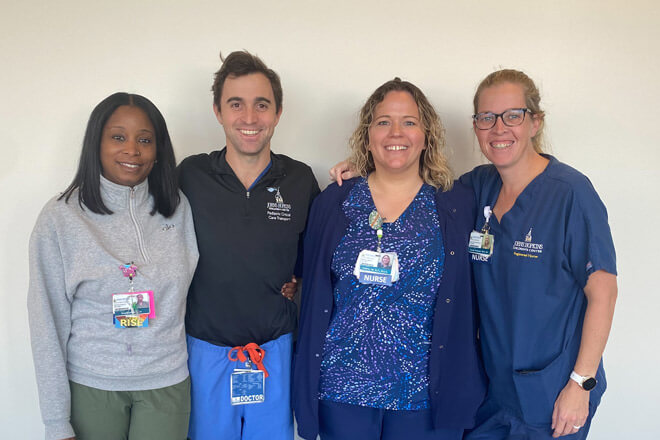 Clinical technician Stephanie Pushia, pediatric critical care physician Philip Cohen, nurse Andrea Alt and sedation service nurse coordinator Sarah Pohuski.
The one-bay sedation suite is staffed with a nurse, patient technician, child life specialist, sedation physician and the clinician performing the procedure or test. Patients most often have an IV placed in the preoperative area and then receive IV sedatives, without breathing tubes or other airway support. Some cases are supported with only oral or intranasal medications.
The room is clean but not sterile, so parents can stay with their children until they are amnestic or asleep. “Parental presence is reassuring both to the kid and to the parent, who gets to see the space and see their kid safely off to sleep,” says Cohen.
Introduced in July 2025, the sedation service is now being used more than 70 times a month, more than double what it was a year ago, across some 20 specialties, including oncology, urology, neurology and orthopaedics, says Cohen.
Clinicians seeking the service consult with the sedation team to ensure that it’s the right approach for the patient and the procedure, and that the patient can tolerate the medication without risk of respiratory or cardiovascular compromise that would require a breathing tube. It is usually scheduled for the same day.
Julia David, a nurse practitioner in pediatric oncology, described the service as a “welcome addition to our workflow,” adding: “Having a dedicated team of sedation physicians and nurses who are familiar with our patients and their unique needs helps ensure a comfortable, consistent and supportive experience.”
Cohen says similar programs exist in children’s hospitals nationwide, though none regionally offer the same ability to offer comprehensive services to pediatric patients.
As elegant as it seems, the solution took several years to create, and involved coordination among pediatrics, critical care medicine and anesthesiology, says Cohen. Sapna Kudchadkar, anesthesiologist-in-chief at the Children’s Center, was the catalyst, supported by Brenda Banwell, director of the Department of Pediatrics.
“The JHCC Pediatric Sedation Service represents such a critically important component of patient- and family-centered care for children across the age spectrum,” says Kudchadkar. “We are delighted to be able to offer infants and children, their families and medical providers this option, which improves efficiency and satisfaction for everyone.”
Pediatric Sedation Service at Johns Hopkins Children's Center
The Johns Hopkins Children's Center's Pediatric Sedation Service ensures our patients are comfortable and safe when medical procedures might cause pain or stress. This video walks you through an experience with the Pediatric Sedation Service, where the goal is always to provide safe, compassionate, family-centered care.
For Clinicians Clinical Connection
Clinicians, discover the latest in research and clinical innovation from Johns Hopkins experts. Access educational videos, articles, CME courses and other resources from our world-renowned institution.