
New Research Aims to Improve Bone Marrow Transplant Outcomes in Children
Chemotherapy and radiation are commonly used tools in cancer treatment, but in some cases, they can cause permanent damage in seeking to eradicate cancer cells. When cancer is aggressive or treatments such as chemotherapy fail, healthcare providers may elect to perform a total transplantation of the patient’s immune system with a bone marrow transplant (BMT). Providers at Johns Hopkins All Children’s Hospital in St. Petersburg, Florida, use BMT to treat certain cases of leukemia, lymphoma, inborn errors of immunity, inborn errors of metabolism, hemoglobinopathies and bone marrow failure disorders with care plans tailored to each patient.
An allogeneic BMT, in which stem cells are taken from a genetically matched donor, can dramatically increase survival rates for children with certain blood cancers and other disorders, starting them on a pathway to recovery. No walk in the park, the transplant process can inflict enormous strain on a young body. Finding a well-matched donor can be challenging, and post-BMT complications can have lifelong effects. One particularly challenging complication, called graft-versus-host disease (GvHD), is the focus of a five-year research project funded by a $4 million grant from the National Institutes of Health’s National Institute of Allergy and Infectious Diseases. In GvHD, transplanted blood cells and those native to the transplant recipient battle because they don’t recognize each other.
A team made up of researchers and clinicians at The Johns Hopkins University, Johns Hopkins All Children’s Hospital, and Case Western Reserve University will use computational models to study GvHD in a way that is representative of pediatric biology.
Unlocking a Better Understanding of Pediatric GvHD
Despite advances in donor selection, transplant techniques and medications, GvHD occurs in an estimated 10 to 25 percent of pediatric BMT patients and continues to be a threat to their long-term vitality, making understanding and managing the disease increasingly important. The new NIH-funded research project, Engineering Patient Avatars of Hematopoietic Stem Cell Transplantation to Study GvHD, has the potential to improve transplant outcomes by enabling better clinical decision-making informed by patient-specific insights.
The project will bring together basic and clinical science to develop patient-specific digital twins of acute GvHD, integrating clinical data with human tissue and microphysiological models to better understand disease mechanisms and ultimately support more precise, individualized treatment. The goal is to create predictive models that both deepen understanding of GvHD and lay the groundwork for precision-medicine approaches tailored to individual patients.
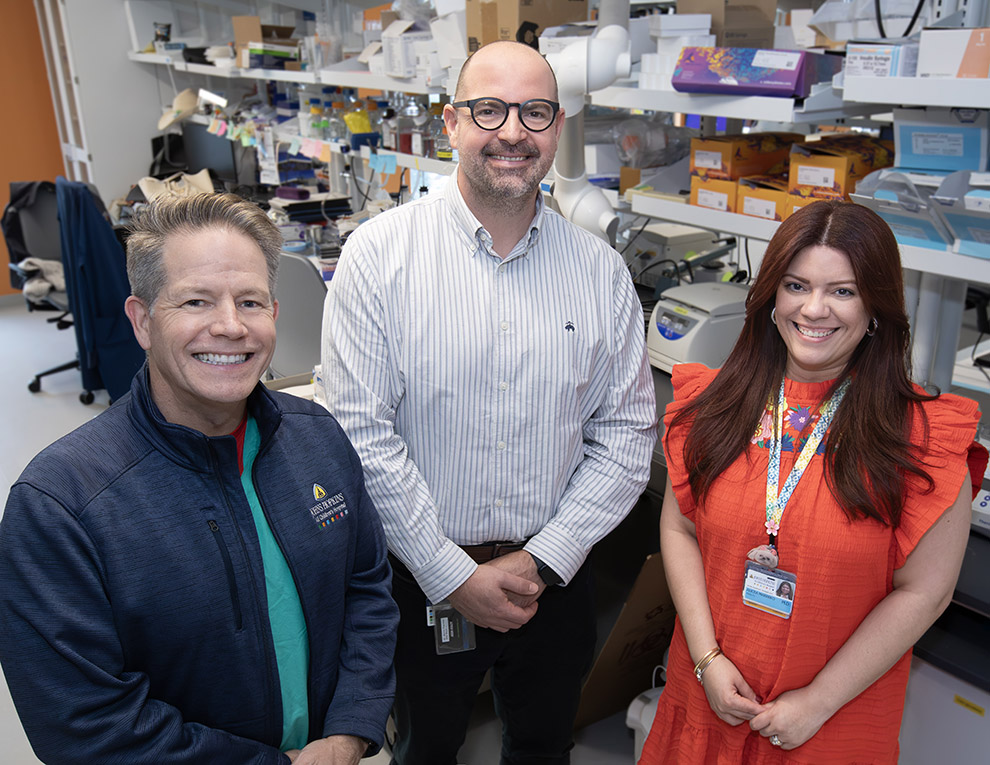
Martin Trapecar, M.Sc., Ph.D., assistant professor of medicine and biomechanical engineering at Johns Hopkins All Children’s, is the project’s co-lead investigator. He emphasizes the project involves close collaboration among basic scientists in the Johns Hopkins All Children’s Institute for Fundamental Biomedical Research and the hospital’s clinician-scientists who treat patients. They also are tapping systems biology and computational modeling program expertise from co-lead investigator Douglas Brubaker, Ph.D., of Case Western Reserve University.
Trapecar emphasizes the two-fold challenge to pediatric patients with diseases like GvHD. First, the disease can take a considerable toll on a patient who is not yet physically, mentally or emotionally formed. Second, children are sometimes subjected to further suffering because their access to some therapies that may be approved for adult patients is often delayed.
What is GvHD?
GvHD is a complication in which donor cells recognize the recipient’s body as foreign and attack it. Unlike in an organ transplant, in which the patient’s immune system rejects only the transplanted organ, in GvHD the transplanted immune system can attack the entire patient and all their organs. The condition is difficult to study and can have an outsized impact on children that are still growing and developing, with complications that can interfere with their quality of life over many years.
There are two types of GvHD, differentiated by symptoms, clinical signs, and the timing of the onset of symptoms:
- Acute GvHD typically occurs within the first 100 days after transplant and mostly affects the patient’s skin, appearing as an itchy, red, angry rash. It can also affect the gastrointestinal tract or liver. The most common GI tract symptoms are nausea, vomiting and diarrhea.
- Chronic GvHD can appear at any time after a transplant, but most cases commence within two years. This form of GvHD can target any organ, and might affect the skin, mouth, liver, lungs, GI tract, muscles, joints or genitals. In the skin, it causes severe tightness that may result in contractures or affect the musculoskeletal system so severely that patients cannot fully extend their joints. Burning lesions in the mouth may cause severe discomfort, and the eyes may itch and feel gritty.
Minelys Alicea Marrero, M.D., a blood and marrow transplantation physician at Johns Hopkins All Children’s, explains GvHD to patients and their families in a way that is easy to comprehend. She tells them, “Our bodies are very smart in knowing what’s ours and what’s not. They know the house they live in. When we introduce stem cells from a different person, the donor’s body, it’s like we’re putting an unfamiliar person in our house. Recognizing they’re no longer in their own home, they attack the recipient’s body, seeing it as an unfamiliar and hostile place.”
Good Matchmaking is Crucial, But Rarely a Sure Thing
As in organ transplantation, finding the best-suited donor is the key to BMT success. A successful procedure requires a donor whose human leukocyte antigens (HLAs) closely match the patient's proteins to prevent rejection or GvHD.
The ideal donor is a fully matched sibling. For many BMT patients, however, a fully matched donor does not exist. When a full match is unavailable, physicians may use a half-match donor, such as a parent or sibling, or a partially matched unrelated donor found through national bone marrow registries.
Clinicians like Alicea know that while the availability of alternate donors has expanded transplant options, there is an increasingly important corresponding need to more fully understand and manage GvHD. “The best donor,” she says, “Is a fully matched sibling who is 100 percent compatible. Because there are not many patients who have either a full sibling that's a 100% compatible or a 100% compatible donor, transplants using what we call ‘alternative donors’ or ‘half-match transplants’ using a parent, sibling, or an unrelated donor who is 50 percent compatible, have become more commonplace.”
She adds that, even in cases where a 100% match is made, there is still a risk of developing GvHD, underscoring the importance of deepening our understanding of the disease and developing patient-specific therapies.
Can Digital Twins Enable New Insights in GvHD Management?
Using microphysiological organotypic culture models (OCMs), the research team will endeavor to develop and validate precise, patient-specific insights into GvHD mechanisms that predict patient responses to various treatments. The project’s primary goal is to create predictive models that both deepen our understanding of GvHD and lay the groundwork for precision-medicine approaches tailored to individual patients. As there are currently no human multiorgan OCM models for GvHD, the team will be breaking new ground.
Computational models, sometimes referred to as “digital twins,” attempt to place a patient’s physical biology into a virtual environment. When the treatment the patient is physically undergoing is compared with its “twin” (the treatment replicated in an microphysiological system [MPS]) the research team can determine whether the two can be meaningfully connected computationally.
To accomplish this, the team will connect data collected from experiments in a controlled, laboratory environment with clinical data gathered from the same patients from which the physical models are established. The researchers will use computational methods to determine whether different sources of information relevant to the patient – data from the patient’s microphysiological system, clinical information from the patient, the treatment the patient is receiving, and treatment responses observed in the MPS – can be meaningfully connected to predict patient responses.
In a role that constitutes a bridge between the physical models and predictive computational modeling, Case Western Reserve expert Brubaker is responsible for developing computational approaches to translate MPS data into clinical outcomes. While Trapecar leads development of the physical patient “twin” using microphysiological systems that incorporate the patient’s living tissues, Brubaker leads the digital twin counterpart, integrating data generated by the physical twin with clinical data from the patient. The project’s real potential lies in bringing the physical and digital models together.
For nearly a decade, Brubaker has been working on the question of how to map laboratory observations back to human physiology, using hybrid models of patient data and data harvested from a laboratory model of a patient’s disease. He says, “Our job is to take all of that data, model it together, and come up with something that tells you what from the experiment is predictive, translatable, generalizable to that specific patient's treatment course and outcomes.” In other words, the physical twin generates biological information. The digital twin helps determine what that information means in the context of the patient. It’s an approach that could eventually help researchers move beyond asking: What happens in GvHD? to asking the more clinically useful question: What is likely to happen in this patient?
“The MPS,” Brubaker says, “makes the translational gap we’re trying to bridge much smaller, and aligns the biology of the experiment much more closely with the biology of the patient.”
Such translational computational models aren’t necessarily new. They’ve been used to study Alzheimer’s disease, tuberculosis, inflammatory bowel diseases and other common human disorders, but Brubaker says what’s different about this new “organ on a chip” dimension of the work is its potential as a platform for multi-organ human physiology. “With Dr. Trapecar’s models we can start constructing the multi-organ experimental avatar that feeds into the multi-organ digital avatar of the patient.”
Wanted: Kid-Specific Drug Development
Hinting at another translational gap that may soon be bridged, Brubaker says much of the technical development in this study involves adult samples, but the translational aspect is anchored in the pediatric populations, envisioning an era when clinicians will have more pediatric-specific treatment options.
In Trapecar’s view, the quest for patient-specific therapies that work well in pediatric patients begins with a look at how therapies are traditionally developed. He says, “When we think about how we actually develop therapies, whether it's for children or adults, we are relatively limited in how we can study a disease and develop a therapy. Typically, we use animal models, or simple cell culture models, or clinical specimens like biopsies and tissues, and we try to learn from those. But rarely do these consider pediatric biology or physiology. We’re either working with animals, who are not children and not humans in the first place, or adult tissues. So, we have this second problem where we’re trying to develop drugs, but not specifically with pediatrics in mind.”
Trapecar says his team’s work will tackle both issues, and “where these two collide is where we will attempt to develop a new way of studying pediatric diseases. GvHD is the battlefield on which we choose to do it.”
“Computational models allow us to predict both transplantation immune response and therapeutic success,” Trapecar says. “The important thing, and our main mission, is to develop an approach and model that doesn’t exist yet. We hope to learn something new about GvHD, but we want to establish a complete approach. Once it’s established, then we can study any diseases that could benefit from a similar approach.”
A Model by Any Other NAM
Once viewed as not much more than an engineering novelty, microphysiological systems and the development of alternatives to traditional animal models have been increasingly supported by the NIH and the U.S. Food and Drug Administration. The field has adopted the term New Approach Methodologies (NAMs) to describe this broader movement toward more human-relevant models of disease and drug response. According to information on the FDA website, this approach includes AI-powered models, human organ-on-a-chip systems, and real-world data, enabling accelerated development of safer treatments while reducing costs and sparing thousands of laboratory animals annually.
Nearly a century ago, the establishment of mandatory safety testing of new drugs in animals prior to human testing led to the broad institutionalization of animal testing. However, advances in molecular biology and computational modeling during the 1980s and ’90s exposed animal testing’s predictive limitations.
Along with a growing interest in reducing the use of animals in drug testing, a diverse array of NAMs has emerged, with advantages that include direct human relevance and the targeted study of specific biological systems (as in this project). NAMs-enabled high throughput screening can potentially make new drug development faster, safer and more cost-effective, with better prediction of patient responses.
A Multidisciplinary Team Blends Engineering, Computation and Clinical Care
Trapecar and Brubaker are joined by three experts in pediatric medicine, gastroenterology and transplant immunology. At Johns Hopkins All Children’s, Alicea oversees bone marrow transplantation and patient care and provides the clinical perspective on GvHD and transplant outcomes. She collaborates with Michael J. Wilsey, Jr., M.D., FAAP, NASPGHAN-F*, director of interventional endoscopy and vice-chief of the Division of Pediatric Gastroenterology at Johns Hopkins All Children’s. Wilsey performs and oversees the acquisition of gastrointestinal tissue samples that form the basis of research models, work that is particularly relevant to the GI manifestations of GvHD.
Wilsey says biopsy specimens are particularly valuable because they allow clinicians to study what is going on within a patient’s intestinal tissue at the cellular level as GI GvHD produces symptoms like abdominal pain, nausea, vomiting, diarrhea, poor appetite and weight loss.
In describing the essential collaboration between research and clinical teams in this type of translational research, Wilsey says, “Clinicians bring an understanding of how the disease actually presents and evolves in patients, while the research team brings the tools to investigate the underlying biology. By connecting patient care, clinical samples, and laboratory science, we can develop models that are more clinically relevant and, ultimately, may help us better understand GvHD and identify new approaches to its diagnosis and treatment.”
Scott Krummey, M.D., Ph.D., is the team’s transplant-immunity expert. With the support of his team at the Immunogenetics Laboratory at The Johns Hopkins University in Baltimore, he will advise on immune mismatch, immunotyping and immune responses.
Project Workflow Examines Both Virtual and Physical Responses
In a process that begins and ends with the patient, the project workflow is focused on predicting transplantation immune responses and therapeutic success:
- Patient tissue samples are taken from the hospital, grown, and integrated into the team’s microphysiological systems.
- Next, they are deeply phenotyped (phenotyping in humans is the process of observing, measuring and analyzing an individual's observable physical, biochemical and behavioral traits) and characterized.
- The tissues are then studied to determine how they are affected by preconditioning, or the introduction of immune cells.
- Finally, the model is treated with the same therapeutics as the patient in the hospital and the team determines whether there is a correlation between the virtual and physical outcomes.
Better Outcomes Lead to Better Quality of Life for Pediatric BMT Patients
With the ability to replicate the complex interactions occurring during acute GvHD, researchers and physicians will no doubt develop a much better understanding of the mechanisms behind pediatric GvHD. They will have the ability to develop patient-specific insights into disease progression. Their findings may help pediatric care teams identify treatments that work better for children with GvHD and better predict how individual patients will respond to therapies.
At All Children’s, Alicea sums up the importance of understanding GvHD better: “It’s a serious complication, and by developing it so early in life, these children can have lifelong problems. They’ve been through a lot and deserve to be healthy. If our work leads to GvHD being eradicated, it will be one less obstacle standing between them and a better quality of life.”
*NASPGHAN stands for the North American Society for Pediatric Gastroenterology, Hepatology and Nutrition, the leading professional organization in North America dedicated to the care of children with digestive, liver and nutritional disorders.
“Computational models allow us to predict both transplantation immune response and therapeutic success. The important thing, and our main mission, is to develop an approach and model that doesn’t exist yet. We hope to learn something new about GvHD, but we want to establish a complete approach. Once it’s established, then we can study any diseases that could benefit from a similar approach.”
Martin Trapecar, M.Sc., Ph.D.
Assistant Professor of Medicine and Biomedical Engineering
Johns Hopkins University School of Medicine
