
Making His Voice Heard
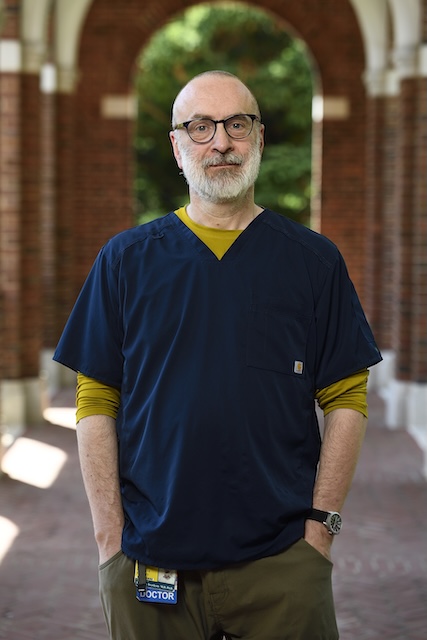
Theodore “Jack” Iwashyna, a Johns Hopkins Medicine critical care physician and health services researcher, shares why he became a regular columnist for the New England Journal of Medicine blog Voices — and where he finds his inspiration.
Interview by Sue De Pasquale
What prompted you take on this regular column in NEJM’s Voices last July?
The New England Journal of Medicine has long been a premier place for reporting clinically relevant science, and it has also had a real intentionality around strengthening the profession of medicine and the nobility of our profession. So when the editors at NEJM were interested in expanding the Voices section, it seemed like an unparalleled opportunity to help think about what the future of medicine looks like.
How do you come up with topics?
I find that being deeply engaged with learners, colleagues and patients has so far made it easy to think about what I want to write — to reflect on their needs and what they’ve taught me.
As I plan posts, I typically cycle among three kinds of topics: a pragmatic, nuts and bolts “how-to” for younger learners, such as my October post explaining how to write the introduction to a research paper; then a broader, social-scientific analysis of an issue to help us understand where we are in medicine and new tools we can use. An example here is a piece I wrote in August about the need in today’s tough federal funding climate for peak-career clinician-scientists to provide financial support from our own grants for next-generation researchers. Thirdly, there’s the column where I explore the human side of being a doctor, such as my post on how a patient in shock forced me to consider the limits of my own knowledge and those of the medical field.
What response have you received to your columns?
I’ve found that peer review through social media really is a thing (chuckles). NEJM’s editors are using Voices to draw in new readers, so they are promoting on BlueSky, Twitter, LinkedIn and Instagram. I check out the comments to see what people like and what they dislike.
The column is an intentional effort to develop my science communication skills. As physician-scientists, we grew up learning how to write NIH grants and scholarly papers — but most of us have had little experience communicating our work to the world at large. This kind of communication is crucial now more than ever given recent dramatic changes in government-university funding partnerships.
Theodore “Jack” Iwashyna joined Johns Hopkins Medicine in 2022 as a Bloomberg Distinguished Professor. Find his NEJM Voices columns here.