
For Older Patients, a New Approach to Emergency Care
With protocols specially designed for older patients, the geriatric emergency department at Johns Hopkins Bayview Medical Center aims to reduce hospital admissions, improve outcomes and lower costs.
Credit: Getty Images
Mimi Barron had quite a year for health issues — she was diagnosed with atrial fibrillation, had a pacemaker implanted, experienced gastrointestinal bleeding from her blood thinner medication and broke her back.
So when the 84-year-old Baltimore resident arrived at Johns Hopkins Bayview Medical Center’s emergency department (ED) in September feeling cold with a fluctuating temperature, clinicians had a number of issues to consider.
She was quickly given intravenous fluids and had an electrocardiogram, with blood tests and a chest X-ray administered soon after. It turned out that she had aspiration pneumonia.
“The physician assistant really thought about what it could be, and she wanted to cover all the bases because it was not clear what was wrong,” Barron says. “And yet, nothing she ordered was too much.”
Barron, who is a patient of the Beacham Center for Geriatric Medicine – Johns Hopkins Bayview Medical Center, was given antibiotics and released to return home, where she lives with her son. She had clear instructions on what to look out for in case the condition worsened, but the antibiotics cleared it up.
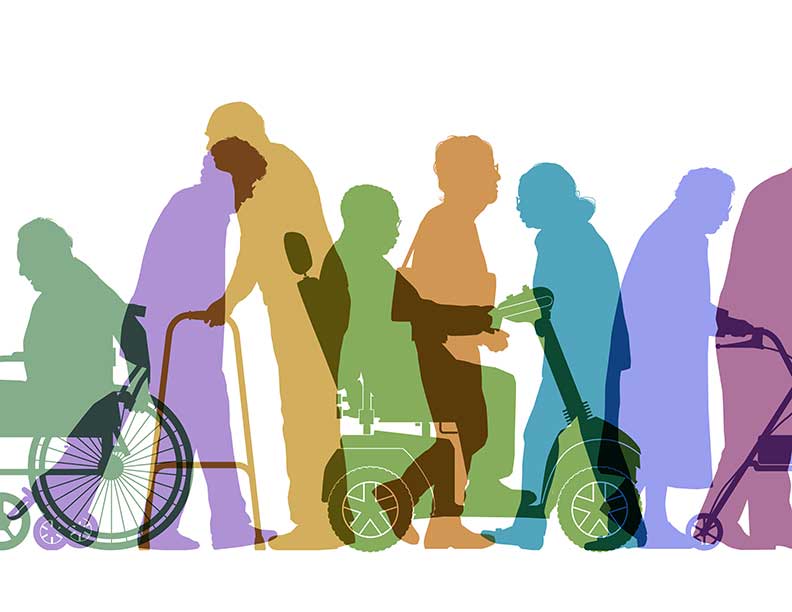
Across the country, patients age 75 and older visit emergency departments at a rate higher than any other age group except infants. But until recently, older adults have not been met with senior-friendly protocols: strategies to prevent falls and disorientation, and the recognition that many, like Barron, contend with an array of chronic conditions and take multiple prescriptions that affect how any acute health crisis should be treated.
In the Bayview ED, being an older adult can set various care processes in motion, depending on the patient’s chief complaint. Clinicians are attuned to pay closer attention to indications that could point to subtle illness or injury.
“It’s not always obvious, it’s subtle, and sometimes those subtleties, when not acted on or noticed, can be detrimental to older patients,” says Phillip Magidson, associate clinical director and director of geriatric emergency medicine at Bayview’s Department of Emergency Medicine.
The 34-bed Bayview emergency department, where nearly 30% of patients coming in are 65 and older, has been an accredited geriatric ED since 2022. The certification is awarded by the American College of Emergency Physicians and includes requirements in staffing, care processes and the ED’s physical environment.
All are strategies aimed at reducing hospital admissions and improving outcomes among the nation’s rapidly graying population, while also lowering costs.
“One condition and one treatment of another condition impacts the other. So you can’t practice medicine in any specialty with an older adult without having the bigger picture of their entire health profile,” says Michele Bellantoni, clinical director of the Johns Hopkins Division of Geriatric Medicine and Gerontology.
Older patients entering the Bayview ED, where the most common complaint is a fall, encounter specially designed processes that are built into the ED’s workflows and tracked through a dashboard. A geriatric patient with a hip fracture, for example, would be taken to a room, be seen by a clinician and have imaging done quickly. Patients would also receive a delirium screening. Additionally, for certain injuries and conditions, Bayview has a special set of geriatric orders — the orders for a geriatric hip fracture include a note to be mindful about pain medication, as older patients may need a lower dosage to prevent interactions with other medications.
It’s a unique patient population that has unique physiologic presentation, biologic presentation, psychologic needs and social needs, so it’s important to tailor our approach. We’re responding to the needs of the community, not only locally here in Baltimore, but nationally.”
Phillip Magidson
“It’s a unique patient population that has unique physiologic presentation, biologic presentation, psychologic needs and social needs, so it’s important to tailor our approach,” Magidson says. “We’re responding to the needs of the community, not only locally here in Baltimore, but nationally.”
He notes that more than 600 EDs across the United States are now accredited as geriatric EDs; the Johns Hopkins Howard County Medical Center ED earned accreditation in 2025.
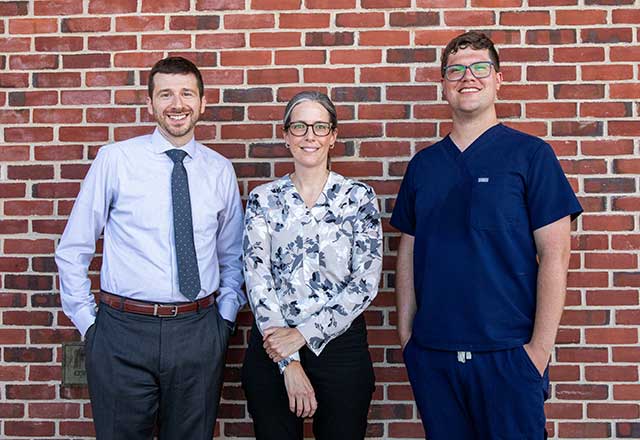 Pictured left to right: Phillip Magidson with geriatric ED team members Rose Ostendarp and Alexander Hill.
Credit: Marc Shapiro
Magidson’s team also includes Rose Ostendarp, assistant director of emergency nursing at Bayview, and ED registered nurse Alexander Hill. Together, they advocate for geriatric ED measures and help educate their colleagues on protocols.
An important part of their approach, Magidson notes, is recognizing that hospital stays bring risks to older patients — including infections and rapid deconditioning, which can lead to stays in rehab facilities or nursing homes. So avoiding admission and figuring out what can be managed outside the hospital setting is a key goal.
“When an older adult comes in for some acute illness or injury, it’s our responsibility to evaluate them as quickly as possible, and then really weigh the risks and benefits — in consultation with the patient and their family — with the goal of getting them out of the acute setting as quickly as possible,” he says. “As older adults do better in the community, they prefer to be there.”
Preventing Delirium
Delirium is a particular risk among older patients in hospital settings, and it can be particularly unsettling for both patients and caregivers when it takes hold. A patient may start feeling foggy, frightened or unable to focus on a conversation. They may not know where they are and, in response, grow agitated or excessively withdrawn. Symptoms can come and go, and often grow worse at night. It is estimated that more than 2.6 million people in the U.S. age 65 or older develop delirium each year.
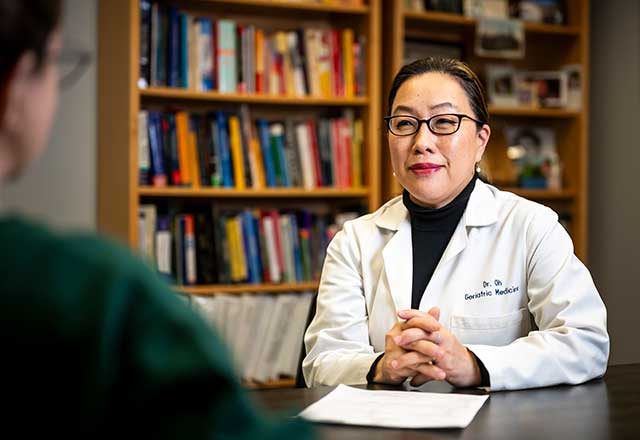 Delirium most often occurs in the first two to three days of a person’s hospital visit, says Esther Oh, but it is believed that 30%–40% of delirium is preventable. So she and the geriatric ED team at Bayview have launched initiatives to reduce delirium among older patients in the ED.
While delirium often occurs in patients with underlying dementia, there is mounting evidence that delirium itself may in turn go on to cause dementia, notes Bayview geriatrician Esther Oh, a nationally recognized expert on delirium.
Oh has seen it happen numerous times: An older adult is hospitalized for an acute illness or a surgery, then has an episode of delirium and emerges with worsening cognitive function.
“Then it’s highly unlikely they’re able to go home, and they have to make the hard decision of ‘Can I go back home where I was living independently, or am I now on the pathway to becoming institutionalized?’” Oh says. “All due to delirium.”
Delirium most often occurs in the first two to three days of a person’s hospital visit, Oh says, but it is believed that 30%–40% of delirium is preventable. So she and the geriatric ED team at Bayview have launched initiatives to reduce delirium among older patients in the ED.
Their efforts start with screening to identify older patients most at risk — a practice not required in EDs. For patients at risk, team members work to keep them oriented through simple conversation (asking patients their name, what day it is, why they’re in the hospital) and easy activities like guided relaxation or range of motion exercises. Special care is paid to making sure patients are oriented, and that they have access to their glasses and hearing aids in order to remain engaged.
This holistic approach takes manpower, and a volunteer program known as MIND-ED* —which Oh has championed with geriatrics postdoctoral fellows Tiffany Tsay and Julia Loosen — is helping. Through MIND-ED, Johns Hopkins students from the schools of medicine, nursing and public health visit older patients in the ED to provide companionship, or get them something to drink or a warm blanket. Additional volunteers, like Claire Lee, come from National Institutes of Health postbaccalaureate programs.
Lee, who plans to go to medical school, has been volunteering with MIND-ED since its inception in November 2025 and has found the experience invaluable. and has found the experience invaluable. She and patients mostly just chat, and if a patient is experiencing delirium, she tries to redirect their attention by asking them basic questions about themselves.
She recalls one man who was talking to the wall when she arrived, whom she was gradually able to engage in conversation.
“He was guarded in the beginning. He didn’t want to say his wife’s name or really tell me anything about himself,” Lee says. “By the end, he was sharing a lot about himself, like his life as a mechanic and how he met his wife on a farm. And it was really rewarding to see his cognition sharpen and focus.”
Patients often tell her that the visit was the highlight of their day, she says.
Since the MIND-ED program launched, some 25 volunteers have logged more than 150 volunteer hours.
“It’s more engagement with patients, and I also think it’s really helping the nurses, who can concentrate on other things they have to do,” Oh says. “What we’ve been noticing is that as the volunteers get more comfortable doing this, they’re spending more and more time with patients.” Some interactions are as long as three hours, she adds.
For the past three years, Oh has been working with nursing leaders from health systems across the country to teach best practices for delirium management — knowledge they then take back to their home institutions. Building on this work, she and a colleague from Northeastern University have a grant from the NIH’s Network for Investigation of Delirium: Unifying Scientists, through which they hope to further disseminate this information.
Looking to the Future
As the baby boomer generation — the oldest members of which turn 80 year this — continues to age, advocates say it is paramount for emergency medicine to incorporate best practices into care.
They point to numerous research studies that show the benefits of geriatric-centered emergency care. A study published May 1 in Journal of the American Geriatrics Society found that ACEP-accredited EDs were associated with lower hospital admission and 30-day mortality among older adults. A 2023 study in the same journal found that consults with geriatric nurse specialists can help decrease inpatient admissions through the ED, and decrease the cost of inpatient and ED care, although it can modestly increase ED revisits.
At Bayview, Magidson’s team uses a dashboard to track metrics including NPO (nothing by mouth) status, urinary catheter use, physical restraint use, delirium and delirium questionnaire compliance, boarding time and admission rates. The team also tracks when case management, physical and occupational therapy, and other specialists are engaged.
Magidson says the dashboard is designed so the team can drill down into specifics in their effort to continually refine and improve care. Any increase in physical restraint use, for example, would prompt a deeper review of the data and the individual cases.
“Geriatric medicine is just good medicine,” Magidson says. “The less time an older adult spends in the emergency department, the better they do. The shorter the hospitalization, the more costs decrease. The more you engage social work and care management to work with patients in the emergency department, and the more you have transitional processes back to the community, the less likely patients are to come back.”
In September, two weeks after her pneumonia diagnosis, Mimi Barron found herself back in the ED with severe acid reflux. Again, clinicians acted fast, figured out that the issue was not with her heart, and gave her a medication to treat the reflux. Again, she left with clear instructions and knew what to look for and what to do if her condition worsened.
She was unaware of Bayview’s geriatric ED certification, and says she and her son couldn’t tell if they were treating her with a special touch because of her age or if everyone gets such care.
“I don’t know if they were more concerned with me because of my heart situation or because of my age, but they were on top of it,” Barron says. “It was clear that it was better than the attention I got elsewhere, and I would not go to another emergency room now, ever.”
Experiences like Barron’s, Ostendarp says, are what keeps her and the geriatric ED team committed to improving care for older patients.
“Emergency medicine throughout the nation is being challenged right now. There’s pressure and there’s throughput and capacity challenges,” she says. “Maybe we can’t solve everything. But while you are here as an older adult within our emergency department, we’re going to do the best that we can to take care of you.”
*Meals and mobility, Interactive orientation, Nurturing environment, De-escalation and symptom management, Engagement in therapeutic activities, Daily sleep optimization.