
Annals: Excellence in Every Breath
The story of Johns Hopkins anesthesiology began with anesthetist S. Griffith Davis Jr., and brain surgeon Harvey Cushing, when the need to keep surgical patients safe and unconscious for long hours called for new, exacting measures. Meet these and other early innovators in this excerpt from a new book commemorating the history of the Department of Anesthesiology and Critical Care Medicine at the Johns Hopkins University School of Medicine.
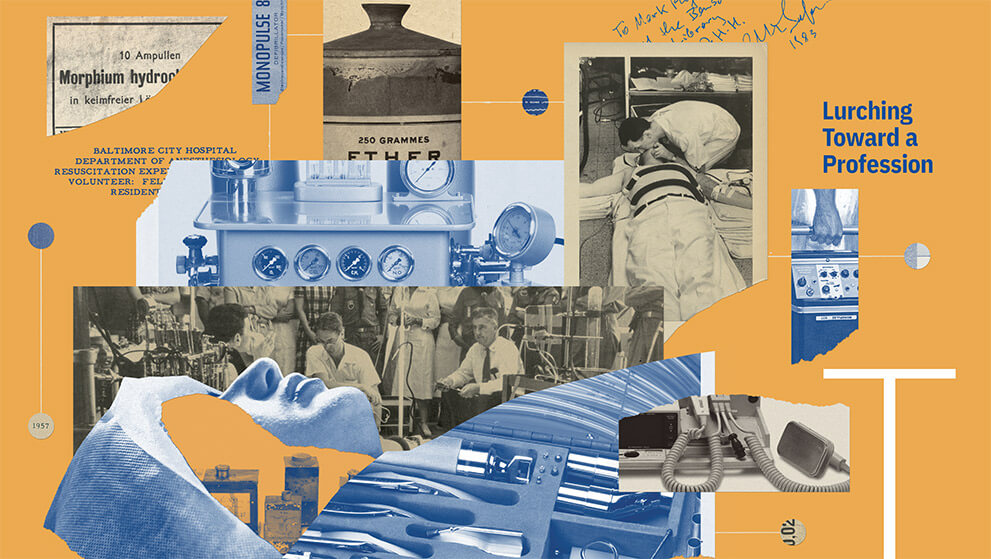
Illustration by Blake Cale
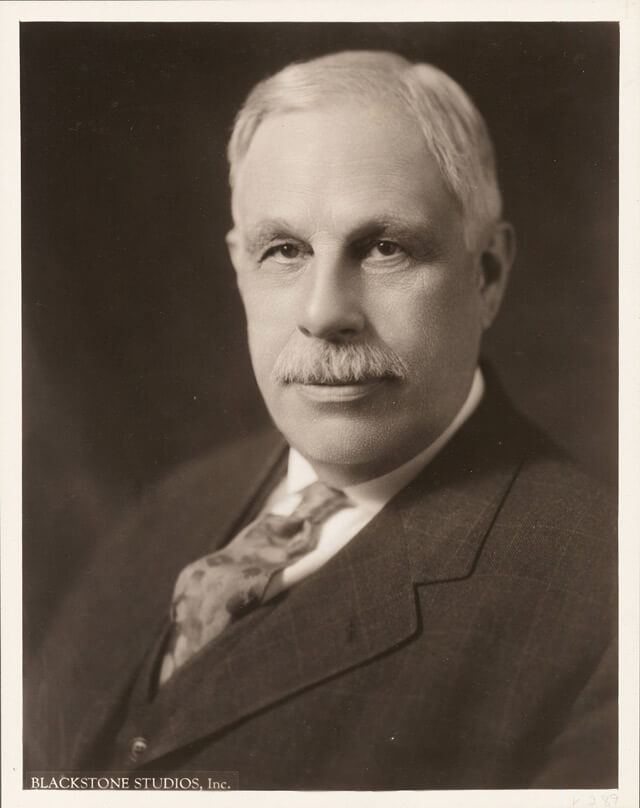 S. Griffith Davis Jr.
Photo: Blackstone Studios Inc./Enoch Pratt Free Library
There were days in the early 1900s when S. Griffith Davis Jr., M.D., would open the door to his office at the Church Home and Infirmary, assess the weather and decide if he should walk the three blocks north on Broadway, use his bike or summon a carriage to take him to the Dome, the epicenter of The Johns Hopkins Hospital.
Davis, an avid hiker, would likely opt for the walk, traversing the cobblestones past grand rowhouses with a trunk fully packed with the tools of the anesthetist’s trade, including gauze-covered ether masks or cones, inhalers, a phonendoscope, a stethoscope and perhaps an early version of a sphygmomanometer.
As he prepared for a lengthy procedure, Davis knew he wouldn’t be able to tote the anesthetizing agent itself: ether. The volume he needed weighed too much. It was volatile and combustible. Davis would arrange for The Johns Hopkins Hospital to provide him with this most essential tool of a decades-old yet slow-developing profession once he arrived at the operating room.
Davis was first summoned to the Dome sometime around 1902 by Harvey Cushing.
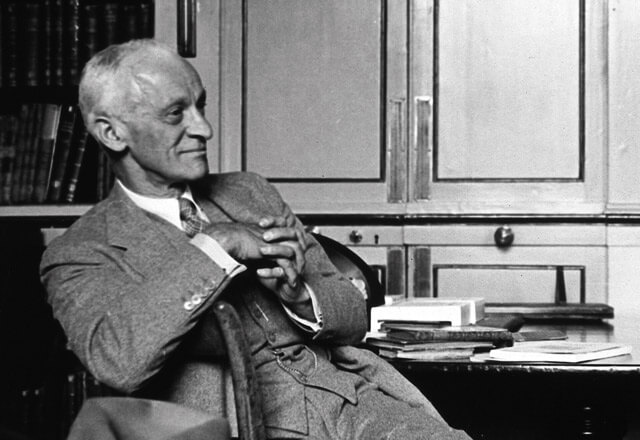 Harvey Cushing.
Photo: Wellcome Collection
Now a legend of medical science, Cushing was then a freshly minted doctor who explored the mysteries of the nervous system on the stray dogs that lab assistants caught along the hospital’s periphery. Animals at the Hunterian Laboratory had taught him much about the brain’s response to compression. Cushing took that knowledge into the operating room with him, performing hundreds of craniotomies on patients with clots or brain tumors.
Besides etherizing the lab dogs during Cushing’s experiments, Davis would attend to the surgeon’s human patients. By 1904, he would be recognized as Baltimore’s first full-time physician anesthetist.
The Cushing-Davis surgical cases were chancy. They were performed in less than ideal conditions, even at the Johns Hopkins’ main OR, advanced for its time. Early in his career, Cushing knew that about 90% of brain surgery patients died on the operating table or shortly thereafter — something that horrified him.
Having watched several anesthetized patients, including one of his own, die while he was a medical student at Harvard, Cushing had desperately sought improvements in anesthesia techniques and practices.
Those included the careful drugging and steadfast monitoring of patients’ hearts and lungs. These services were best provided by a physician who understood the promise and peril of anesthesia — and not by interns or other nonphysicians trained in the “come and struggle” method, Cushing believed. (Because ether had a horrible odor and did not usually take effect immediately, patients would sometimes tussle with their anesthetists before dropping off to sleep.)
But he was running into a strong headwind. The high standards Johns Hopkins required of its medical men were hardly mirrored by its approach to anesthetics. Quite the opposite. Anesthesia was seen as a service, an afterthought.
Then, and for years after at many medical institutions, the administration of chloroform, ether or nitrous oxide was largely taken for granted by surgeons. At Johns Hopkins, surgical residents and house officers typically were drafted to drop ether onto a cone, mask or sponge, then hold it above the face of a patient until they succumbed to slumber.
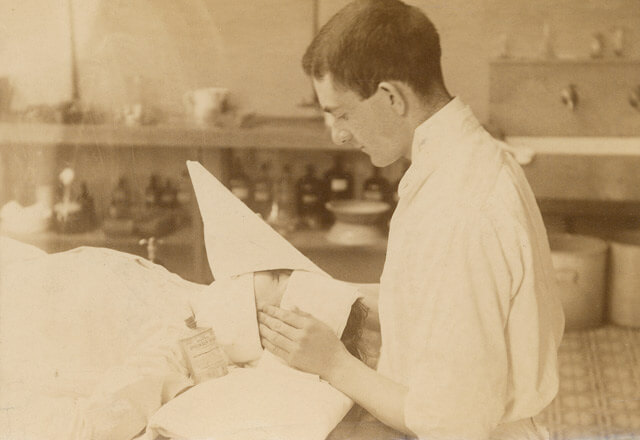 An intern administering open-drop ether anesthesia, circa 1892.
Photo: Alan Mason Chesney Medical Archives
When these junior physicians weren’t around, surgeons turned to nurses — sometimes even to a chaplain or a janitor. “Anybody who could stand the smell was considered fair game for the job,” says George Bause, M.D. ’81, curator emeritus at the Wood Library-Museum of Anesthesiology, in Schaumburg, Illinois. “A lot of people would vomit from it. Four in five patients would be nauseous, postoperatively.”
Students, interns and residents were permitted and encouraged to administer ether at Johns Hopkins. Cushing could do little to stop the practice.
By entrusting patient anesthesia to the nearest warm body, Johns Hopkins apparently dismissed the advice of its own hospital superintendent, Henry M. Hurd, who in 1906 told a medical convention that education in anesthesia was “fragmentary, unsystematic and haphazard.” What’s more, Hurd recommended that every hospital have a skilled anesthetist on staff to oversee all operating rooms and offer regular and systematic instruction on the administration of anesthetic drugs — plans that wouldn’t include physician anesthetists (or, later, anesthesiologists) for years to come.
Cushing couldn’t wait for improvements in practice. The brain operations he developed were precarious slogs. Cushing was known for tying off scores of blood vessels, scanning the surgical theater to make sure it was sterile, and monitoring patients obsessively. All that, plus delicately negotiating his way through often unmapped regions of gray matter, proved time-consuming. His brain procedures could go on for 12 to 16 hours — almost unheard of then.
“People would joke that by the end of these epic procedures, the surgical wound would start to heal before Cushing could close,” Bause says.
The need to apply, then reapply ether many times during these marathons, as well as continuously monitor a patient’s breathing and blood pressure, called for a professional’s expertise and dedication, not to mention physical stamina.
This is where the story of Johns Hopkins anesthesiology begins, at the intersection of Cushing and Davis, at a place where the need to keep patients safe and unconscious for the better part of a day called for new, exacting measures.
There was no celebrated medical giant among physician anesthetists back then, no one on staff who had garnered support from the hospital’s leadership to plot a course toward a leading national role in anesthesiology and critical care. There was only Cushing’s aim to improve neurosurgical outcomes, which led him to Davis, an itinerant physician who cobbled together a livelihood by snatching up anesthesia gigs at the Baltimore College of Dental Surgery, the Church Home and Infirmary, the University of Maryland Hospital — and Johns Hopkins.
Davis’ status as the only physician anesthetist in Baltimore — the only doctor specializing in putting patients under — soon took him beyond the campus’ tall brick buildings. “He wandered around town, usually by bike, delivering anesthesia services,” says Bause. “He was in demand. He had job security — no one could fire him.”
That was good for Davis because jumping ship to Johns Hopkins full time was out of the question. The hospital’s standards for physicians then were lofty to the point of being unattainable. Only well-published scientists and supremely well-regarded surgeons were allowed to practice there. Davis, though in demand, would never become part of the Johns Hopkins faculty, Bause says.
Then and for decades to come, Johns Hopkins’ opinion of the physician anesthetist would swing as steadily as a pendulum — to the detriment of physicians like Davis and other early specialists in the field.
Aside from the likes of Cushing, who was determined to find an alternative to the administration of ether by nonphysicians for his groundbreaking neurosurgical work, anesthetists received little support from other specialists.
A Rare Arrangement
Cushing and Davis created a novel working plan. At the surgeon’s urging, Davis became the first anesthetist in the United States to monitor and document the breathing of anesthetized patients. By doing so, he eased Cushing’s worst fears of losing them.
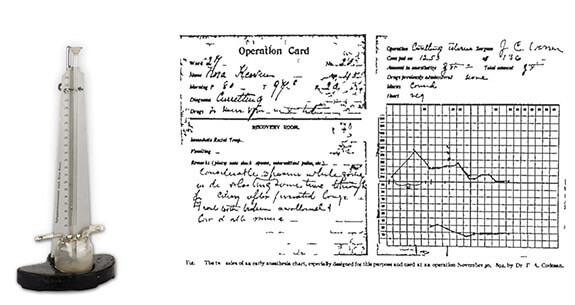 The Riva-Rocci mercury sphygmomanometer (left), introduced in 1896. Its use by Johns Hopkins’ Harvey Cushing helped establish blood pressure as a critical vital sign for patient monitoring during surgery and anesthesia.
Device Photo: Wood Library-Museum Collections Facility.
While at Harvard, Cushing further developed a checklist protocol — a chart — he had helped devise for anesthetized patients. During an educational tour to Europe as a surgical resident, Cushing became impressed by a new blood pressure device made by Scipione Riva-Rocci. As a newly minted Johns Hopkins faculty member in 1901, Cushing incorporated blood pressure readings in his charts.
But Cushing needed a partner who could provide even more than reliable monitoring. Brain patients required a variety of services just so they could remain alive.
As surgeons and hospital staff worked to keep patients cool during operations, the endless hours of Cushing’s procedures presented a problem. The body loses heat while under anesthesia during surgery. But for brain patients, any kind of reaction to the cold — coughing, shivering, sneezing — could put them in jeopardy by raising their blood pressure or dislodging vital equipment. Davis would do all he could to keep patients warm, including wrapping them in blankets.
Davis also had to keep the ether safe, especially when other machines were running. (Johns Hopkins would face occasional OR explosions from ether up until the World War II era.)
Administering ether, via a tube or the drop method, was especially difficult during brain procedures. Surgical patients were often placed in awkward positions — on their sides, prone or sitting — and under drapes, all of which made it hard to use the gas (or, sometimes, for the physicians themselves to avoid its effects). Other complications abounded. Patients were more likely to stop breathing as a surgeon applied pressure to centers of the brain that affect heart and lung functions.
Davis would monitor changes in rates and patterns, likely using a phonendoscope, a device with a tube attached to a patient’s chest on one end and an anesthetist’s ear on the other, to constantly follow their vital signs. Davis had adapted the device for use from the Hunterian lab dogs to Cushing’s brain surgery patients.
The phonendoscope offered “uninterrupted information of the patient’s condition,” Cushing wrote. “The anesthetists need not disengage a hand for the occasional palpation of a pulse. On several occasions, by the prompt appreciation of change in heartbeat or respiration thus acquired, it has been possible to avert what otherwise might have been surgical disasters, owing to the immediate warning which led to the cessation of certain disturbing manipulations.”
The partnership reversed the mortality rate for brain surgery patients. Under Cushing, often with Davis’s help, 90% would survive in the years to come, Bause says.
Cushing wasn’t shy about giving Davis his due. And he was willing to pay Davis out of his own pocket, covering patients who couldn’t foot the bill on their own.
“There are trials enough for the surgeon in these cases without the added anxiety in regard to narcosis,” Cushing wrote in 1909. “For the past few years, Dr. S. Griffith Davis, who devotes his time exclusively to this work, has greatly lightened these responsibilities for me by anesthetizing all my neurologic patients. It is entirely due to his skill that in over 300 cranial operations there has been a complete absence of the calamities usually assigned to anesthesia.”
The Advent of Regional Anesthesia
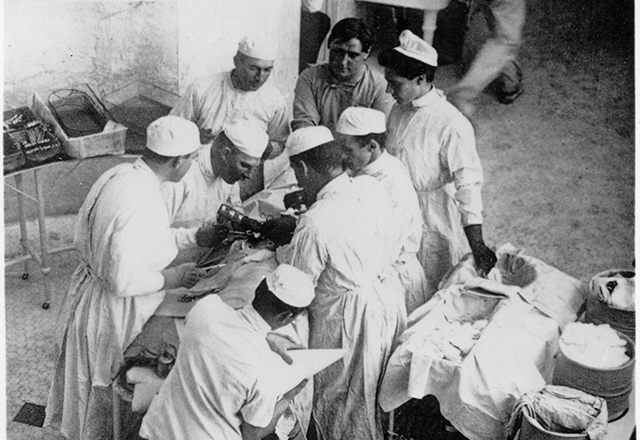 William Steward Halsted performing an operation in the surgical amphitheater at Johns Hopkins, with assistants and nurses.
Photo: Chesney Medical Archives
During the years he collaborated with Davis, Cushing stepped up his work at the bench. His lab projects aimed to increase the understanding of local and regional anesthesia. That subject had been pioneered by his mentor, William Stewart Halsted, who headed up Johns Hopkins’ Department of Surgery during its formative years.
Halsted, inspired by the findings of Carl Koller, an Austrian physician who had successfully anesthetized parts of the eye with a solution of cocaine hydrochlorate, devised some experiments using the agent with a colleague at New York’s Roosevelt Hospital in 1884.
A race was on to expand the uses of local anesthesia. Koller’s findings had thrown open the door to experimentation with cocaine — of all kinds. Scientists around the world saw potential in the drug as a method for anesthetizing parts of the body during surgery, as well as an analgesic. Putting people under combustible ether during surgery was still dangerous. Many patients died from overdosages, which caused them to stop breathing. Cocaine offered a safer way, it was thought, to perform local and dental procedures without knocking the patient out with general anesthesia.
No less a figure than Sigmund Freud had signed off on cocaine as nonaddictive, calling it dangerous only to people who already maintained a morphine habit. Without worry, Halsted and his colleague injected each other with the drug to learn how it would affect the sensory cutaneous nerves. Eventually, they performed nerve blocks on one another before treating surgical outpatients in New York with the drug.
Historians have noted Halsted’s key role in identifying cocaine’s power in stopping pain locally and regionally — work Cushing would build from. But Halsted never published on the subject in a comprehensive way. The lone, short paper published during his lifetime, written in breathless prose in 1885, was penned under the influence of cocaine. The following year, he entered a hospital in Rhode Island — the first of at least two rehab trips — to recover from his addiction.
A year later, William Welch, one of the four doctors credited with instilling The Johns Hopkins Hospital with its impeccable standards, hired Halsted, an old friend — not as a surgical chief or department chair, but as a lab worker. Welch considered the job “occupational therapy” for his sick colleague.
“Dr. Halsted’s contributions to the development of local anesthesia were important but his role was not recognized at that time,” wrote Peter D. Olch, in the journal Anesthesiology. “He anticipated all of his contemporaries in the recognition of the principle of regional anesthesia by blocking nerves, and he was the first to demonstrate systematically its practical value in dental and oral surgery.”
As it did for so many other founding fathers of anesthesiology, the search for effective anesthetic agents took a personal toll on Halsted. While at Johns Hopkins, Halsted took to morphine to decrease his yearnings for cocaine. Though a gifted and revolutionary surgeon during his Johns Hopkins years, it is likely his addiction became a sad, lifelong affair.
As Halsted made substantial advances, including in antiseptic techniques, breast cancer surgery, blood transfusions and the setting of fractures, Cushing, as a Johns Hopkins surgical resident, outlined the use of local anesthesia for hernia surgeries. He also put the Hunterian dogs to work so he could learn the effects of “cocainization” on large-nerve trunks to lower the risk of shock and blood pressure fluctuations in amputation patients, while investigating the effects of anesthetic agents on the brain. All these efforts, along with his pioneering brain procedures, played a role in the development of the subspecialty of neuroanesthesia.
In the Wake of a Legend
After Cushing left for Harvard in 1912, Samuel Crowe, an otolaryngologist who had worked with him, announced that he “did not want house officers to administer anesthesia to his patients.” But Crowe was hardly endorsing the physician anesthetist. He preferred the services of Margaret Boise, the nurse whom he hired to anesthetize his patients, against the initial misgivings of Halsted, who was then serving as the chief of surgery.
Five years later Boise would start The Johns Hopkins Hospital School of Anesthesiology, which would educate many of the nurses who became the primary providers of anesthetic care at the hospital for the next few decades.
Few records exist regarding Davis, so it’s difficult to determine the sum of his ongoing involvement with Johns Hopkins, how many surgeons he may have worked with, or for how many years. But when his presence on the Baltimore medical scene was diminished, other physicians weighed in with concern.
In 1916, surgeons throughout Baltimore were “deploring the loss” of Davis to the Fifth Regiment Army, which had sent him to a post in Mexico. “Dr. Davis’ specialty is anaesthetizing patients about to undergo surgical operations, and in this delicate line he is recognized as being remarkably skillful,” noted The Aegis, a newspaper in Harford County, Maryland, where Davis owned a farm and a summer home.
The paper sought out comment from J.M.T. Finney, a legend among early Johns Hopkins surgeons.
“I am still too much surprised to say anything that would adequately express our valuation of Dr. Davis,” Finney said. “When he goes the city will suffer a loss that cannot be repaired, for while our loss will be the soldiers’ gain, the medical profession will be quite unable to fill his place. Not only is he one of the greatest and most expert anaesthetizers in the country…he is one of the greatest men as well.”
Excerpted from Excellence in Every Breath: A Century of Science, Discovery and Clinical Innovation (2026), the history of the Department of Anesthesiology and Critical Care medicine at the Johns Hopkins University School of Medicine.