
Every Piece Matters: The Puzzle of Geriatric Care

Illustration credit: Francesco Ciccolella
It’s no secret that as we age, our healthcare needs get more complicated. Many older adults end up managing multiple chronic and complex conditions, plus all the treatments, follow-ups and medications that go with them. Care like that requires time and expertise that many physicians don’t have: It requires a geriatrician. Unfortunately, the United States currently has fewer than 7,000 to serve an older adult population that’s at 61.2 million people and rising.
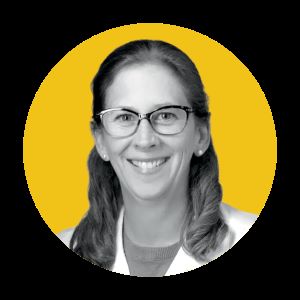 Jessica Colburn, M.D.
The Fellowship Training Program in Geriatric Medicine and Gerontology at Johns Hopkins has been creating geriatricians since 1983. Over 200 physicians, educators and researchers have come through our doors and left as experts in aging and related issues, and how the conditions common to older adults can impact each other and quality of life. They’ve learned it all from the starting assumption that geriatricians are puzzle-solvers. As fellowship Director Jessica Colburn puts it, “The incredible medical complexity of people who have multiple chronic conditions trying to maintain their function and quality of life while balancing that enormous complexity makes geriatrics an art. For me, as a person who loves the compassion and storytelling part of medicine, but also the logic problem piece of medicine, there isn’t a better specialty.”
Whether our fellows choose the track of clinician, leader, educator, researcher or a combination, they learn that solving these logic problems is a key aspect of caring for older adults.
A Choose Your Own Adventure in Geriatrics
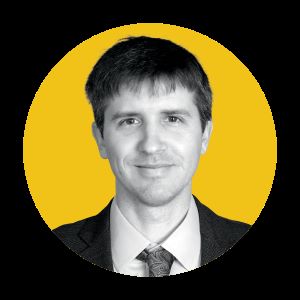 Michael Brady, M.D.
Michael Brady came to the clinician educator fellowship track indirectly. As an undergraduate, he majored in economics to gain an understanding of the field’s influence on society, politics and government. But his lifelong interest in science led him to take premed classes, too. After graduation, he worked in a pharmacy, reigniting his desire to pursue medicine as a career. So Brady increased his scientific credentials by attending a yearlong postbaccalaureate program at Virginia Commonwealth University prior to completing medical school at VCU. He says, “In medical school, I participated in a program focused on people who have limited access to medical care. That influence was important in that it made me want to focus more on making sure people had basic healthcare services. Primary care is a large part of that, and geriatrics is an extension of that.”
“The incredible medical complexity of people who have multiple chronic conditions trying to maintain their function and quality of life while balancing that enormous complexity makes geriatrics an art.”
— Jessica Colburn
It was during his residency at Johns Hopkins Bayview Medical Center that Brady began to seriously consider becoming a geriatrician. He didn’t apply to the fellowship right away, however; after residency, he worked for five years at a Baltimore community health center, seeing many older adult patients and focusing on his clinical work. Then he realized he wanted a new challenge. “Hopkins’ clinician-educator fellowship track made a lot of sense for me,” he says. “I was looking to add some other skills in addition to clinical work. And after being out in practice for five years, you may not get many chances to take a break and learn.” It also made sense to return to a place where he was comfortable and confident in the leadership. “The whole division is very thoughtful about things,” Brady says. “Orientation time was great to get to know the other fellows, to think about the year and what we’re going to gain, and we had meetings throughout the year to reflect, to meet and mark the year as it progressed.”
 Krista Cook, M.D.
For Krista Cook, now in the first half of her fellowship year on the clinical track, deciding to come to Johns Hopkins wasn’t as straightforward. Although her residency training was in family medicine, she developed a strong interest in geriatrics and sought out an elective rotation to further explore the specialty and experience the program firsthand. “I was fortunate to arrange an elective rotation at Johns Hopkins,” she says. “What stood out to me most was how comprehensive and patient-centered the care was. The team looked beyond a patient’s diagnosis and really considered cognition, function, medications, living situation, caregiver support and the patient’s individual goals. I also appreciated how approachable and invested the faculty were in teaching. I felt welcomed as a visiting resident and was given the opportunity to actively participate rather than simply observe.” Now that she’s part of the program, she’s looking forward to not only learning more about caring long term for older adults, but also finding ways to improve their care and to pass along her knowledge to other clinicians.
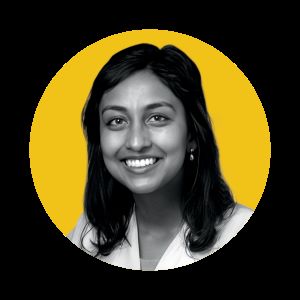 Shivani Bhatnagar, M.D.
Currently in the last months of her fellowship as a clinician leader, Shivani Bhatnagar also hadn’t considered a career as a geriatrician during med school. Then she heard about the Medical Student Training in Aging Research (MSTAR) program. “I was very grateful to be accepted to the Johns Hopkins MSTAR for a summer research project with Drs. Bruce Leff and Orla Sheehan,” she says. “Meeting all the wonderful clinicians and staff, I realized this could be an exciting place to continue my medical training.” But she didn’t plan to follow the clinician leadership track. At first, she says, “I couldn’t understand why clinicians would need to learn more about the business aspects of medicine. But it’s really important for clinicians to understand the perspectives of our administrators as well as for our administrators to understand the perspectives of us as clinicians so we can best serve our patients. By understanding these leadership skills, doctors can have a greater ability to stimulate change and innovation within our healthcare system.”
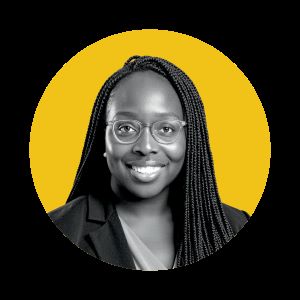 Mfon Umoh, M.D., Ph.D.
Mfon Umoh, who completed the clinician researcher track and joined the Johns Hopkins faculty in 2025, loves the clinical work of helping her patients manage their conditions. She’s focused her research equally on topics like delirium and social isolation. Umoh’s goal is to use this research to find opportunities to intervene in patients’ lives before their cognitive health declines. “Since undergrad, I have been fascinated by understanding how the brain works,” she says. “I’ve always liked working on complex problems. This path allows me to care for patients while also advancing therapeutic options. The influence I’m able to have with both brings me immense joy.”
‘Come for the Joy, Stay for the Geri’
Post-fellowship, our fellows take on roles in geriatric primary care, as medical directors, and as educators and researchers, covering the many pieces of care for older adults. For Bhatnagar, one additional important aspect of her career is making structural change. “Something that drew me to geriatrics is that there appears to be a general fear of aging, especially in America,” she says. “I think a lot of this has to do with systems-level issues of how we support older adults, and I’m hopeful that through this training, I’ll be able to gain better perspectives to foster improvements in this space.”
Brady, who plans to move closer to family to practice after he completes his fellowship, is grateful for his 10 years in Baltimore and his time at Johns Hopkins. He reflects fondly on discussions with fellowship Associate Program Director Mariah Robertson and faculty member Jen Hayashi on art and books, and on the weekly didactics meetings the fellows shared, where they could bond and exchange best practices and tips. “There are so many different nuances to practicing geriatrics,” he says. “[During weekly meetings], some of us would be talking about issues that come up when you’re answering telephone calls overnight or in clinic, or sharing challenges with patients that you’re connecting to hospice care. I liked that.”
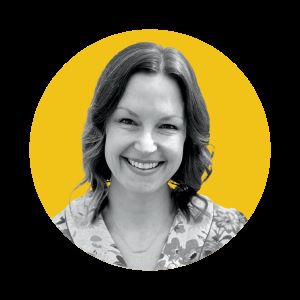 Mariah Robertson, M.D., M.P.H.
Robertson sees these connections as a vital part of meeting fellows where they are throughout the program. “One of my favorite things about being a program leader is the ability to make mentorship a verb in ways that feel truly impactful on each trainee’s career path,” she says. “There are so many amazing ways you can build a career as a geriatrician, and helping each fellow see what their specific journey will be is truly delightful. We get to be mirror-holders in the best possible way. Our motto is ‘Come for the joy, stay for the geri.’ There is so, so much joy in this work.”