
A Sixth Sense for Scleroderma
For five decades, Fredrick Wigley’s keen clinical eye and devotion to patients have helped reshape the understanding and treatment of an often-devastating illness.
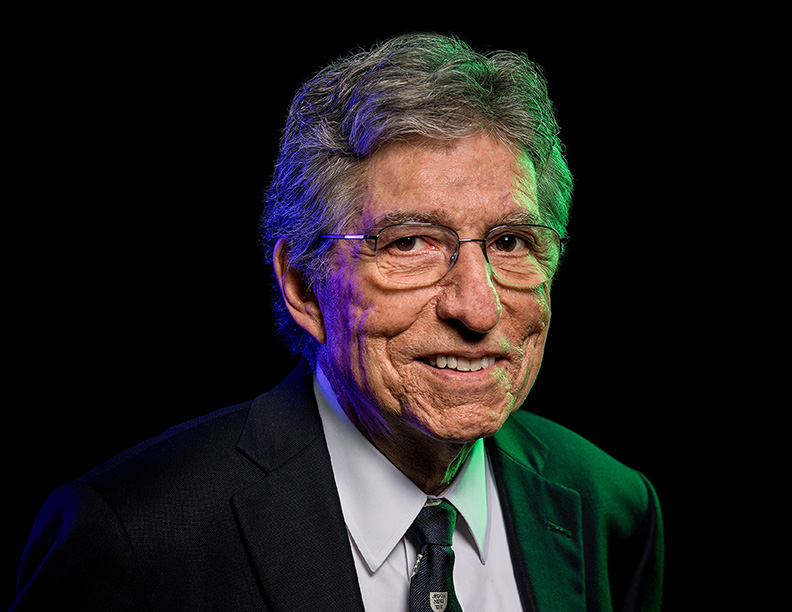
“Our ability to make discoveries in scleroderma has been based on brilliant people putting our database to work,” says Wigley. “There is no way I would be able to do the incredible science — or even have a Scleroderma Center — without my colleagues, whose talent has been so integral.”
When Fredrick Wigley, M.D., began his medical residency at Johns Hopkins in the early 1970s, very little was known about systemic sclerosis (scleroderma), the frequently devastating rheumatologic disease that can affect nearly every organ of the body. In the five decades since then, he has worked tirelessly to improve the outlook for those with scleroderma, one patient at a time — through his extraordinary commitment to patient care and what colleague Antony Rosen, M.D., describes as a “sixth sense” for finding clinical connections that have driven better understanding of the disease’s causes and progression.
“Scleroderma was a disease with tremendous mortality and enormous medical complexity and most physicians didn’t want anything to do with it,” says Rosen. “But that was not Fred — he took it head on.”
In 1990, together with pulmonologist Robert Wise, M.D., Wigley launched the Johns Hopkins Scleroderma Center. Today the center is a world leader in research and treatment for scleroderma, drawing patients from across the country and around the globe. With more than 50 active research studies — spanning basic science, clinical trials and epidemiology — the center features one of the largest scleroderma research registries in the world.
The registry got its start with Wigley’s vision.
“At the time, scleroderma was a disease no one knew how to treat, so I started collecting data, setting up a database that would characterize every facet of a patient’s profile, including blood samples that we stored in the freezer for ‘a rainy day,’” recalls Wigley. “All these years later, we now have thousands of patients’ data going all the way back to when we started — so we can look at the course of the disease rather than at just one point in time.”
That’s been key to ongoing advances at the Johns Hopkins Precision Medicine Center of Excellence for Scleroderma, which launched in 2018 and is improving treatments for a disease that takes a highly varied course in patients, often requiring individualized care plans.
“Scleroderma is still a challenging disease today and we haven’t hit the home run — in terms of finding one drug or a combination of drugs — that can cure it,” says Wigley. “But we have made incredible progress in managing it. The favorable impact over these decades upon patients’ lives has been wonderful.”
Inspired by a Pantheon of ‘Greats’
The strength of Johns Hopkins’ immunology and rheumatology program first drew Wigley to the institution for his residency in 1972, when A. McGehee Harvey, M.D. ’34, was chief of medicine. Lawrence Shulman M.D., Ph.D., who directed the Connective Tissue Division from 1955–1975, had established a robust clinical and research program which, under the expert leadership of Mary Betty Stevens, M.D. ’55 (1975–1987), would continue to grow and be renamed the Division of Rheumatology.
“There was a pantheon of ‘greats.’ Johns Hopkins was a very exciting place to be,” recalls Wigley, noting that both Shulman and Stevens were pursuing early studies of scleroderma, while Harvey had undertaken definitive work in lupus.
After completing his residency and fulfilling two years of military service, Wigley returned to Johns Hopkins in 1977 for fellowship training in rheumatology. It was Stevens, he says, who suggested he focus his fellowship project on Raynaud’s phenomenon. Closely related to scleroderma and often one of its earliest symptoms, it causes episodic narrowing of the small blood vessels, usually in the fingers or toes but sometimes in other tissues. Raynaud’s phenomenon, which may herald the onset of scleroderma, would subsequently become a major focus of Wigley’s scientific inquiry throughout his long and distinguished career.
An early breakthrough started with a clever insight. As Wigley remembers it, one day he was mulling over how scleroderma might affect the lungs of patients exposed to cold air when he bumped into Wise in the library of Good Samaritan Hospital, a key site of the Johns Hopkins rheumatology program during that period. Then a pulmonology fellow, Wise’s interest was piqued, so the two developed an experimental protocol.
“I donated a window air conditioner from my mother’s house and Fred procured a cooling blanket, while we had patients breathing cold air. Our findings resulted in our first paper together,” says Wise. Published in Chest in 1982, their work was one of the earliest
studies testing the hypothesis that patients with scleroderma might experience a “pulmonary Raynaud’s phenomenon”— a cold-induced abnormal response of the lung circulation analogous to an episode of Raynaud’s in the fingers.
“Raynaud’s was not exactly in Fred’s wheelhouse, and it wasn’t exactly in my wheelhouse, but we both learned a lot,” says Wise. “We subsequently developed a number of research protocols regarding the effect of cold exposure in patients who have Raynaud’s phenomenon — mostly those with scleroderma — which resulted in various drug studies and even NIH grants for the multicenter study of Raynaud’s.”
Says Wigley, “We now know, many years later, that pulmonary hypertension is related to the higher burden of morbidity, and even mortality, in scleroderma. Those early studies examining pulmonary circulation in scleroderma helped lay the groundwork.”
Based on their finding that blood vessels in Raynaud’s phenomenon fail to dilate properly after cold-induced constriction, Wigley and collaborators would go on to identify vasodilator medications, particularly calcium-channel blockers such as nifedipine, as being effective in increasing peripheral blood flow and relieving arterial vasospasm — work described in a seminal paper in New England Journal of Medicine in 1983.
“Nifedipine remains one of the most widely used drugs for treating Raynaud’s phenomenon today,” Wigley says.
A Mentor with ‘Boundless Enthusiasm’
After completing his fellowship, Wigley was dispatched to set up practice at Johns Hopkins Bayview Medical Center (then Baltimore City Hospitals), where he was the only rheumatologist on campus. “I saw all sorts of rheumatic disease and treated hundreds of patients with different rheumatic conditions,” he recalls.
But his interest in scleroderma persisted. As he and Wise pursued more studies, an increasing number of scleroderma patients were drawn to participate and receive treatment. Before long, Wigley suggested establishing a formal Center for Scleroderma.
As Wise remembers the start of the center, “Fred was given an exam room by the chair of medicine and one nurse, and that was about it. I helped Fred in evaluating patients and he gave me the encomium of being the center’s co-founder.”
Key to the ultimate success of the fledgling center, Wise says, was the foresight Wigley showed in starting the registry of all the scleroderma patients they saw. “Every night he would take the records of the patients he’d seen that day and type them into his computer, and we did a number of studies from that list of patients,” says Wise. “Eventually we developed a more sophisticated database, which became a very important resource for establishing care. It was Fred who recognized early on the importance of developing a registry of patients with scleroderma as a basis for a variety of treatment trials.”
Rosen, who would go on to direct the Division of Rheumatology from 2002–2022, began as a rheumatology fellow in 1992 and says the ensuing years he spent working closely with Wigley were formative.
“When I was a clinical fellow my first year, we did a lot of consults together and I witnessed his exceptional talents as a clinical observer, always asking questions about the mechanism of disease,” Rosen says. “Even though Fred’s primary interest is scleroderma, he is an exceptional rheumatologist across the spectrum.”
Rosen remembers fellowship training as intense, with a grueling workload. “When there was a lot of demand on our time, you would hope there wasn’t going to be a new consult on a weekend, a chance to catch your breath. But that was not true when I was on with Fred. I used to hope on a Saturday morning to get a bunch of new work so that on Sunday morning we could discuss it together. You learned enormously from him. His approach made what you were doing both meaningful and fun, which is a rare skill.”
Wigley served as clinical director of the Johns Hopkins Division of Rheumatology in the summer and fall of 1992, then assumed overall leadership of the division at the outset of 1993. He led the division with conviction over the next 10 years, through a period of major growth in its research, clinical and educational footprint, advancing multiple dimensions of the division’s academic mission. Notably, the model of creating a center-focused clinical and investigative program in scleroderma, together with the existing and expanding program in lupus, became the template for subsequently launched centers in arthritis and vasculitis, which in their own right enjoyed tremendous success.
Wigley’s “boundless enthusiasm” as a mentor, Rosen says, was a key to the growth of the Scleroderma Center, which attracted a steady stream of talented young rheumatologists over the years who would go on to make their marks on the field.
Other Wigley mentees, in addition to Rosen, came and stayed at Johns Hopkins, among them Ami Shah, M.D., M.H.S., and Laura Hummers, M.D., Sc.M. Shah, director of the Division of Rheumatology since 2022, is now co-director of the Scleroderma Center and actively studying various aspects of scleroderma and Raynaud’s phenomenon. Hummers, who began as co-director of the Scleroderma Center with Wigley in 2003 and remains co-director with Shah, studies predictors of outcomes in scleroderma.
Together they lead the Scleroderma Center's clinical, research and educational missions with the deep patient-centered focus that they learned from Wigley. Building on his initial database, they have transformed the registry to support precision medicine initiatives by harnessing data from the electronic medical record system, patient reported outcome measures, wearable devices, quantitative imaging measures and more. Including Shah and Hummers, the center now has seven faculty members, plus extensive partnerships with subspecialists throughout the institution who are focused on clinical care and research (both translational and basic science) in scleroderma.
“We’ve been able to attract and build a significant team of people who have helped the Johns Hopkins Scleroderma Center grow to become one of the biggest and most influential centers in the world,” says Wigley. “Our ability to make discoveries in scleroderma has been based on brilliant people putting our database to work. There is no way I would be able to do the incredible science — or even have a Scleroderma Center — without my colleagues, whose talent has been so integral.”
Driven to Make Patients’ Lives Better
Over the years Wigley has worn many hats— clinical researcher, mentor, division director, fundraiser — but his greatest gifts may be most evident in his care of patients.
“I can say that he is the best doctor I’ve ever seen,” says Wise. “He is so dedicated and devoted to his patients. And he gives the same devotion and attention to detail, literally to royalty and people who come from all over the world to see him, as he does to patients from the community right around Bayview. He makes no distinction.”
Rosen concurs. “Fred really is driven by making patients’ lives better. As a patient, you couldn’t ask for a better doctor. You really couldn’t. He listens, he advocates, he is so smart. And he always gets to the bottom of things.”
The complexity of scleroderma, Wigley says, requires closely listening to patients and paying careful attention to detail, as those with more advanced disease often present with co-occurring complications, ranging from digestive issues like severe reflux and difficulty swallowing, to shortness of breath caused by heart problems, to interstitial lung disease and pulmonary arterial hypertension. Patients with milder forms may struggle with reduced flexibility in their fingers and disfiguring tight, shiny or thickened skin (often on the fingers, hands, and face) that gives scleroderma (“hard skin”) its name.
“Even with the best of treatments, scleroderma is a disease that affects you physically, your appearance, and it’s a tough disease emotionally,” Wigley says. “Being available to patients, explaining where they stand and taking care of the stress they have makes a big difference in care.”
For Wigley, “being available” has meant starting his days at Johns Hopkins at 5:30 a.m. (“I could never beat him in,” Rosen recalls), working late into the night from his home office going over patient charts and returning emails, and consulting on patient cases even while “on vacation” (Wise adds air quotes here).
Notably, Wigley was installed as the inaugural Martha McCrory Professor in 2014. Martha’s mother, Mary Estelle McCrory, was enormously grateful for the outstanding medical care and comfort provided to her daughter by Wigley and his dedicated team. Her generosity resulted in the creation of this professorship in the Johns Hopkins Division of Rheumatology.
Wigley’s clinical and scientific contributions have earned him numerous professional honors, including two American College of Rheumatology awards (the ACR Distinguished Clinician Scholar Award in 2009 and the ACR Masters Award in 2011). In 2024, Johns Hopkins recognized him with its William Baumgartner, M.D., Physician of the Year award.
While such recognitions are meaningful, Wigley says his greatest joy has come from seeing improved outcomes for the many people he treats. “Patients today are doing so much better than when we first started, thanks in part to biologics and other drugs,” he says. “When patients walk in, we don’t just diagnose them with scleroderma. We can characterize what type they have, tell them what to expect and manage their care in a very streamlined manner.”
Though scleroderma has traditionally been known for cutting lives short, says Wigley, “Today I have patients who come in and say, ‘This is our 40th anniversary together.’”
For Clinicians Clinical Connection
Clinicians, discover the latest in research and clinical innovation from Johns Hopkins experts. Access educational videos, articles, CME courses and other resources from our world-renowned institution.