
A Pipeline for Health Careers
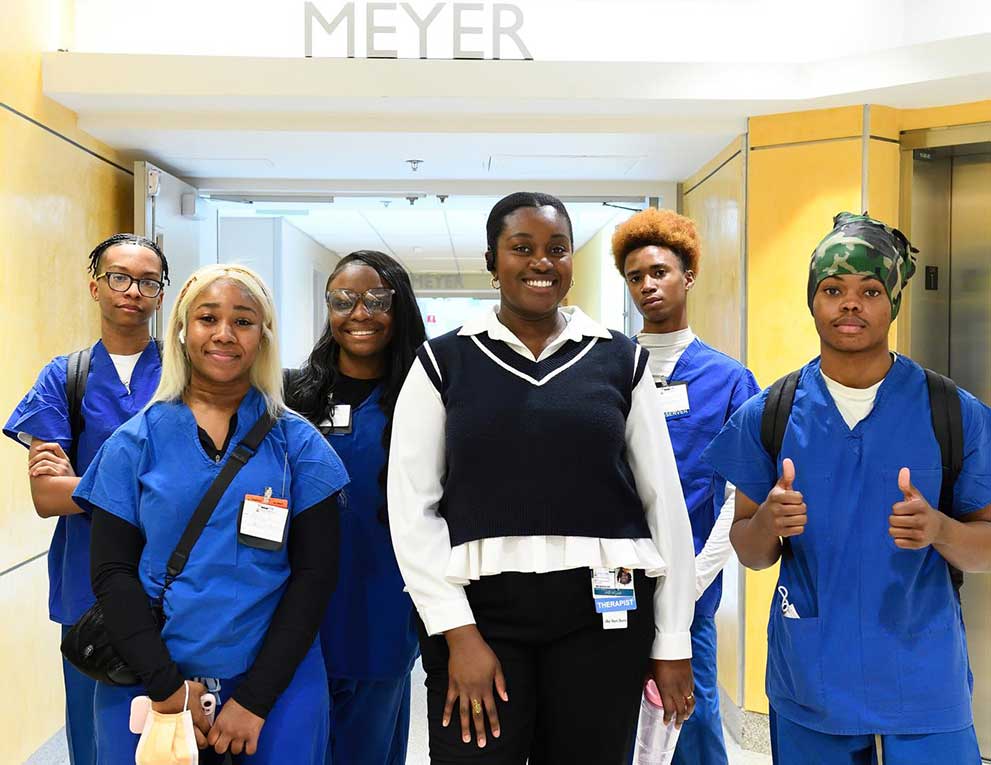
Students in the reborn Dunbar-Hopkins Health Partnership.
Credit: Will Kirk
Leslie Sherrod was a ninth grader at Baltimore City’s Paul Laurence Dunbar High School in 1990, unclear what she wanted to do with her life. Then her mother heard about a new program wherein Johns Hopkins was partnering with Dunbar to help high schoolers explore careers in healthcare through special classes, symposiums, mentoring opportunities and more.
Before she began 10th grade, Sherrod found herself on the Johns Hopkins campus taking introductory classes. Her participation in the program continued through her high school graduation.
Sherrod is now a licensed certified social worker with a master’s degree in social work. She leads a three-person therapy practice, and when she’s not helping her clients deal with issues such as depression and anxiety, she’s pursuing a doctorate in social work.
“The Dunbar-Hopkins partnership provided a lot of opportunities to have continued exposure to the health professions,” Sherrod says, calling it the “light bulb” that illuminated her career path.
The Dunbar-Hopkins Health Partnership went on hiatus in 2016 after the state launched the Pathways in Technology Early College High School, or P-TECH, program to give participating students supplemental training to earn a no-cost associate degree along with their high school diploma. Johns Hopkins was a co-sponsor of P-TECH at Dunbar, where the focus was on the health sciences; 69 participants left high school with associate degrees in fields such as nursing, respiratory therapy and physical therapy thanks to P-TECH.
After Dunbar stopped enrolling P-TECH students a few years ago, Johns Hopkins and Dunbar renewed the partnership program. Now beginning its second year, the reborn Dunbar-Hopkins Health Partnership is poised to reach more students and provide even more pathways to careers in health and medicine. The partnership is serving more than 1,000 students in grades 9 through 12.
“We're supporting the original vision of the Dunbar-Hopkins Health Partnership combined with some of the best elements of the P-TECH program to provide comprehensive support for the young people at Dunbar,” says Alicia Wilson, vice president for civic engagement and opportunity at Johns Hopkins.
As a product of the Baltimore City Public Schools, Adam Milam, professor of anesthesiology and critical care medicine at the school of medicine, can relate to the Dunbar students. “Programming like this, where you have early exposure to the healthcare field and physicians and nurses, is a great experience for the students,” he says.
Milam has had some 20 Dunbar students shadow him or his operating room colleagues. “They get to see what we do as anesthesiologists and just pick our brains about what it takes to become one and what our day looks like,” he says.