
A Match Made in Baltimore
More than 50 years after meeting as undergraduates at Johns Hopkins, Rick and Marian Damewood have established a research fund that has shaped how Johns Hopkins medical students discover research, mentorship and their futures in medicine and women’s health.
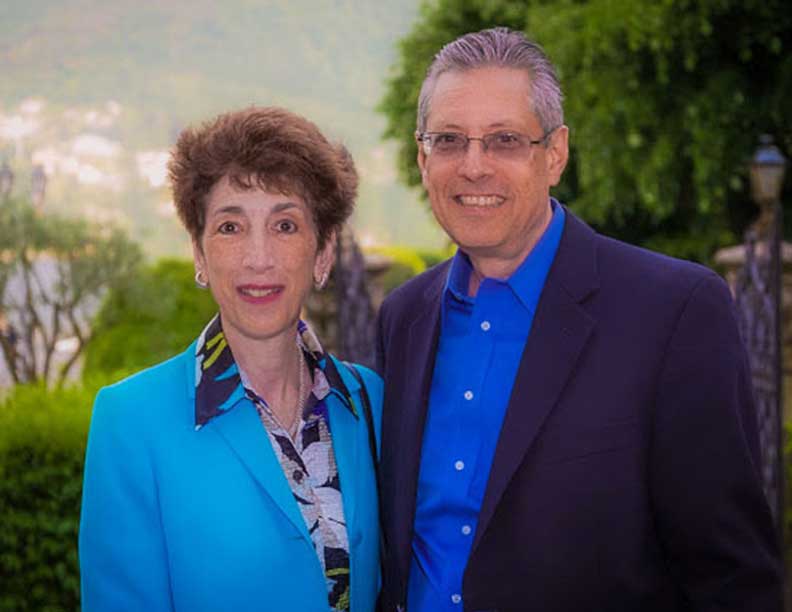
Marian and Rick Damewood
On April 13, 1973, 19-year-old Marian de Marinas, a college sophomore, stood in the lobby of the Wood Basic Science Building, waiting to be interviewed for the Johns Hopkins accelerated B.A./M.D. program. Across the room, she noticed a young man in a striking blue suit talking with a senior medical student. “He already knows someone; he will probably get in,” she thought.
That young man was Rick Damewood, also a sophomore. He had noticed Marian, too. “I remember seeing her and hoping she’d get into the program,” he recalls, “and that I would, too.” Neither knew the other’s name that day. Both got in.
More than 50 years later, the two are sharing their story as the donors behind the Marian and Richard Damewood Medical Student Research Fund. The program has shaped how Johns Hopkins medical students discover research, mentorship and their futures in medicine and women’s health.
The Damewoods married a week after graduation in 1978. They spent the following years building their careers, often going weeks without seeing each other. “We understood what we each were going through; we just shared a lot,” Rick says. That shared experience shaped how they would think about giving back.
Marian’s path led her to reproductive endocrinology/infertility, and she was the only woman among 32 Gyn/Ob residents at The Johns Hopkins Hospital in 1978. Her career included roles as a hospital department chair, residency program director and site visitor for the Accreditation Council for Graduate Medical Education. She was elected president of the American Society for Reproductive Medicine.
Rick built a career in surgery, eventually chairing a hospital’s surgical department, where his deepest satisfaction came from training residents. He was elected president of the National Association of Program Directors in Surgery. Both Damewoods trace their career paths to Johns Hopkins Medicine mentors who recognized something in them early and nurtured it.
That belief in mentorship drew them to a 2018 proposal from Johns Hopkins’ Silka Patel, then the clerkship director in the Department of Gynecology and Obstetrics, and Andrew Satin, chair of the department. Patel had noticed a gap: The department had no direct funding to help students pursue research, present at conferences or gain visibility with mentors. She proposed a three-part model: research funding, conference travel and mentorship built into every award.
Marian’s response: “We’ll [fund] all of them.” The Damewood Medical Student Research Grant Program launched that year.
The program is set apart by its structure: Every recipient must have a faculty mentor in the Gyn/Ob department. Each application requires a mentor’s letter outlining how they’ll support the student. Patel modeled the program after how major NIH grants operate, ensuring clarity around authorship and establishing best practices in academic settings, all to teach students something many don’t yet know how to do: advocate for themselves.
The breadth of funded research is notable. Recipients have explored venous thromboembolism risk among patients with gynecologic cancer, barriers to menstrual equity for Baltimore teens, and how maternal depression shapes prenatal care — covering clinical care, health equity and mental health, all aimed at improving outcomes for women.
When Patel started at Johns Hopkins Medicine, she estimates one or two students a year pursued Gyn/Ob residency. Today, that number has tripled, to nearly 10% of each graduating class. While only one or two students win the grant each year, other students benefit — because the program has already connected them with a mentor and a plan. “The secret sauce,” Patel says, “is that applying to the grant program gets everyone trying.”
When asked what they’d say to fellow alumni considering a gift, Marian doesn’t hesitate: “Look at your path to Johns Hopkins and the people who influenced your life and career — and pass it on to the next generation.”