
2026 Radiology QI Showcase Spotlights Staff-Led Innovations

QI Program participants shared posters detailing efforts to improve patient care and workflow processes.
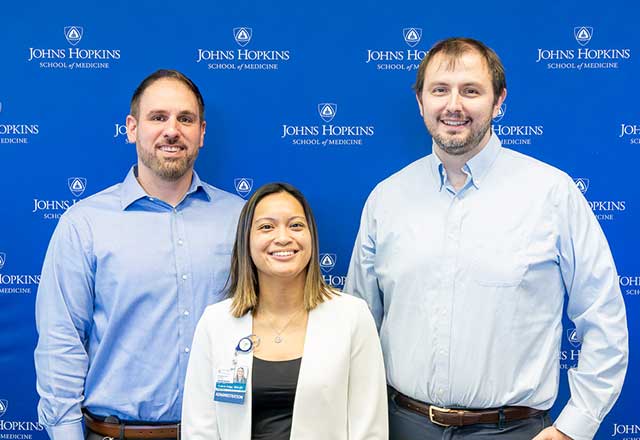 (From left) Vince Blasko, assistant director of QI and patient safety, with Valerie Felipe, QI team leader, and Dr. Javad Azadi, vice chair of quality and safety.
Staff, trainees and faculty gathered to share ideas on how to improve patient care and work processes during the Johns Hopkins Department of Radiology’s 2026 Quality Improvement (QI) Program Poster Showcase at The Johns Hopkins Hospital on Nov. 18.
Since 2009, the Radiology QI Program has focused on promoting quality improvement initiatives among clinical and non-clinical staff in radiology and imaging. The program is led by Vince Blasko, assistant director of QI and patient safety, and Valerie Felipe, QI team leader.
Throughout the year, the QI Program Committee meets monthly to offer training to staff on quality improvement practices and principles, including optimizing patient outcomes and experiences, improving safety and reducing waste in healthcare delivery. The aim is to empower team members to become agents for positive change by providing the resources needed to drive that transformation.
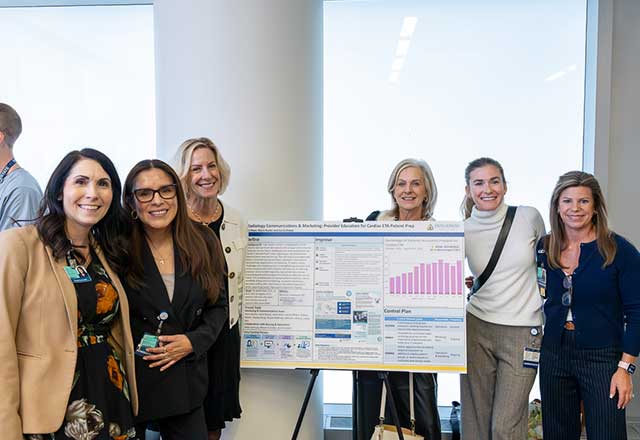 (From left) Danielle Karavedas, president of Johns Hopkins Medical Imaging and chief administrative officer of the Department of Radiology, poses with physician liaisons and their QI project.
Participants in the program include teams from The Johns Hopkins Hospital, Johns Hopkins Medical Imaging (JHMI), and Johns Hopkins Bayview Medical Center.
The committee concludes each year with a showcase featuring posters developed by staff and trainees from across the department, including technologists, nurses, patient care coordinators, customer service representatives, engineers, marketing liaisons and radiology residents. Participants spend months on the project, from selecting a topic to collecting and analyzing data and implementing a plan. This year’s event featured 20 projects detailing quality improvement efforts in areas and modalities across the department.
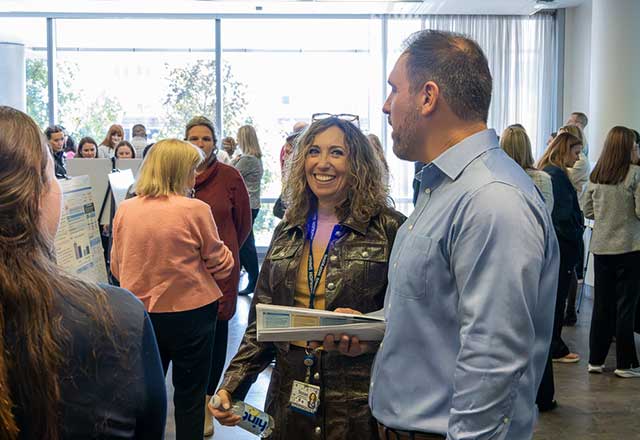 A QI program participant shares her project with (from left) Susan Press, radiology administrator, and Vince Blasko.
Among the projects featured during this year’s event were efforts to improve scheduling and registration processes, reduce delays in emergency department care, improve workflow efficiency and optimize protocols.
Attendees at the event included April Taylor, vice president and chief operating officer of The Johns Hopkins Hospital.
“Quality improvement is really important because there are lots of opportunities to improve care for our patients, families, but also to improve the experience for our staff, whether it's our staff in radiology, or our radiologists, or the nursing staff,” she explained.
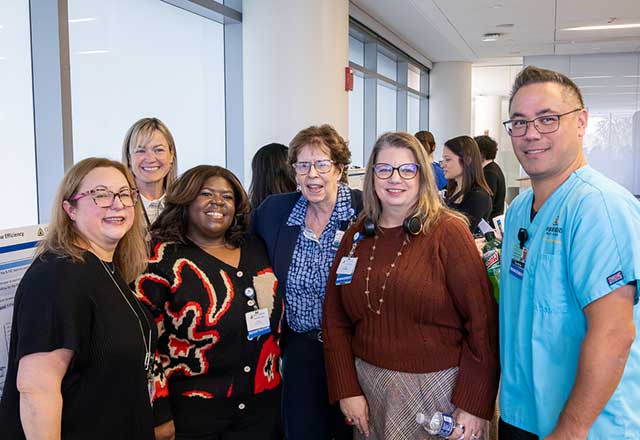 JHMI staff, including (center) Peg Cooper, radiology operations administrator and director of JHMI, and Noel Foster, director of imaging at JHMI Wilde Lake Pavilion, gathered for the event.
“Almost all of these projects, you can see not just the result locally within radiology, but the result that it has downstream,” she continued, adding, “The number of projects that I've seen that connect to our strategic priorities, like reducing length of stay, is amazing. I don't know how much the staff here even recognize or connect their work with the impact on ensuring that patients that need care here at JHH are able to receive it in a timely way.”
Dr. Jenny Hoang, interim chair of the Department of Radiology, echoed these sentiments, praising the teams for their valuable work.
“The quality improvement poster day is so important because it represents months of work from our staff across all of our sites,” she said. “It really gets to what I think is so important and so unique about our teams. Our teams at the front line are seeing how we can be better and actually being part of solving, coming up with the ideas, piloting something, taking it all through like a research project of measuring the improvement. It makes us better as a department for our patients, for our staff.
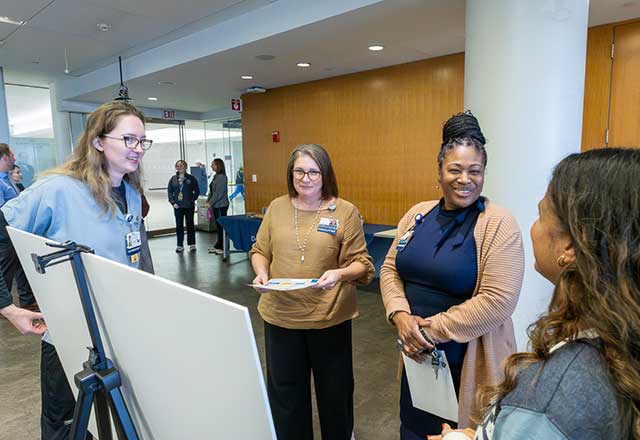 QI Program participants shared their projects with attendees.
She concluded, “It's so exciting for a day like this to bring us all together so we can learn from each other and continue to be better as a department.”
For Dr. Javad Azadi, vice chair of quality and safety for the Department of Radiology, the fact that the projects were developed by frontline staff made their findings all the more valuable.
“These are members of our department, technologists, nurses. They are the front line. They're the ones who are actually experiencing these issues. They're the ones who are able to best come up with the solutions,” he said, continuing, “But it's more than that. They were able to define their problems, they were able to measure, and they were able to both put in a solution and able to show that they were able to make a meaningful improvement in their issues. So not only are they saving the patients time and money, they're just making the health system more efficient. And I just couldn't be more proud of them.”
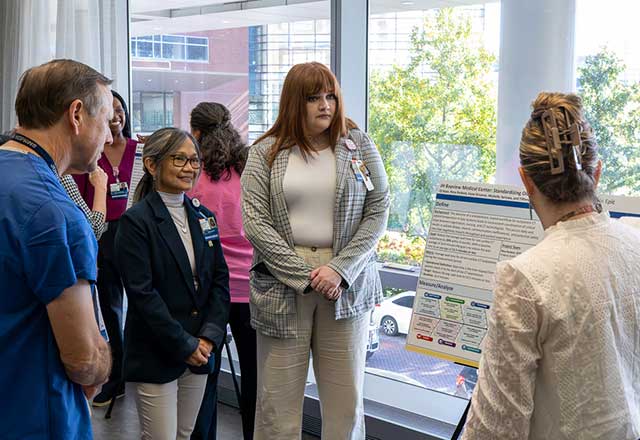 This year’s QI Showcase featured 20 projects detailing quality improvement efforts in areas and modalities across the department.
Lakiesha Brown, director of imaging operations at Johns Hopkins Medical Imaging at Green Spring Station, expressed her gratitude directly to program co-coordinator Vince Blasko during the event.
“Vince, I just wanted to let you know that this is such a phenomenal turnout,” she said. “I see the blood, sweat, and tears that you're putting in every year. You and Valerie do such an amazing job.”
“Looking at the smiles on these presenters' faces; they're so engaged and they're so proud of their projects,” she continued, adding, “I just want to thank you for taking the time out to do this for us as a department. Great work, strong work, great finish. We appreciate you.”
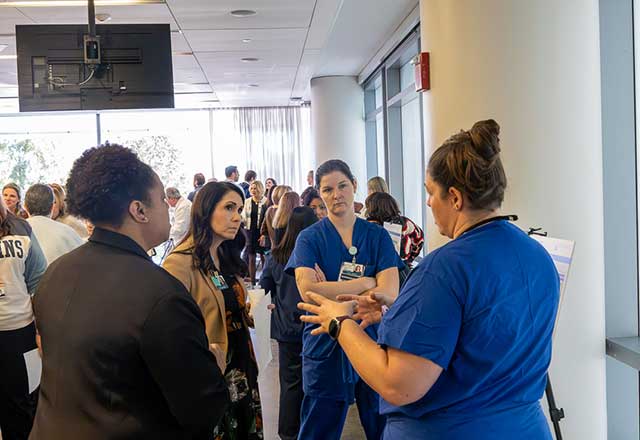 QI projects aim to optimize patient outcomes, improve safety and reduce waste in healthcare delivery.
For his part, Vince was quick to share the credit with all of the QI program participants.
“It's not just us,” he said. “I think the frontline teams that come together, they're our change agents – the people that really put the time and effort in to make the project successful. It's their hard work that we're really showcasing today.”
Now, with the knowledge gained from this year’s QI Showcase projects, staff, trainees and faculty can implement new initiatives to improve experiences for patients and team members not just in Radiology, but across Johns Hopkins Medicine.