
Mentorship Across Generations: Advancing Discovery, Collaboration and the Future of Critical Care Medicine
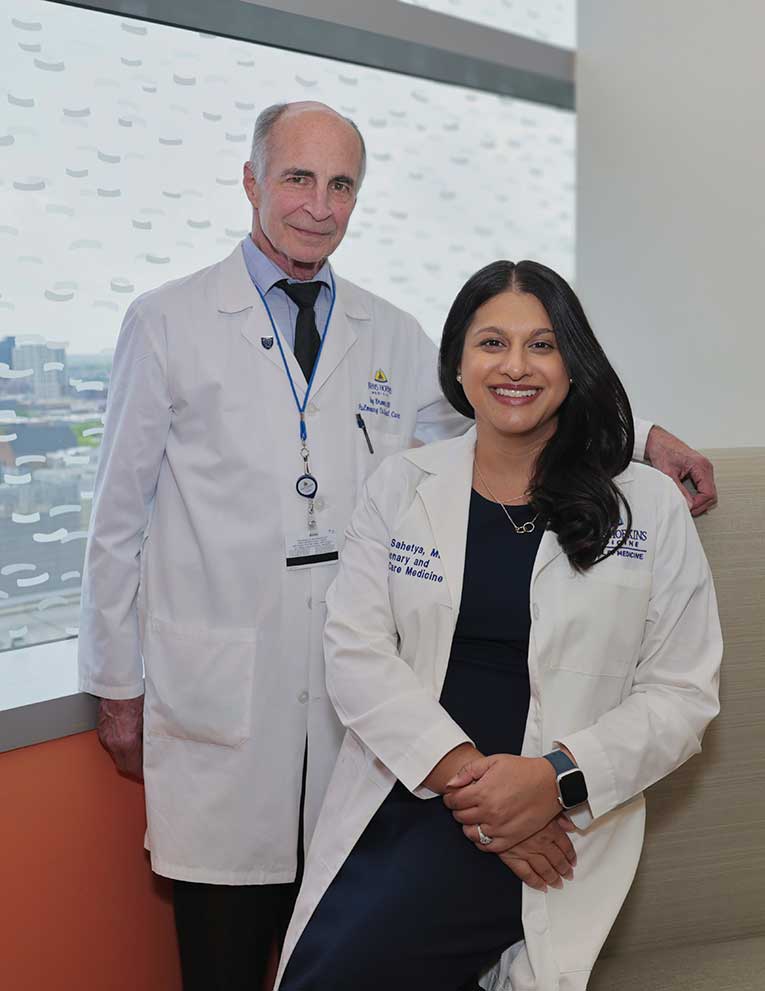
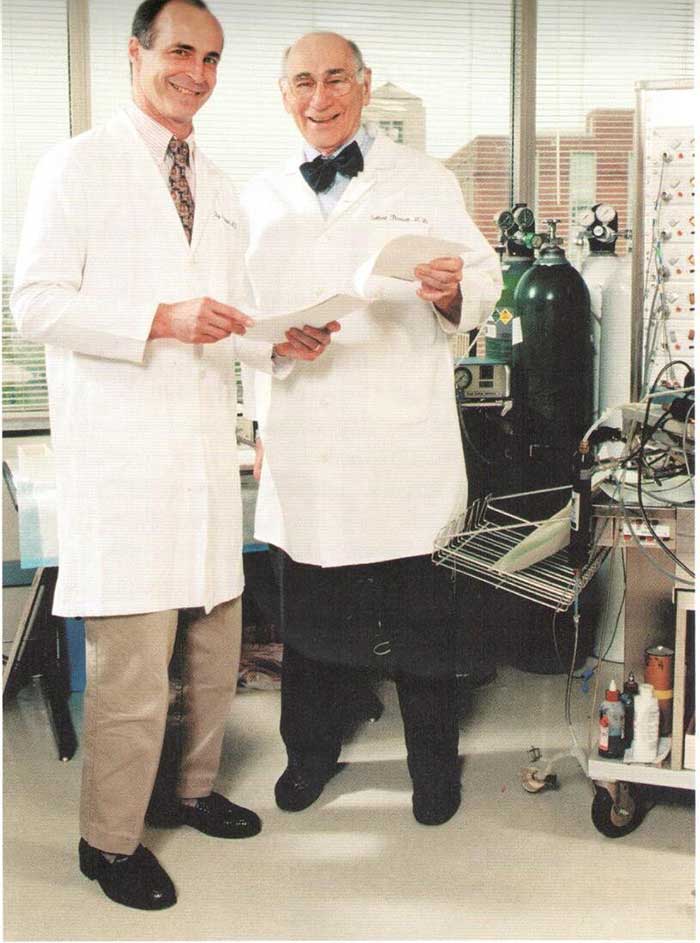 Roy Brower and Sol Permutt
Progress in academic medicine rarely emerges from individual effort alone. As Roy Brower, a professor of medicine in Johns Hopkins Medicine’s Division of Pulmonary and Critical Care Medicine (PCCM), has noted, “Good mentorship is a symbiotic relationship.” This principle was evident in his own formative mentorship with renowned physiologist Solbert Permutt, and it continues to shape the culture of PCCM today. The advancement of clinical science depends on intellectual curiosity, the transmission of knowledge, and scientific discipline across generations of investigators. Within the division, mentorship has long played a central role in developing physician scientists and sustaining innovation in critical care research.
Where Mentorship Begins
For many clinicians who pursue academic medicine, the influence of mentorship begins early in training. That was the case for Brower and Sarina Sahetya, an assistant professor in PCCM, who first met when Sahetya was an intern. Early interactions with experienced investigators often shape how trainees approach both clinical questions and scientific inquiry. Mentors introduce the foundations of research methodology, guide manuscripts and grant proposals, and help trainees translate bedside observations into scientific questions. These relationships cultivate the habits of inquiry, persistence and intellectual rigor that define successful research careers.
Roy [Brower] always told me that progress can be made because we stand on the shoulders of giants, and that allows us to see farther,” Sahetya recalls. “PCCM and our long line of giants have helped shape my career and research."
From Mentorship to Collaboration
Over time, mentorship often evolves into collaboration. As Sahetya advanced in her training and research career, she began developing the framework for what would become one of the largest clinical trial research initiatives currently hosted within the division, the Driving Pressure Limited Ventilation in Hypoxemic Respiratory Failure (DRIVE) trial. DRIVE is an international multicenter phase 3 randomized clinical trial that evaluates whether a ventilator strategy that focuses on limiting the change in pressure during a breath (the driving pressure), compared to limiting the size of a breath (tidal volume), will help patients with acute hypoxemic respiratory failure get extubated more quickly. The trial also includes a six-month follow-up assessment to better understand patients’ long-term quality of life after critical illness.
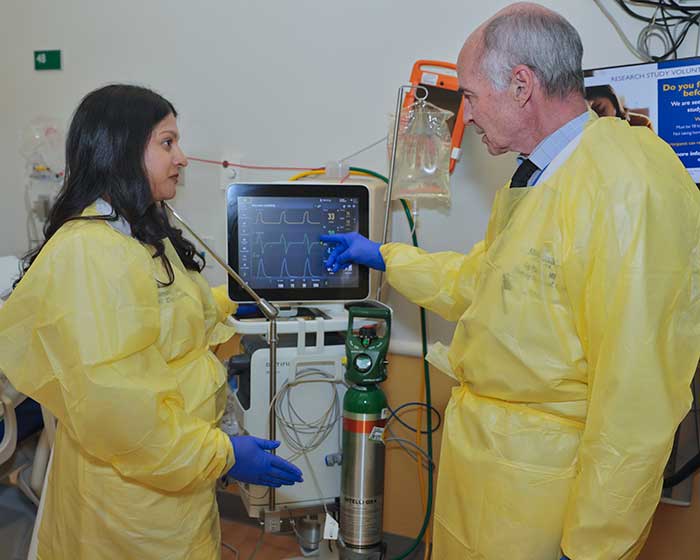
Sahetya is the principal investigator of DRIVE-USA, which is the 26-hospital consortium in the U.S. contributing to the International DRIVE trial. Sahetya serves on the international DRIVE and steering committees, and works with colleagues Dale Needham and Brower, who are members of the DRIVE-USA clinical coordinating center. The U.S. component of the DRIVE trial is supported by funding from the Department of Defense’s Congressionally Directed Medical Research Program. The trial represents a major international effort to refine mechanical ventilation strategies for critically ill patients with respiratory failure. This study builds on Brower’s prior research and reflects decades of leadership in critical care research. He was a key investigator in the landmark ARDS Network clinical trial, published in 2000, which demonstrated that lower tidal volume ventilation significantly improved survival for patients with acute respiratory distress syndrome. Prior to this work, larger ventilator breaths were commonly used, and they often worsened lung injury. The trial showed that a lung-protective ventilation strategy reduced mortality by approximately 22%, fundamentally reshaping ICU practice worldwide. Subsequent research from Brower and colleagues further clarified how ventilator settings such as tidal volume, positive end-expiratory pressure, and driving pressure influence lung injury and patient outcomes.
Building Legacy and Shaping the Future
For Sahetya, mentorship has also shaped the way she approaches her own academic career. Her research focuses on improving outcomes for patients with respiratory failure and understanding the role of respiratory physiology in optimizing mechanical ventilation. In 2026, she received the American Thoracic Society Assembly on Critical Care Early Career Achievement Award, recognizing her contributions to critical care research and patient care. Through leadership roles in studies such as the DRIVE trial and other collaborative investigations, she has helped advance research that examines both immediate treatment strategies and recovery after critical illness. Colleagues frequently point to her ability to bring together multidisciplinary teams of clinicians, statisticians and implementation scientists to address complex clinical questions.
Mentorship within PCCM continues to perpetuate this cycle of discovery. Experienced investigators provide perspective and scientific rigor, while emerging researchers introduce new analytical tools, technologies and methodologies that expand the possibilities of clinical investigation. These collaborations extend across national and international research networks, allowing discoveries made at Johns Hopkins Medicine and The Johns Hopkins University to influence the practice of critical care medicine around the world. The partnership between Brower and Sahetya illustrates how mentorship sustains the future of academic medicine. By combining experience, scientific rigor and new perspectives, their collaboration demonstrates how mentorship can transform early-career curiosity into large-scale research that advances patient care. Through this culture of mentorship and collaboration, the division continues to train the next generation of physician scientists while advancing the science of critical care medicine.
For Clinicians Clinical Connection
Clinicians, discover the latest in research and clinical innovation from Johns Hopkins experts. Access educational videos, articles, CME courses and other resources from our world-renowned institution.