
2026 Radiology Research Day: Research Reimagined
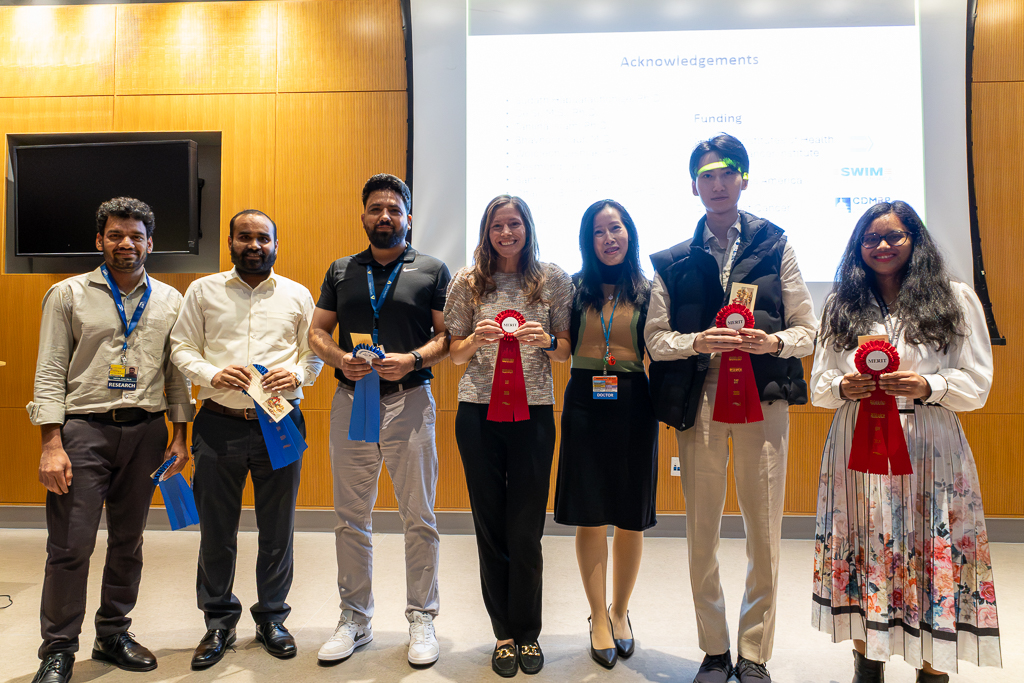
Winners of the 2026 Radiology Research Day Poster Awards.
Faculty, trainees and researchers came together to share cutting-edge breakthroughs during the 9th Annual Radiology Research Day at The Johns Hopkins Hospital on Sept. 30. The theme of the gathering, which featured presentations and posters on a variety of new imaging treatments and technologies, including unprecedented new uses for artificial intelligence, was “Radiology Reimagined”.
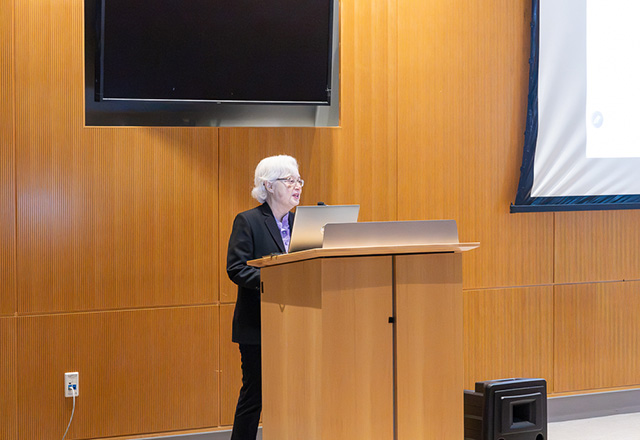 Dr. Zaver Bhujwalla was lead coordinator of Radiology Research Day.
The day was organized by Zaver Bhujwalla, vice chair of research and director of the Division of Cancer Imaging Research, with support from a large team of faculty from across the department as well as administrative assistance.
The event began with introductory remarks by Jenny Hoang, interim chair of the Department of Radiology. Dr. Hoang highlighted the importance of the event, calling it “a day to stop to see what we’ve built together and to learn from one another.”
While acknowledging the difficulties research institutions across the country have faced in recent years, she emphasized the importance of continuing this critical work.
“Research is not a negotiable mission,” she said. “It is essential.”
She also shared that, despite the challenges, faculty and researchers secured 49 new grants and $35.8 million in new funding in fiscal year 2026, up from $26.4 million the previous year. Faculty were also prolific in publishing, with more than 30 manuscripts with a high impact factor appearing in prestigious medical journals.
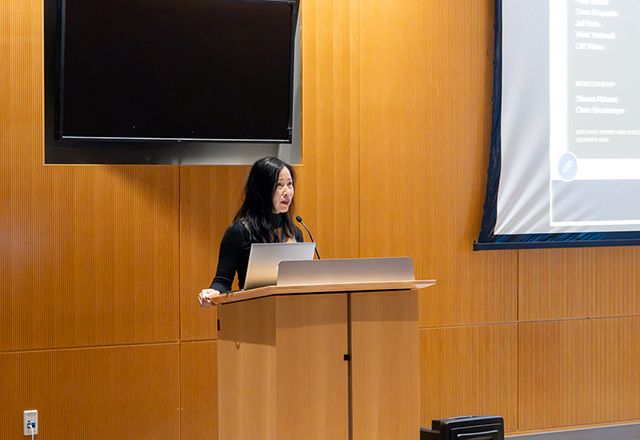 Dr. Jenny Hoang, interim chair of Radiology, offered welcoming remarks.
The day’s presentations began with a session featuring assistant professors, including Kevin Leung, who described his work using AI in molecular imaging to quantify tumors, allowing for greater precision in the diagnosis and treatment of malignancies. Next, Melissa Caughey presented on several research projects she is spearheading, including developing AI to assist in analyzing tortuosity (abnormal elongation or twisting) in blood vessels of the brain, while Janaka Senarathna spoke on his lab’s efforts to build micro imaging tools able to perform continuous neuroimaging scans over a 24-hour period.
The next session was dedicated to associate professors. Jingyang Xu offered an update on her team’s research into developing alpha-SPECT mini, a small scanner able to image alpha emitters in preclinical testing, followed by Michael Shar, who detailed his team’s research into the diagnostic benefits of patient-performed exercises during cardiovascular MRI scans. This session concluded with a presentation by Sairam Geethanath, who spoke on the development of autonomous MRI systems as a means of providing greater imaging access to developing countries.
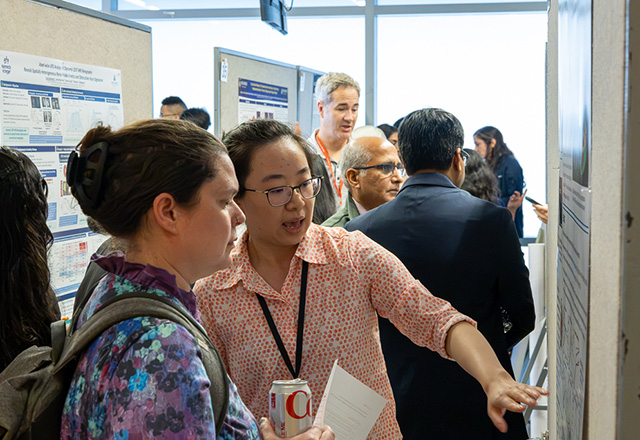 Researchers shared posters highlighting their recent work.
The next session was a special award session for postdoctoral fellows. The three presenters selected to share their work were Sara Momtazmanesh, who spoke on using AI to determine the biological age of skeletal muscle, with presenter Anand Thotakura sharing research on using PET and optical based imaging to track key peptides that drive inflammation in gastrointestinal diseases. The session concluded with fellow Puneet Khandelwal presenting work on finding and destroying pancreatic cancer cells by targeting the tumor’s metabolism.
Following this was a session dedicated to research presented by residents. Selin Ocal opened by detailing a new workflow in which residents took over primary responsibility for interpreting radiographs of unintellectually-retained objects during overnight shifts. Previously, such scans were interpreted by on-call attending radiologists. The session also included work by Swathi Raman, who discussed a piloted program that would expedite the callback process for screening mammography patients whose results showed a higher risk for cancer, and Lindsey Greenlund-Ross, who presented findings on the efficacy of performing CT angiography on patients presenting to the emergency department with neurological symptoms.
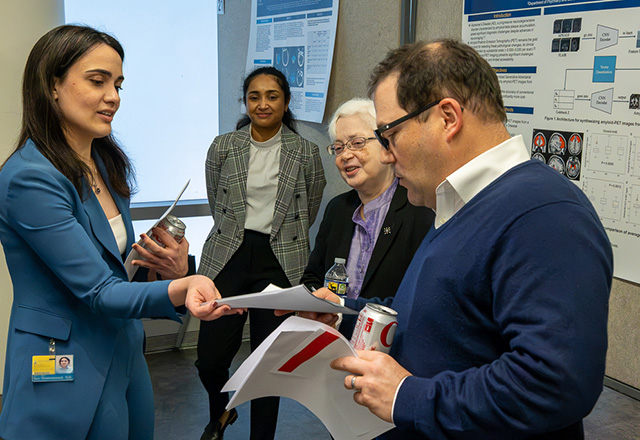 During lunch, attendees had the chance to review research posters.
After a full morning of speakers, attendees had a chance to take a break during a lunch session that included the display of more than 60 research posters detailing the breadth of groundbreaking research underway throughout the department.
The first post-lunch session featured clinical faculty presenters. Arash Kardan, new chief of the Division of Nuclear Medicine and Molecular Imaging, opened with a discussion on research into using amino acid-targeting PET scans to find and treat cancerous tumor cells in the brain. Vivek Yedavalli spoke on the importance of tracking the outflow of blood in the brain of patients experiencing ischemic stroke, while Javad Azadi presented results of a study on the benefits of lung ultrasound to detect pulmonary tuberculosis in patients in Peru.
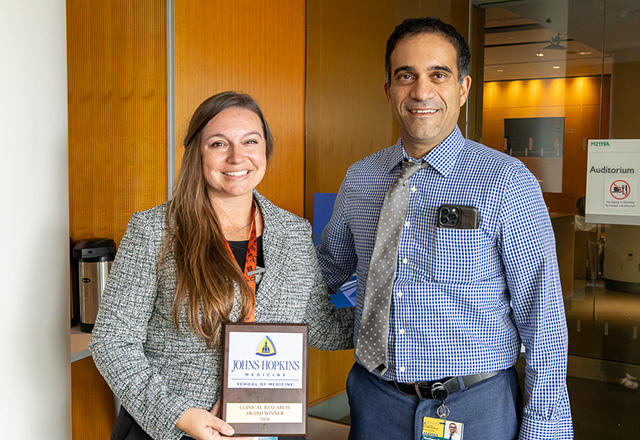 Dr. Shadpour Demehri presented a clinical research award to Dr. Erin Gomez.
Following this, faculty members Erin Gomez and Zhiliang Wei were honored as winners of this year’s research awards. Candidates for the award were evaluated based on the quality and impact of their work, as well as published papers and grant awards from the National Institutes of Health. During the session, Dr. Gomez presented her work evaluating clinical outcomes of patients who underwent imaging to evaluate placenta accreta, while Dr. Wei offered results on the diagnostic yield of pre-clinical in-vivo imaging.
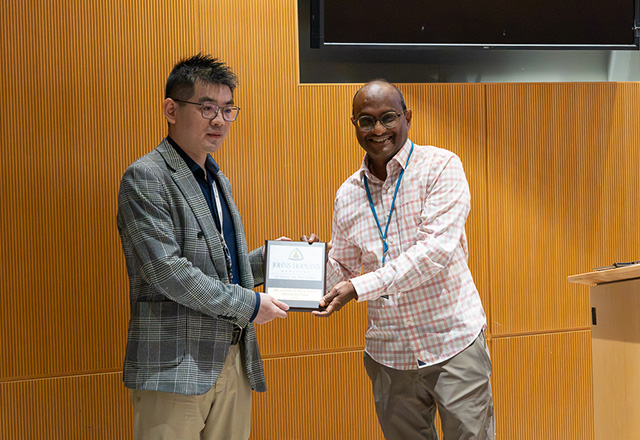 Dr. Sridhar Nimmagadda (right) presented a research award to Dr. Zhiliang Wei.
The last session of the day was entitled “The George Sgouros Session for Endowed Professors – Radiology Research Reimaging.” Sgouros, who had been director of the Radiological Physics Division, passed away in June 2026.
The session began with Ken Taguchi recounting Sgouros’ legacy at Johns Hopkins and throughout the medical physics community. He also spoke of Sgouros personally, noting, “He was always smiling and optimistic,” Dr. Taguchi said, adding, “He always shared the joy.”
Presenting first during the session was Peter Barker, chairholder of the Jonathan S. Lewin, M.D. Professorship. He offered insight into his 35 years of research into using spectroscopy, a noninvasive advanced imaging technique, to study the biochemical and metabolic characteristics of tumors in the brain.
The last presentation of the session, and the day, was presented by Dmitri Artemov, chairholder of the Albert B. Shackman M.D., F.A.C.R. Professorship. He shared his research into using a two-step technique called pre-targeting to find and mark malignant tumors. Using this process, clinicians can inject a non-radioactive isotope into the patient to locate a tumor before then injecting the radioactive material to kill the malignant cells. Using this method allows for precise targeting and treatment with less radiation exposure to the patient.
After a day full of collaboration and discovery, the event concluded with Dr. Hoang’s remarks and the presentation of awards for the winning poster displays.
In her closing comments, Dr. Hoang noted the breadth of expertise in the department, saying, “In every corner of this place there are people that are experts – world number one – and very generous with their time.”
She lauded the faculty present for the importance of their work and contributions, concluding, “Everything you do is going to be enduring.”
2026 Research Day Presenters and Awards:
Assistant Professor Session
- Kevin Leung - Large-scale Al in molecular imaging for precision medicine and improved patient outcomes
- Melissa Caughey - Research Ramblings in the Park
- Janaka Senarathna - Continuous Neuroimaging over 24 hours: The Next Frontier in Brain Science
Associate Professor Session
- Jingyang Xu - Alpha-SPECT-mini: a small SPECT/CT scanner for imaging α-emitters
- Michael Schar – Exercise in the MRI
- Sairam Geethanath - Towards Autonomous Magnetic Resonance Imaging
Special Award Session for Postdoctoral Fellows
- Sara Momtazmanesh - Deep Learning Skeletal Muscle Biological Age “MyoAge” at Chest CT: Development in MESA and External Validation
- Anand Thotakura - Macrocyclic Peptide-Based PET and Optical Imaging of IL-23R in Preclinical Models of Colitis
- Puneet Khandelwal - Metabolotheranostics of pancreatic cancer by targeting choline, glutamine, and glucose transporters with photoimmunotherapy
Radiology Resident Presentations
- Selin Ocal-Transition from Attending to Resident-Interpreted Overnight Intraoperative Radiographs for Unintentionally Retained Foreign Objects
- Swathi Raman - Impact of an Expedited Diagnostic Callback Pathway for Screening Mammography
- Lindsey Greenlund-Ross - Evaluating the Diagnostic Yield of CT Angiography in Emergency Neurologic Presentations
Clinical Radiology Session
- Arash Kardan - Advanced Amino-acid PET Imaging in Neuro-oncology
- Vivek Yedavalli - Venous Outflow Imaging in Acute Ischemic Stroke
- Javad Azadi - Point of Care Lung Ultrasound for Detection of Pulmonary Tuberculosis in Peru
Research Award Winners
- Erin Gomez - Clinical Outcomes Among Patients Undergoing Imaging Evaluation of Placenta Accreta Spectrum: 20 year experience from Johns Hopkins
- Zhiliang Wei - Imaging Brain Physiology
George Sgouros Session for Endowed Professors
- Peter Barker, Lewin Professor - 35 years of brain tumor spectroscopy: what's new?
- Dmitri Artemov, Shackman Professor - Ready, Target, Fire: Pretargeting for Precision Imaging and Therapy
Pre-Clinical Poster Award Winners
- Aberrant Glycan Signatures Enable Hydroxyl Proton Transfer-Weighted (HPTw) MRI for Early Detection and Stratification of Glioblastoma Aggressiveness
Asif Itoo, Janani Gurumurthy, Hernando Lopez-Bertoni, Shreyas Kuddannaya, Safiya Aafreen, Guanshu Liu, Jeff W.M. Bulte - A Peptide-Based Radiotheranostic for CD38-Targeted Imaging and α-Particle Therapy in Multiple Myeloma
Ajay Kumar Sharma, Kuldeep Gupta, Akhilesh Mishra and Sridhar Nimmagadda - Structure-Guided Linker Optimization Enhances Tumor Targeting of FAP-Targeted PET Radiotracers
Suresh Alati, Rajan Singh, Anand K. Thotakura, Andrew G. Horti, Sangeeta R. Banerjee
Clinical Poster Award Winners
- Brain Arterial Tortuosity, Intracranial Atherosclerosis, Cognitive Decline, and Incident Dementia: Longitudinal and Prospective Analyses From the Atherosclerosis Risk in Communities (ARIC) Study
Ziyang Xu, Melissa C. Caughey, Sile Wang, Xinwei Zhou, Bruce A. Wasserman, and Ye Qiao - When AI Evolves: Clinical Implications of Algorithm and Threshold Changes in Screening Mammography
Shefali Jain, Babita Panigrahi, Lisa Mullen, Kelly Myers, Emily Ambinder - Voxel-wise UPD Analysis of Dynamic CEST MRI Renography Reveals Spatially Heterogeneous Renal Probe Kinetics and Obstructive Injury Signatures
Zinia Mohanta, Julia Stabinska, Aruna Singh, Michael T. McMahon