
Tom Quinn, M.D., Retires After 45 Years of Service
Quinn reflects on his career as a "lab guy" and the importance of surrounding yourself with good people to have great impact.
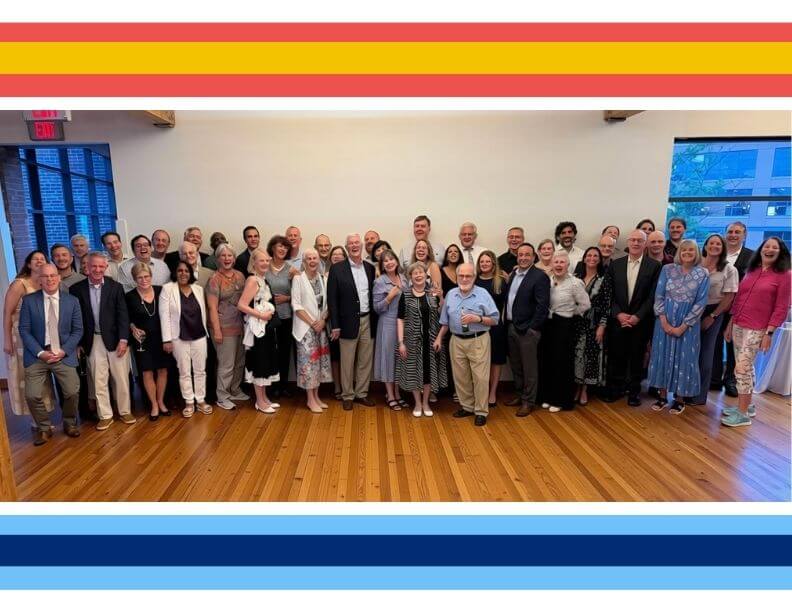
Family, friends and colleagues gathered to celebrate the remarkable career of Thomas C. Quinn, M.D., pictured center, in the blue sport coat.
Photo by Molly Bowen
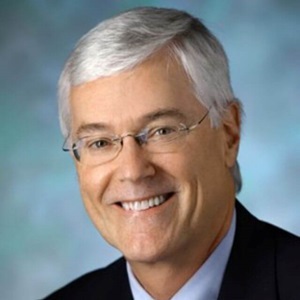 Family, friends and colleagues gathered over the summer to celebrate the retirement of Thomas C. Quinn, M.D., and to mark his 45 years as an NIH-funded intramural researcher with the Johns Hopkins Division of Infectious Diseases.
At heart, Quinn is an enthusiastic and energetic scientist renowned for major discoveries in the epidemiology of HIV in Africa and the role of sexually transmitted coinfections in HIV transmission, as well as foundational research that underpins both prevention as treatment and what we now know about suppressing HIV viral load to undetectable, and thus untransmittable, levels. For those efforts, he has more than 1,000 scientific publications and is a recipient of scores of meritorious awards for distinguished service and groundbreaking science. Quinn, however, maintains that his enduring legacy is global collaboration and mentorship of junior investigators. He is not so much retiring from science as he is stepping outside the core of the network built over his career.
One Course Changed Quinn’s Course
As an undergraduate at the University of Notre Dame, Quinn’s interests were initially in music — he played guitar in a rock band — and communications — he worked part-time at NBC. His story likely would have played out in a much different way had he not enrolled in a microbiology course. Professor George Craig, an entomologist and vector biologist, became Quinn’s first career mentor, sparking his interest in malaria and parasitology.
“I was so excited about it,” he recalls. “Those little parasites would go into red blood cells and destroy them and kill people, and yet there was treatment, there was work on a vaccine and there was vector control.”
Mentors Shaped His Career
While Craig nurtured Quinn’s enthusiasm for lab-based research, he decided to pursue an M.D./Ph.D. degree, jointly conferred by University of Notre Dame and Northwestern University, where he received his medical training. Following residency, he applied for a fellowship training position at the National Institutes of Health (NIH). Working under Louis Miller, his second career mentor, Quinn conducted lab research on malaria. The experience was pivotal for him and was the beginning of his careerlong connection with the NIH.“It was a big laboratory led by a National Academy scientist who was just outstanding, probably number one in the field of malaria research,” Quinn says. “He really taught me lab-based research.”
Despite his budding passion for lab research, Quinn found that he missed working with people. He applied for another infectious diseases fellowship, at the University of Washington. It was there he met his third and most significant mentor, King Holmes, a leader in the field of sexually transmitted infections. Leading by example, Holmes not only provided scientific and patient-care mentorship, he also profoundly shaped Quinn’s career values for mentorship. Their trainer-trainee relationship became a close friendship that lasted for decades.
“He broadened my horizon beyond malaria into epidemiology, microbiology, sexually transmitted diseases and taught me how to really go after a research question. He was a great clinician who taught me the skills of taking care of patients. He was a phenomenal mentor who taught me how to be a mentor. He really knew how to take someone who’s got energy and enthusiasm and shape it.”
A Chance Assignment in Baltimore
A stipulation of Quinn’s NIH fellowship was a service payback obligation of two years. Following training, he was assigned to Wyman Park — at the time, a U.S. Public Health Service hospital — where he served as chief of infectious diseases. After President Ronald Reagan abolished the U.S. Public Health Service hospital system, Wyman Park merged with Johns Hopkins.Quinn recalls, “That was 1981. John Bartlett had just arrived at Hopkins, and we hit it off. He offered me space, while the NIH supported my salary and research to stay in Baltimore for two years to supervise rotations of NIH infectious diseases fellows to train within the Johns Hopkins infectious diseases clinical fellowship. That was 45 years ago, and we still train NIH fellows today.”
The program worked well for both Johns Hopkins and the NIH, and that’s how Quinn became a career intramural/extramural researcher. Anthony Fauci, to whom Quinn reported at NIH, was very supportive of the arrangement, and for Quinn, it afforded the best of both worlds: funding to do research and train scientists, and opportunities for clinical experiences and collaboration conferred by a large academic medical research institution.
“The Johns Hopkins University is a setting with medical students and much more clinical pathology in terms of patient care than you would see at the NIH, which is mostly research patients. So I could teach, I could see patients, I could do research with people at the schools of public health, nursing and engineering. The world's your oyster right here.”
When Quinn arrived at The Johns Hopkins University, the Division of Infectious Diseases was nowhere close in size to the nearly 500-person entity it now is. “Oh, it was tiny,” he says. “It was John Bartlett, John Mann, Pat Charache, Diane Griffin, Patrick Murphy and me.”
The AIDS epidemic changed that.
The AIDS Epidemic and Focus on Global Health
The Division of Infectious Diseases was on the front lines of the AIDS epidemic clinically, serving patients in Baltimore, as well as scientifically, conducting research on diagnosis, therapeutic development, transmission dynamics, supportive care and epidemiologic studies that characterized disease among populations. Quinn’s work has had significant and enduring effects on HIV care and prevention globally, and while he began in 1982 with a trip to Haiti to investigate the disease, he is perhaps best known for his work in sub-Saharan Africa, where the epidemic was severe, rapidly expanding and especially devasting to entire communities.By 1984, Quinn was living in Kinshasha, Zaire (now the Democratic Republic of the Congo), for the launch of Projet SIDA (“Project AIDS” in French), a long-term collaborative effort among Zairian, American and Belgian scientists to examine clinical features, immunology, virology and epidemiology of AIDS. The project was among the first to identify heterosexual transmission of HIV.
During this time, Quinn published one of his most important papers in Science with colleagues, summarizing lab and epidemiologic investigations on HIV/AIDS. Based on those data, the team concluded that if the AIDS epidemic wasn’t addressed in sub-Saharan Africa, there would be a pandemic. Quinn notes, “And, of course, more than 80,000,000 people were infected with HIV over the next 40 years.”
While the work in Zaire was moving the science along, the political environment in which the team was operating became far from ideal.
“The project was going great, but Zaire in 1991 was facing economic collapse and political instability that really put the team’s safety in jeopardy,” Quinn says. “We were evacuated under the military control of Belgian paratroopers across the Congo River to Brazzaville in Republic of Congo. The French ambassador was killed — everything was just turmoil. No one on our team was injured, thankfully, but it was horrible. We had to close down the project completely due to safety concerns.”
The work was discontinued, but the impact was significant and far-reaching, providing a foundation for breakthroughs in HIV research and care that, over time, ushered patient outcomes from a certain death to a manageable chronic disease.
“In retrospect, we really discovered a lot of things working together,” he continues. “We contributed to the discovery of what causes AIDS. We shipped specimens from Kinshasa to the Pasteur Institute, and they identified the virus from our specimens. We also helped them develop a serologic test for HIV for use in epidemiological studies. They won the Nobel Prize for their discovery, and Projet SIDA gave them specimens to help them prove it.”
Quinn was next invited to Uganda to help set up a lab for HIV research — specifically, to conduct an intervention trial on sexually transmitted diseases. He and colleagues surmised that sexually transmitted infections were important co-factors for HIV transmission. The results were not what they expected, and further inquiry into why ultimately transformed how HIV prevention is approached to this day.
“The trial was a failure,” he says. “But I’m a lab guy, so we did all the viral loads on the participants, and we found out that while sexually transmitted infections are important, the level of viral load was even more important in transmission dynamics. The team discovered that when the virus was suppressed in one marital partner who was infected, their partner was protected from infection. During this observational trial, not one partner of a person with HIV viral suppression became infected over a four-year period. What’s now known as U=U — undetectable viral load equals untransmissible — all stems from that study.”
Controversy and Renewed Commitment
Findings were published in 2000 in the New England Journal of Medicine and were accompanied by two editorials. One editorial emphasized the importance of the finding that viral suppression prevents HIV transmission. But another editorial questioned the ethics of the study, inferring that the study team withheld care for participants. Quinn was furious at the allegation, and issued a response.“The whole premise of that editorial was flawed,” he notes. “Our study looked at viral loads retrospectively from a study conducted between 1994 and 1998. Treatment wasn’t even available in Africa then — it was only barely available in the U.S., where new drugs cost like $40,000 and involved around 20 pills per day. I mean, it was a different time. Treatment didn’t start to move into Africa until the Global Fund came along in 2002 and then PEPFAR in 2003, and that’s when we started treating everyone.”
The criticism and the experience in Africa shaped Quinn’s resilience as a researcher and sharpened his focus on global health and equity.
“I was very upset, but it fueled my enthusiasm and optimism to bounce back, and I said, ‘I’m dedicating the rest of my career to global health.’”
Moving Ahead: The Johns Hopkins Center for Global Health
That enthusiasm and optimism led Quinn to establish the Johns Hopkins Center for Global Health in 2006 as a platform spanning the schools of medicine, public health and nursing to foster research that offers the promise of Johns Hopkins Medicine clinical breakthroughs and scientific collaboration to countries suffering from a large burden of disease. Global health grants and technical support are available for faculty, and a central component of the center is to leverage faculty work to place trainees in underserved countries through nine distinct funding programs and fellowships. Travel and research grants are provided to medical and public health trainees at the graduate and undergraduate levels, and the center even offers a virtual global health program for high school students. Quinn’s career was formed through high-value mentorship experiences, and a deep sense of commitment to fueling enthusiasm among the next generation has been a hallmark of his career.“The success we’ve had with the Center for Global Health is something I’m proud of,” Quinn notes. “For 20 years we’ve provided immersive global health opportunities for more than 1,200 students and more than 200 residents and fellows to travel to nearly 100 countries for research and practical experience. We’ve also funded $50,000 faculty starter grants that have brought more than $25.5 million back to the university through subsequent grant applications. And Anna Kalbarczyk in the Center has developed the Emerging Women Leaders in Global Health program, cultivating leadership among women around the world who are early career professionals. The return on investment has been tremendous.”
Reflecting on a 45-Year Career
For Quinn, while professional notoriety and research accolades mark scientific success, enduring relationships with colleagues and trainees are what he values most.“I’ve seen the advancement in careers of people who I’ve worked with and mentored, and there’s nothing more rewarding,” he says. “You know, a publication is great; you get lots of citations, and that’s a metric of success. But it’s the people who succeed that's even more important. If someone does great science, but isn’t mentoring anyone, I think that’s a failed career. You've got to be able to see others take root and carry the work forward.”
In retirement, Quinn is looking forward to spending more time with family and piloting his 41-foot sailboat, christened Simaril. In J.R.R. Tolkien’s fictional language, the name of the boat means “radiance of pure light,” and it’s an apt metaphor for the enthusiasm and commitment absorbed from mentors and global collaborators, for the knowledge, guidance and camaraderie Quinn has offered to trainees over 45 years, and for research that has radiated into better outcomes for patients with infectious diseases around the world.