
Telling the Story Behind the Science: Francesco Simonetti’s Work to Crack the Code of HIV
The study of HIV has produced major advances in patient care over the last four decades, and Simonetti sees plenty of room for meaningful progress, from deeper understanding of basic virology to novel clinical outcomes.
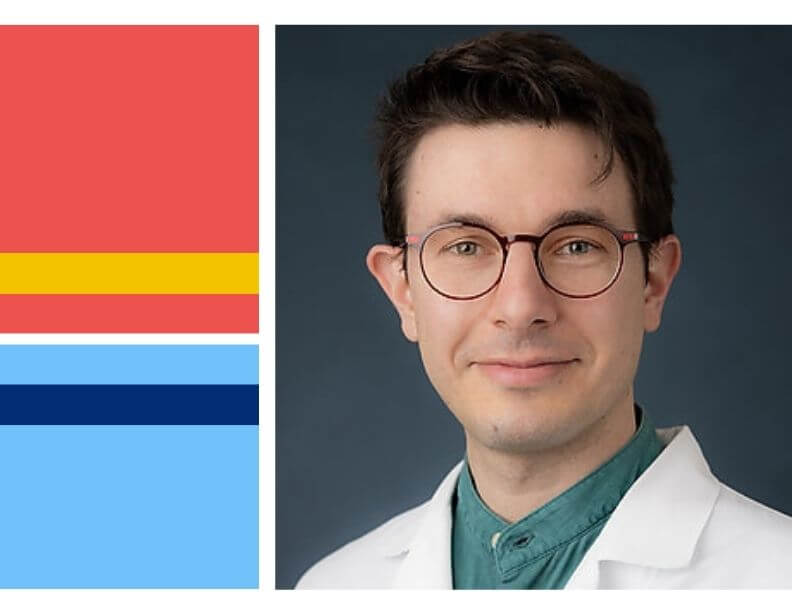
Francesco Simonetti, MBChB, PhD
“I love telling the story of how we got to ask a certain question, and the storytelling behind a scientific project and its implications.”
Fitting, then, that he would be drawn to a career in HIV research, an infectious diseases specialty with so many stories to tell.
Born in Italy, Simonetti completed medical school, residency and fellowship training in infectious diseases in Milan. An opportunity at the National Cancer Institute (NCI) brought him to the United States, where he spent a year and a half working in an HIV replication and dynamics program. For a clinician already enamored with research, those months at NCI set the trajectory of Simonetti’s career.
“My background training is in clinical infectious diseases, [but] I really enjoyed pathogen-host interactions, and I immediately found HIV as my thing,” he says, “because it was such a nexus between fascinating research and a disease that was disproportionately affecting populations in need, especially the most disenfranchised.”
His focus solidified, Simonetti returned to Italy fully intent on finding a way back to the U.S. to continue his research in HIV. That opportunity came in 2016, when he was accepted into a doctoral program at the Johns Hopkins University School of Medicine, joining the lab of renowned HIV researchers Robert Siliciano and Janet Siliciano. When the COVID-19 pandemic temporarily shuttered the Siliciano lab, Simonetti busied himself writing his thesis and applying for grants. One of those applications became a turning point. He secured an early independence award from the National Institutes of Health that allowed him to stay at Johns Hopkins as a faculty member, skipping the traditional postdoctoral training phase.
Simonetti opened his own lab in 2021. This September marks five years since that launch, a milestone he sees as evidence of how quickly a research career can evolve when the right questions are driving it.
An Endless Puzzle
For Simonetti, HIV remains one of science’s most compelling puzzles because it never stops changing.“There’s this thing about HIV, when we think the system is saturated and we know everything about it, someone discovers a new element,” he says.
The study of HIV has produced major advances over four decades, but Simonetti still sees plenty of room for meaningful progress, from a deeper understanding of basic virology to novel clinical outcomes.
“One feature of HIV is its striking capacity for diversity,” he explains. “I’m excited by the fact that this is such an unfathomable system that we keep learning from, and where we can see real translation. It’s not just for the sake of science; it has implications across the spectrum of HIV care.”
That sense of forward motion keeps him energized, but there is also a very clear downside to devoting a career to the study of a virus that evolves so freely.
“Sometimes you feel like you’re emptying the sea with a bucket,” Simonetti quips. “But at the same time, the main goal in my field is to achieve an HIV cure so that people can live their lives without therapy and without the virus coming back.”
It’s a story Simonetti is keen to tell.
The High Bar of a Cure
Simonetti admits curing HIV is a daunting challenge — he compares it to trying to find a single cure for every type of cancer. The bar is extraordinarily high, and the path to cure is anything but clear cut. Still, he believes the adaptability of the virus and the persistence of those who study it is an advantage.
“Because we keep discovering new things, there’s still hope that we can find a new target [for development of a cure],” Simonetti says. Some current strategies show promise, but those approaches, he notes, often come with a major limitation. Immunotherapy, stem cell transplants and expensive antibody cocktails may be powerful tools, but they are not practical solutions on a global scale. What the field needs, he says, are effective interventions that are easier to manufacture and distribute.
He pointed to one example that has generated excitement in recent years. Ongoing research at Johns Hopkins Medicine and other institutions suggests a protein called CARD8 can sense HIV in the body and trigger a process that kills infected cells. What’s more, a molecule that’s been used in HIV treatment drugs for decades appears to enhance this effect.
Now, Simonetti and others are revisiting banked samples and earlier studies to look for signatures of this mechanism, while pharmaceutical companies work to develop new drugs that might exploit it.
“This is an example of something that was overlooked for many years, but that we can now revisit, and it has the potential to become translatable and serve as the next generation of HIV treatment.”
A Physician-Scientist’s Balance
A trained clinician, Simonetti admits he had difficulty choosing the lab bench over the bedside.“I had been torn for almost a decade about whether my focus would be patient care or research,” he says. “Clearly, I made my decision by being at the bench and becoming a lab rat.”
Yet his approach to research has allowed an equilibrium that satisfies his desire to stay connected to patients, and clinical questions still inform his work every day. Study recruitment often begins with a clinician’s request to examine a difficult case or complex patient history. Simonetti then spends time studying clinical records, looking for the story behind the science.
“I love science communication,” he admits. “That can be told to a highly sophisticated audience, clinicians who are not familiar with the virology or molecular biology intricacies or even a community audience. I really like that part.”
Guidance from mentors who share his passion for bridging clinical care and research has also been transformative. Beyond Robert Siliciano and Janet Siliciano, he credits Joel Blankson with shaping his path through quiet determination and intellectual rigor. He also points to Eileen Scully as a model physician-scientist, someone who embodies the breadth and depth he once struggled to reconcile in his own career.
If Not Science, Then What?
If Simonetti had not become a scientist, he suspects he might have ended up somewhere surprising — perhaps in the kitchen. A self-described foodie, he sees a lot of similarities between restaurant work and HIV research. High-pressure, high stakes and an outcome that’s never guaranteed.“I like to study the lives of chefs,” he says. “I find so many analogies with the painstaking, asymptotic aim of a researcher — it never ends. You always have to refine what you’re making.”