
Shaping the Future of Neonatal and Pediatric Interfacility Transport
A consensus publication updated recommendations expanding the field, with the Johns Hopkins Pediatric Transport Program among those leading the change.
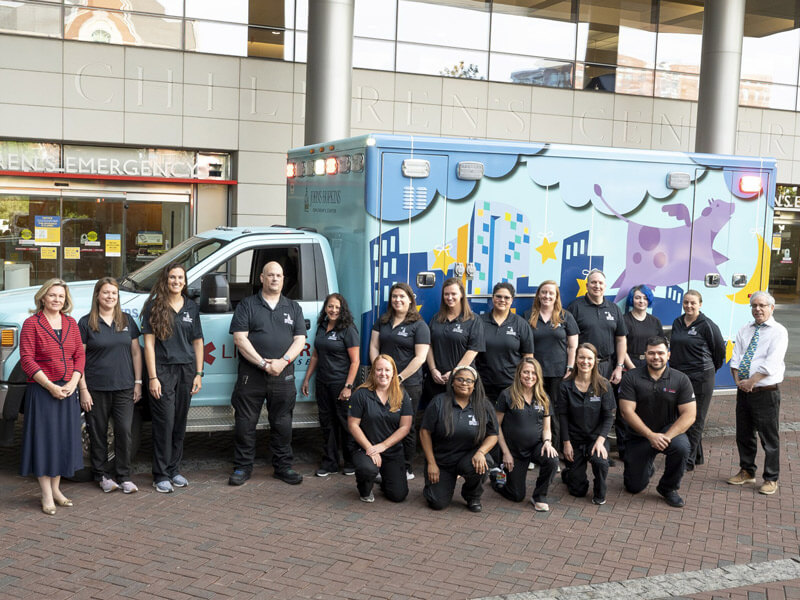
Members of the Johns Hopkins Pediatric Transport Program
Key Points
- A team led by Corina Noje, co-director of the Johns Hopkins Medicine Pediatric Transport Program, produced a consensus document outlining a new set of best practices that neonatal/pediatric transport teams should follow.
- The paper is based on recommendations from a 2022 national consensus conference of 75 neonatal and pediatric transport leaders.
- Johns Hopkins Children’s Center’s Pediatric Transport Program has built a standardized education curriculum, while sharing simulation-based training tools with transport teams across the country.
Leaders in neonatal and pediatric interfacility transport, including the Johns Hopkins Pediatric Transport Program, are paving the way for the future of transport medicine. For the first time in more than a decade, 14 authors — led by Corina Noje, co-director of the Johns Hopkins Medicine program, produced a consensus document outlining best practices that neonatal/pediatric transport teams should follow and recommendations on how they can move the field forward.
The paper, titled Consensus on Neonatal and Pediatric Interfacility Transport and published in Air Medical Journal, is based on recommendations that stemmed from a 2022 national consensus conference of neonatal and pediatric transport leaders. The audience included 75 professionals representing every level of transport care, including physicians, registered nurses, respiratory care practitioners and emergency medical services clinicians.
The consensus paper covered 10 main focus areas for neonatal and pediatric transport practice:
- Role of the medical director
- Training and education
- Team composition
- Accreditation
- Partnering with vendors and industry
- Benchmarking of neonatal and pediatric teams
- Quality improvement initiatives and research
- International transport
- Outreach and social media
- Diversity, equity and inclusion
“Neonatal/pediatric transport has evolved into a distinct discipline that reflects both the advancements and the broader challenges of modern healthcare,” says Noje. “As a small team usually caring for one critically ill patient at a time, we must deliver highly coordinated care in a resource-limited mobile environment. Success depends on seamless communication and collaboration across multiple disciplines.”
Since the last consensus paper in 2013, the field has vastly evolved with new technologies, processes, benchmarking improvements, partnerships and more. Many of these advances came from recommendations from the last paper. Similarly, the new paper looked at the future of the field and offers recommendations for the direction of neonatal/pediatric interfacility transport. Authors emphasized opportunities to develop transport-specific training and certifications, including a certification for medical directors, a national standardized education curriculum and materials to address logistics.
Experts in the field have already started to rally behind these recommendations.
Standardization and Benchmarking: Keys to Success
The growth of the Johns Hopkins Children’s Center Pediatric Transport Program mirrors the evolution described in the consensus paper. Over the past decade, the team has built a standardized education curriculum tailored to its own staff and mission, while also sharing simulation-based training tools with transport teams across the country. That collaborative approach to education, Noje notes, is part of a broader effort within the field to help shape what a national training standard could eventually look like.
Benchmarking is another area where the Children’s Center has leaned into the recommendations laid out in earlier consensus work. The team participates in the Ground Air Medical qUality Transport (GAMUT) Quality Improvement Collaborative, which pools clinical, operational and safety metrics from transport programs around the globe. Contributing to that shared pool of data allows the Children’s Center to track its own performance while also benchmarking against similar programs internationally — a practice the new consensus paper identifies as essential to demonstrating and reporting on quality of care.
“As medical transport professionals, we operate a mobile ICU staffed by a small team of highly trained specialists,” says Noje. “When this team is at work, every role must be perfectly coordinated — like a symphony delivering a flawless performance.”
The Johns Hopkins Children's Center pediatric transport team has also made a point of involving nursing colleagues and transport personnel directly in research and quality improvement projects, an area the consensus paper flags as historically underdeveloped in the field. Transport work is highly clinical, and staff rarely have protected time to pursue research on top of patient care. By helping nursing staff carve out that time and mentorship, the Children’s Center has seen team members publish their work and receive national recognition for it.
The team is also playing a leading role in a 28-site interstate transport study now underway, serving as the study’s primary site — the kind of multicenter, collaborative research network the consensus paper calls for as a priority for the field’s future.
“Our growth over the past decade has closely mirrored the trajectory described in this consensus statement,” Noje says. “Johns Hopkins Children’s Center is proud to help the neonatal/pediatric transport community shape the future of the field.”
Medically reviewed by Corina Noje, M.D.
For Clinicians Clinical Connection
Clinicians, discover the latest in research and clinical innovation from Johns Hopkins experts. Access educational videos, articles, CME courses and other resources from our world-renowned institution.