
From The Director: A Department at the Forefront of Gyn/Ob
Andrew Satin, director of the Department of Gynecology and Obstetrics, discusses his department’s top rankings in U.S. News & World Report and Newsweek.
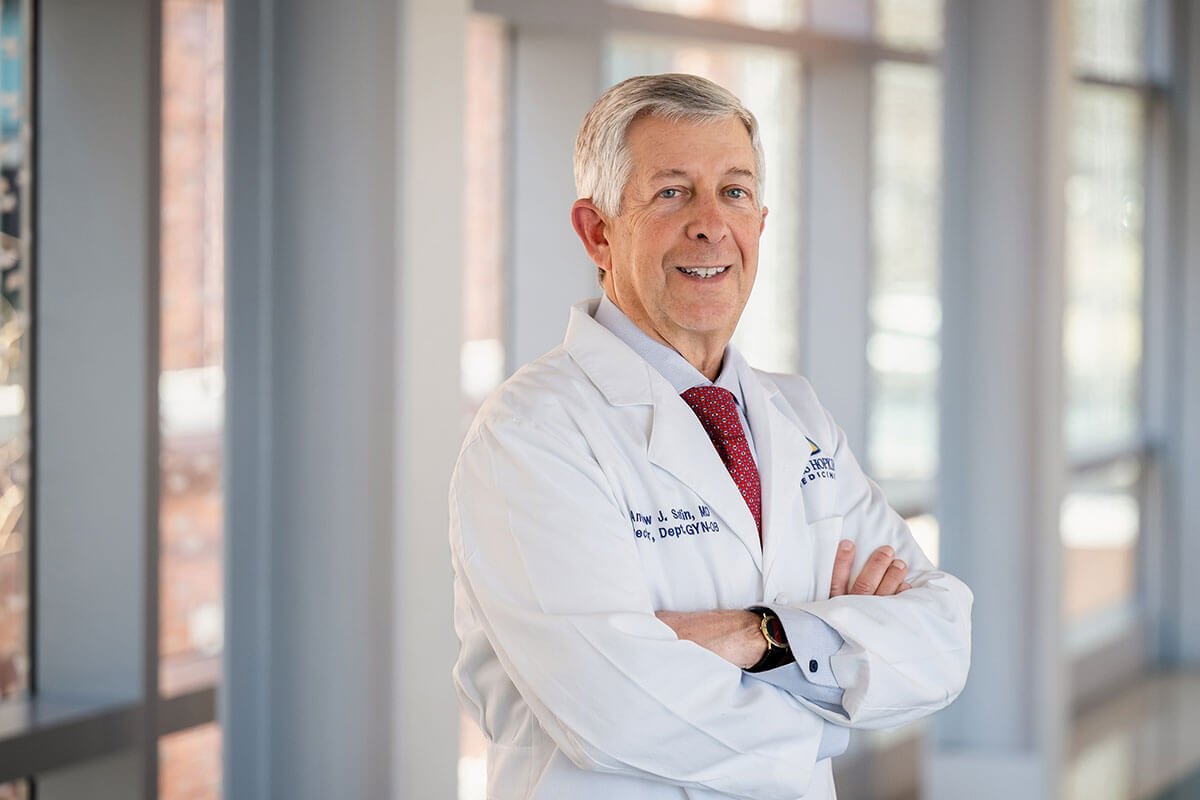
I am proud to share that our department earned two distinct honors recently: The Johns Hopkins Hospital is ranked #1 in the nation for Obstetrics & Gynecology, according to U.S. News & World Report’s 2026–27 Best Hospitals list, and #1 in the world by Newsweek in its World’s Best Specialized Hospitals 2026 rankings. It’s the first time a Gyn/Ob department has been #1 in both rankings. To reach these milestones was a true team effort, both within the Department of Gynecology and Obstetrics and across Johns Hopkins Medicine.
Our clinical outcomes are excellent, particularly when controlling for patient acuity and the very complex cases that are referred to us. Our teams of subspecialists in gynecologic oncology, minimally invasive gynecologic surgery, maternal-fetal medicine, genetics, fetal therapy and in utero surgery, reproductive endocrinology and infertility, urogynecology, and complex family planning help ensure that we can provide individualized care for all patients, from routine appointments to complex tertiary and quaternary care.
We perform the most challenging surgeries through multidisciplinary collaborations with our colleagues in highly subspecialized surgical fields, and we treat complex obstetric cases in collaboration with our colleagues in areas such as pediatric neurosurgery, cardiology and urology. What’s more, 90% of our surgeries, including cancer procedures, use minimally invasive techniques, which are associated with faster recovery and lower morbidity.
Our Fertility Center, with a team of infertility specialists, reproductive endocrinologists, clinical nurses and embryologists, offers comprehensive care for patients trying to start families, preserve their fertility, or manage complex conditions that affect fertility.
With the expansion of our Fertility Center into Baltimore County at Green Spring Station, we have more than quadrupled our in vitro fertilization procedures to nearly 1,000 a year. We also opened subspecialty clinics in Howard County, in the Greater Washington region at Sibley Memorial Hospital, and elsewhere, expanding our reach beyond downtown Baltimore.
We are fortunate to have a strong research portfolio across gynecology, obstetrics and our subspecialties. We’re one of the only institutions in the United States to have two Specialized Programs of Research Excellence (SPORE) grants from the National Cancer Institute, one for ovarian cancer and one for cervical cancer, for which we collaborate with other institutions.
Our researchers are doing important, innovative work. Rebecca Stone, director of the Kelly Gynecologic Oncology Service, was recently featured in the New York Times for her advocacy of opportunistic salpingectomy to prevent ovarian cancer. She and a number of her colleagues are a part of Break Through Cancer, a collaborative with top cancer research centers that focuses on the deadliest cancers, including ovarian cancer.
Ie-Ming Shih, director of the TeLinde Gynecologic Pathology Laboratory, is part of a team that helped determine that 80% of ovarian cancers originate in the fallopian tubes. Our researchers are also developing liquid biopsies for early detection of cancer, particularly gynecologic cancer.
Among our many NIH grantees, Ahize Eke, the director of research in our Division of Maternal-Fetal Medicine, has multiple NIH grants studying the pharmacodynamics of medications treating infectious diseases in pregnancy such as HIV and tuberculosis. Ernie Graham, professor of gynecology and obstetrics, is working with colleagues in biomedical engineering to research a novel way of monitoring oxygenation in fetuses, which could lead to a paradigm change in how we prevent hypoxic-ischemic encephalopathy and birth injury.
Education and advocacy remain central to our mission. Clinicians who graduate from our programs have gone on to lead departments and specialty and subspecialty divisions across the country. And it’s hard to find a professional organization in our discipline that hasn’t had a faculty member from our department in a leadership role in the past five to 10 years, including the American Board of Obstetrics and Gynecology, the Accreditation Council for Graduate Medical Education, the American Gynecological and Obstetrical Society, the American College of Obstetricians and Gynecologists, the American Association of Gynecologic Laparoscopy, the Society of Gynecologic Oncology, the Society for Maternal-Fetal Medicine, the American Society for Reproductive Medicine and the Society for Reproductive Investigation, among others.
Between our clinical outcomes — including our ability to treat the most complicated cases — our robust research programs and the strength of our training programs, I’m so proud of everything this department has accomplished. We are honored to have been recognized by our peers in this manner.
Andrew J. Satin, M.D.
Director
Johns Hopkins Department of Gynecology and Obstetrics
For Clinicians Clinical Connection
Clinicians, discover the latest in research and clinical innovation from Johns Hopkins experts. Access educational videos, articles, CME courses and other resources from our world-renowned institution.