
Johns Hopkins University School of Medicine Student Assists Athletes with Disabilities
Bronckers says the experience has made him a better medical student and community member.
In 2025, stroke survivor Melvin Wright ran the Shamrock 5K, with the assistance of Samuel Bronckers, a Johns Hopkins University School of Medicine student. Despite the cold and a cramp in one of Wright’s legs, the duo made it to the finish because of their training with Achilles International, a global organization operating in 18 countries that transforms the lives of people with disabilities through athletic programs and social connection.
“What made the moment especially meaningful was that all of the Achilles athletes and guides who participated were waiting and celebrated with us at the end. We debriefed together in the cold, but the atmosphere felt so warm,” says Bronckers, class of 2029. “That moment captured so much of what I love about Achilles: partnership, perseverance, trust and a community that celebrates effort, not just speed or placement.”
When Bronckers started at Johns Hopkins Medicine, he attended a Grand Rounds hosted by the Department of Physical Medicine and Rehabilitation. There, he met Stacy Suskauer, vice president of neurorehabilitation, who told him about Achilles.
“It felt like a natural continuation of the work I already cared about — exercise, neurological disability, rehabilitation and community,” says Bronckers.
Bronckers was a former national-level field hockey player in the Netherlands, where he learned how important exercise, activity and community can be for physical and mental well-being.
“My experiences with Achilles and in neurorehabilitation have made me especially interested in how exercise and physical activity can support outcomes for people with neurological disorders or after neurological surgery. In the future, I hope to contribute to that intersection of neurosurgery, rehabilitation and long-term functional recovery,” he says.
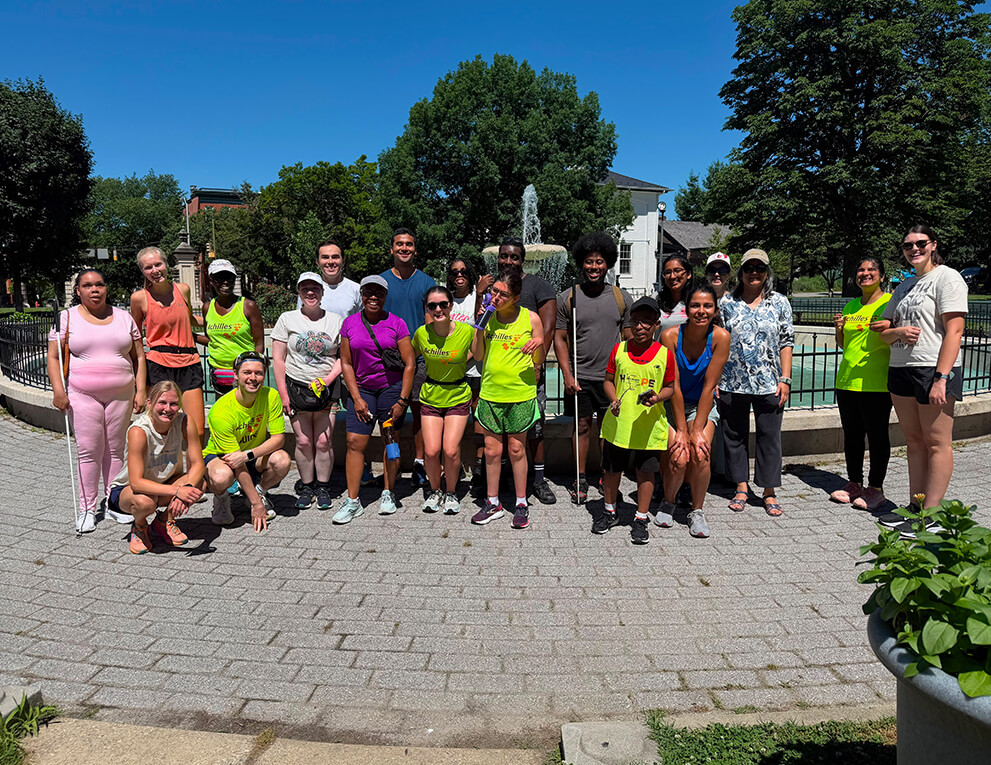
Every Saturday, Bronckers arrives a little early in case anyone is new or needs help getting to the meeting point at the fountain in Patterson Park. The athletes are paired with guides like Bronckers and work out for about 1½ hours.
“Some athletes walk, some run, and others use adaptive cycling. Throughout the workout, I try to be as helpful as possible to the athlete I am paired with,” says Bronckers. “I like to start each workout by asking, ‘How can I best help you today?’ or, if we have worked out together before, ‘Is there anything I can improve on from last time?’ I think creating that open environment, welcoming athletes, asking directly for their feedback, and centering their perspective is really important.”
Achilles International guides commonly assist with identifying upcoming obstacles such as potholes, uneven pavement, curbs, cyclists or other people in the park. They also serve as positive companions and support the athlete’s effort over performance.
“It is also a place where athletes can build community with guides and with other athletes who may understand some of the challenges they are experiencing,” says Bronckers.
The disabilities represented in the group vary widely. Some athletes are blind or visually impaired, some are stroke survivors, and others have experienced traumatic brain injury, spinal cord injury, or other neurological or physical conditions.
The guides are also a diverse group. Many are medical students, undergraduate students from Johns Hopkins and other Baltimore colleges, and friends or family members of athletes.
“Over my time with Achilles, I have been very fortunate to learn from these incredible people about how neurological disorders and disabilities affect them in unique ways, either directly as athletes or indirectly as caregivers,” he says. “Those conversations have given me insight into daily life with disability, the challenges of access and transportation, the importance of independence, and the emotional impact of being part of a supportive community. This has also influenced how I think about medicine. It has reminded me that patients are the experts in their own lived experiences. As a future physician, I want to bring that same genuine curiosity, humility and respect into clinical care.”
Athlete Melvin Wright says that during the Shamrock 5K, Bronckers continually checked on him to make sure everything was OK.
“He kept me safe,” says Wright, of Baltimore City. “He made sure I didn’t get knocked down and that I was drinking water. He checked on my breathing. It’s easy just to walk with somebody, but you have to pay attention and be aware of what’s going on with your athlete as a guide when you’re in a race.”
Wright had a stroke on April 6, 2024. When he went to a doctor’s visit, the doctor saw on his chart that he was a runner and asked Wright if he wanted to get into moving again. The doctor invited Wright to one of the Achilles International Saturday sessions, and he’s been going ever since.
“Sam is an awesome guide,” Wright says. “He’s a gentleman. He’s smart and bright and has a good sense of humor. He’s particularly good at listening to the athletes.”
Athlete Jackie King, who has low vision, says she observed Bronckers assisting another blind athlete.
“We were at a 5K, and she was a little bit nervous,” says King, also of Baltimore City. “I saw the care he had for her. He allowed her to take the lead, but he was very present for her and made sure she wasn’t overwhelmed.”
King has been a runner for 20 years. She says she started to lose sight gradually and could not continue to run safely by herself. In April 2024, she became a founding member of the Achilles Baltimore chapter. She ran the New York City Marathon using two guides. Now, she is training for the original marathon in Athens, Greece, on Nov. 8.
“I wouldn’t be out there without the guides. I don’t take it for granted,” she says.
King says the thing that makes Bronckers the best guide is that he’s very easy to talk to.
“He’s so accommodating,” King says. “Every week he asks what’s your goal for the day. He lets the athletes lead the workout. It’s a partnership, a symbiotic relationship."
Emmeline Leggett is also a guide with Achilles International. She is a fourth-year student at the University of Maryland School of Medicine. She served as a guide for King in the New York City Marathon.
Leggett says Bronckers is a great addition to the Achilles team.
“Sam is very kind to everyone, and he was immediately ready to take on responsibility,” she says. “His calm, welcoming tone made him trustworthy from the start. I appreciate how every weekend he shows up ready to work with whomever he can.”
Bronckers says the experience has made him a better medical student and community member.
“Achilles has taught me to listen more carefully, to ask how I can be helpful rather than assuming, and to appreciate the lived experience of disability in a deeper way,” he says.
Learn more about Achilles International