
Johns Hopkins Medicine Forms Nation’s Only Female Leadership Pair in Pediatric Cardiology and Congenital Heart Surgery
As co-directors of the Blalock-Taussig-Thomas Pediatric and Congenital Heart Center, Aimee Armstrong and Stephanie Fuller are building on a legacy of innovation.
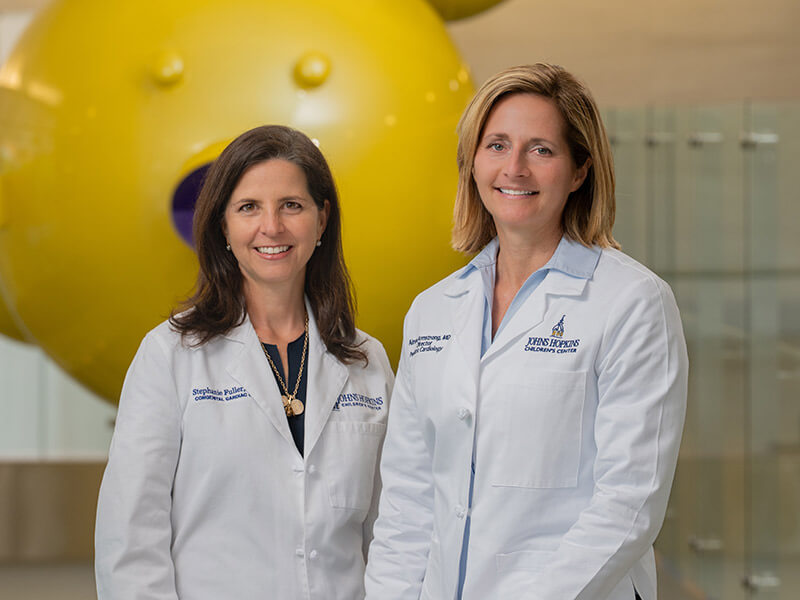
Drs. Fuller (left) and Armstrong are the only female pairing in the United States of pediatric cardiology and congenital heart surgery leadership.
In June, Aimee Armstrong, M.D., became division director of cardiology for Johns Hopkins Children’s Center, director of congenital interventional cardiology in the Department of Pediatrics and co-director of the Blalock-Taussig-Thomas Pediatric and Congenital Heart Center.
Also new to Johns Hopkins Children’s Center is Stephanie Fuller, M.D., who joined in December 2025 as chief of pediatric and congenital cardiac surgery and co-director of the Blalock-Taussig-Thomas Pediatric Heart Center.
Armstrong and Fuller co-direct the Heart Center alongside Dheeraj Goswami, M.D., chief of pediatric cardiac critical care and anesthesia. Together, they lead one of the nation's premier pediatric and congenital heart programs. Armstrong and Fuller also represent the only female pairing in the United States of a director of pediatric cardiology and a chief of pediatric and congenital cardiac surgery.
Building on a Strong Foundation
Armstrong and Fuller are articulating bold goals for the Heart Center, building on its history as a clinical and research leader dating back to the pioneering work of cardiologist Helen Taussig, who created the field of pediatric cardiology in 1944 when she worked with Johns Hopkins Hospital chief surgeon Alfred Blalock and surgical assistant Vivien Thomas to palliate patients with tetralogy of Fallot, known as blue babies.
“We want to be the best congenital heart center in the world,” says Armstrong. “We want to be the most innovative, to deliver the highest quality care, and to show our patients and families how much we care about them and their experience here.”
Armstrong earned her medical degree from Northwestern University Medical School, followed by a pediatrics residency at Riley Hospital for Children at Indiana University Health and fellowships in pediatric cardiology and pediatric interventional cardiac catheterization at University of Michigan’s C.S. Mott Children’s Hospital. After 11 years on faculty at the University of Michigan as an interventional cardiologist, she most recently worked 11 years as the director of cardiac catheterization and interventional therapies at Nationwide Children’s Hospital in Columbus, Ohio.
Fuller earned her medical degree from Eastern Virginia Medical School, followed by a general surgery residency at Albert Einstein Medical Center, cardiothoracic surgery residency at Thomas Jefferson University Hospital, and a fellowship in congenital cardiothoracic surgery at Children’s Hospital of Philadelphia (CHOP). Before joining Johns Hopkins Medicine, she practiced at CHOP and the University of Pennsylvania for 18 years as the Thomas L. Spray Endowed Chair of Pediatric Cardiac Surgery and the director of adult congenital cardiac surgery.
Better Care, Now and in the Future
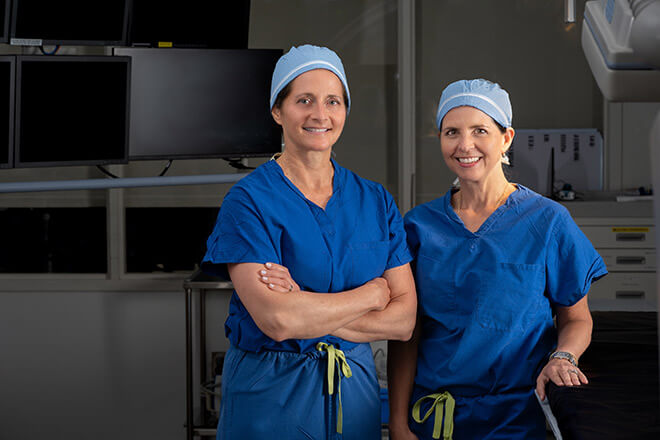 Drs. Armstrong (left) and Fuller.
Armstrong and Fuller both say they chose Johns Hopkins Medicine for the opportunity to care for patients over their lifespan.
“It’s a really extraordinary place that can take care of all age groups, from fetus to geriatrics, all under one roof,” says Armstrong.
The result is better care, now and in the future, says Fuller, who studies longitudinal outcomes of cardiac surgeries. “Following patients throughout their life helps us better understand which interventions allow us to improve survival and enhance quality of life,” she says. “That includes the neurocognitive outcomes of heart disease,” she notes.
After she was hired, one of Fuller’s first assignments was working with Department of Pediatrics Director Brenda Banwell, M.D., to recruit Armstrong.
“If I could have picked anybody in the world, it would have been Dr. Armstrong,” says Fuller. “She brings with her an amazing clinical experience along with an incredible research background. She’s an innovator. She is always seeking alternative pathways for our patients. I think a lot of her ideas are going to contribute to the future of cardiology for decades to come.”
Both physicians take a keen interest in novel devices and innovative procedures, such as implantable heart valves that can grow with patients and catheterization guided by MRI instead of radiation. Armstrong is leading efforts to make pediatric heart procedures more effective and less invasive.
“What I didn’t know when I started interviewing here is how much Hopkins has done in the interventional MRI space, which is where much of my research is focused,” Armstrong says. “I also have a particular interest in fetal cardiac intervention, and Hopkins has a world-renowned center for fetal therapy.”
More than 80 years after Helen Taussig founded the field of pediatric cardiology at The Johns Hopkins Hospital, the institution is now home to the nation’s only female director of pediatric cardiology and chief of pediatric and congenital cardiac surgery leadership pair. Together, they bring talent, sensitivity, drive and passion to transform the future of Johns Hopkins Medicine while preserving its legacy.
For Clinicians Clinical Connection
Clinicians, discover the latest in research and clinical innovation from Johns Hopkins experts. Access educational videos, articles, CME courses and other resources from our world-renowned institution.