
Neurosurgery Pain Research Institute Is a Hub for Specialized Studies
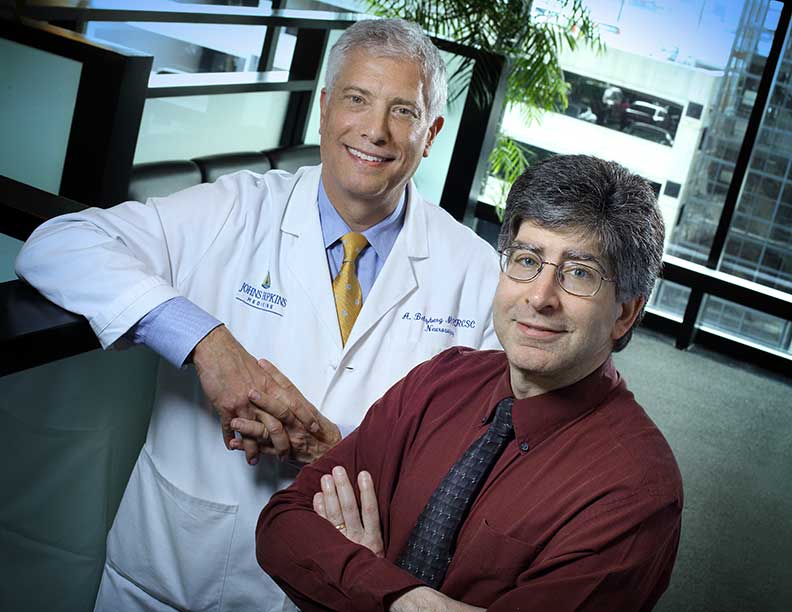
Allan Belzberg, left, and Michael Caterina, co-directors of the Johns Hopkins Neurosurgery Pain Research Institute
Key Points
- The Neurosurgery Pain Research Institute (NPRI) fosters individual and collaborative research into the mechanisms underlying pain.
- Co-directors Michael Caterina and Allan Belzberg research rare diseases, nerve injury and other neurological pain conditions.
- Researchers hope that by studying specific pain conditions they will uncover broader insights into how pain works and how to treat it.
At the Johns Hopkins Neurosurgery Pain Research Institute (NPRI), a multidisciplinary team of clinicians and researchers is looking into the underlying physiological mechanisms behind pain, specifically neurological diseases that trigger pain and pain as a result of neurosurgical procedures.
“How can we approach the problem of clinically relevant pain in ways that haven’t been fully explored by the field?” asks basic scientist and the Solomon H. Snyder Professor of Neurosurgery Michael Caterina, who co-directs the NPRI alongside neurosurgeon Allan Belzberg. “Where are the gaps, and where might there be some latent opportunity?”
Established in 2013, the NPRI supports individual investigators and fosters collaborative research both within the Department of Neurosurgery and across Johns Hopkins, facilitating more than 250 publications. Fifteen faculty members with primary or secondary appointments in neurosurgery perform research under the NPRI, and collaborations extend to at least 10 different departments and other neurosurgery labs.
The co-directors’ own research includes study of rare diseases, neuropathic pain associated with traumatic nerve injury and schwannomatosis, as well as nerve regeneration and neuromodulation. The hope is to better understand these specific, hard-to-treat conditions in order to develop better therapies, as well as to discover more insights about pain overall.
At the NPRI, Caterina’s lab is researching:
- Palmoplantar keratodermas, or PPKS. This group of rare hereditary diseases involves thickening of the skin in the hands or feet. Pain is a prominent symptom of some PPKs, of which there are estimated to be about 25–50 variations, with each PPK affecting only about 25 to 1,000 people worldwide. Caterina uses mouse models to find which changes in neuron gene expression contribute to augmented pain sensitivity. “That might yield insights that are relevant, not only for individuals suffering from these diseases, but it might be telling us something more broadly about pain mechanisms,” he says.
- Peripheral nerve injury. Neuropathic pain can be induced by traumatic nerve injury that results in changes to the spared neurons. The research is looking into how those spared neurons change functionally and at a molecular level in response to their damaged neighboring neurons. The spared neurons might also contribute to painful abnormal hypersensitivity in the skin and muscles as they try to re-innervate the skin and other tissues, a process known as collateral sprouting. In partnership with neuroscientist Sang-Min Jeon, research aims to understand the mechanisms that drive collateral sprouting and its impact on exaggerated pain sensitivity. Additionally, Caterina is working with neuroscientist Mollie Meffert to understand the role micro RNAs play in the behavior of both injured and spared neurons.
- Genetically Based Pain Therapies. A collaboration with cell biologist Stephen Gould, this research involves harnessing genetically based tools and synthetic biology to try to diminish the abnormal sensitivity to pain that happens after injury or inflammation as a new approach to treating pain.
Belzberg focuses his research on neuropathic pain, particularly in the peripheral nerve system. His ongoing research includes:
- Schwannomatosis. This genetic condition is a rare form of neurofibromatosis that causes nerve sheath tumors called schwannomas, which can lead to debilitating pain. “It’s unclear why even tiny little tumors will cause so much pain in these patients,” Belzberg says. When he removes one of these tumors from a patient during surgery, his basic science collaborators culture them. One of their early findings shows that the supernatant can be applied to another nerve and cause pain. They’ve been studying the factors that contribute to this and how to minimize them.
- Nerve regeneration and imaging. As a neurosurgeon specializing in the peripheral nerve system and surgical repair of nerve damage, Belzberg is often faced with a tough decision in the operating room. If a nerve is regenerating, he should leave it alone, but if a nerve is “stuck” and formed a neuroma, he should cut the bad part of the nerve out and splice it with a functioning nerve. The problem is, there isn’t a surefire way to know the state of a damaged nerve during an operation, so Belzberg is leading a multidisciplinary study with basic scientist Matthias Ringkamp using various modalities to assess the regeneration process and try to better understand pain associated with neuromas.
- Working with the intraoperative monitoring and neurology teams, Belzberg uses electrodes during procedures to see if there is evidence of regeneration. His research has helped optimize these electrophysiological recordings.
- Using optical coherence tomography, Belzberg works with biomedical engineer Xingde Li to image removed nerves. Belzberg and his team perform histology to confirm Li’s findings. The team similarly works with colleagues at Kennedy Krieger Institute using high-resolution MRI, and also uses high-resolution ultrasound to image nerves.
- Working with Amir Manbachi in biomedical engineering, Belzberg is using highly focused, high-powered ultrasound to study mechanical sensitivity in nerves. This novel method prevents an issue that comes up when using electricity to get nerves to fire, which is that the process itself causes an artifact, interfering with researchers’ ability to capture electrophysiology recordings.
- Neuromodulation. There is a great variety of modulation tools and procedures, many of which help patients. The problem? Neurosurgeons aren’t entirely sure how and why many of them work. Belzberg and his collaborators, including Yun Guan and Claudia Campbell, look at the biological mechanisms of neuromodulation and where responses happen in the body that create positive results for patients. Part of this research is looking at scrambler therapy, which involves electrical stimulation through the skin via electrodes placed above and below areas where chronic pain is felt. “If we could better understand the science underlying scrambler therapy and other forms of neuromodulation, maybe we can tweak them to make them work even better,” he says.
- Dorsal root entry zone (DREZ) lesioning. Belzberg is one of the few neurosurgeons in the world who performs DREZ lesioning, a delicate, high-risk, high-reward operation performed under microscopy that involves removing part of the spinal cord. Some patients with spinal cord trauma or brachial plexus injury, which can involve nerves being torn from the spinal cord, most often from high-speed injuries, have avulsion pain, some of the most severe pain doctors see. Belzberg says patients describe it as not of this world. “One classic description is a crushing, burning sensation,” he says. “If it’s in the hand, patients say it feels like a moving van parked on their hand, then someone lit the van on fire.” DREZ lesioning can alleviate this pain, and Belzberg has worked to refine the procedure and change certain parameters, making it more accurate, safe and consistent.
Caterina and Belzberg’s research is just a small sample of what’s happening at the NPRI and around Johns Hopkins to better understand and treat pain.
“There is a critical mass of investigators across Johns Hopkins trying to pick these physiological mechanisms apart and see if any might be exploited for use as target for alternative pain therapies,” Caterina says.
For Clinicians Clinical Connection
Clinicians, discover the latest in research and clinical innovation from Johns Hopkins experts. Access educational videos, articles, CME courses and other resources from our world-renowned institution.