A Crash Course In E-bike Helmets
Faster Ride. Bigger Risk.
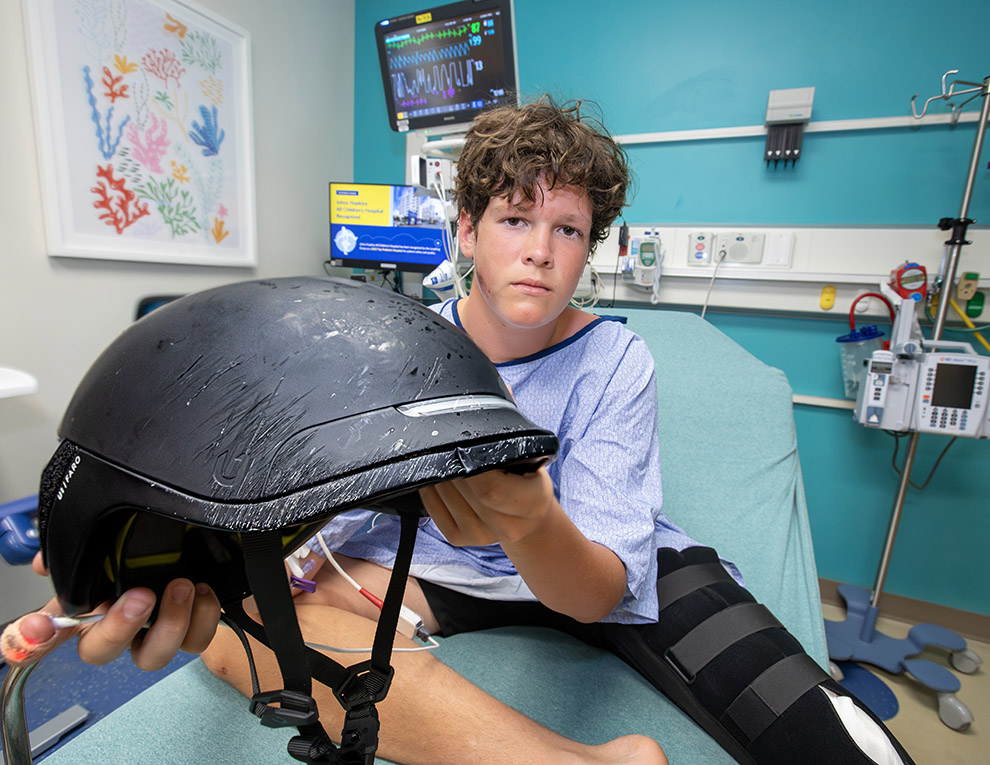
Returning to get his heftier helmet, Eli made the smartest decision of his life. Minutes later, the wise 15-year-old’s e-bike lay mangled after a crash with a car. He remembers flying through the air and waking up telling a good Samaritan to call his dad while another was calling 911. “Don’t move him,” he recalls someone shouting. “Our best helmets were in my dad's room and he was asleep, so I first took a lesser one but came back and swapped it for the really good helmet.”
Gaining popularity around 2018 to 2020, electric bikes, or e-bikes, speed and improved lithium-ion batteries have rocketed high on teens’ wish lists.
Fortunately, Eli’s e-bike collision only disrupted a family’s Florida vacation without becoming a tragedy. The U.S. Consumer Product Safety Commission (CPSC) reports an estimated 155,200 emergency department-treated injuries and 310 fatalities associated with e-bikes from 2017 through 2024. Not including minor injuries involving battery-powered bikes, Johns Hopkins All Children’s Hospital in St. Petersburg, Florida, has had 84 trauma calls involving e-bikes in the past eight months alone, reports Tiffany Dugan, the hospital’s trauma program manager.
Years spent on road and mountain bicycles taught Eli’s dad, Shawn Scheinoha, what every e-bike buying parent needs to know — helmets are essential and rated for impact speed. Like the bikes themselves, e-bike helmets are different from traditional bike helmets.
“I always knew what good (road bike) helmets were. Weeks before this trip to Florida I was like, well, we've got e-bikes now. This is a whole different game,” he recalls. After a little sticker shock for the top-rated models, which include crash detection and Bluetooth® text notification, “I remember thinking this is a lot of money. But I was thinking about Eli, you know, because you think you're never getting in an accident, right? I got to have them. Praise God, he gave me that wisdom.” Proud of the lessons his son heeded, Scheinoha later wrote the manufacturer thanking them for building a product he attributes to Eli leaving the Emergency Department with only a bruised knee and scruffy helmet.
100 Years of Childhood Independence
Bicycles have been essential apparatus in the minds of kids for more than a century. And despite a young rider’s best vroom vroom, brrrrr-brrrrr, and nyyyy-om sounds imaginable, their speed didn’t exceed their young legs’ ability to pedal for 100 years — about 8-10 mph.
E-bikes alone were involved in an estimated 155,200 emergency department visits from 2017 through 2024, according to the U.S. Consumer Product Safety Commission (CPSC). The reason is weight and speed.
Kinetic Energy = ½mv²
Doubling the speed of a bicycle from 10 mph to 20 mph multiplies a crash’s destructive energy by four times, not two. Emergency medicine physicians and neurosurgeons visualization of this acceleration of force is far more sobering than what kinetic energy mathematicians draw on a whiteboard using symbols for mass, speed and velocity.
Physicians, safety experts and bike shop managers alike want parents to know the importance of a helmet’s design and fit before any bike’s first ride. Standard bicycle helmets (CPSC / CE EN1078), using a U.S. standard, are tested for impact speeds up to 14 to 15 mph. E-bike helmets (NTA 8776) are tested for speeds up to 28 mph, using a Dutch standard for higher-speed e-bike riding.
“Helmets are designed to absorb force and not transfer that force forward to a child's head. If a helmet is only rated for a bicycle, it's not made to sustain an injury to a head coming at them from 20 miles an hour or more,” says Meghan Martin, M.D., an emergency medicine physician at Johns Hopkins All Children’s Hospital where she routinely treats kids in crashes. “Skin and bones can heal, but when it comes to injuries to the brain, it's much more difficult to have complete healing back to where you were before,” she warns parents. The problem is becoming so common, she even witnessed an e-bike crash driving to work.
Brain injuries on e-bikes can be severe. “Surgeries can be as simple as fixing a skull fracture to line up the bones better, or as involved as a decompressive hemicraniectomy or removing half of a child’s skull to relieve pressure and allow the brain to swell out because of all the extent of injury to it. We then wait for all the swelling to go down before doing another surgery to put the bone back,” says neurosurgeon S. Hassan Akbari, M.D., M.S.C.I., director of Clinical Research in the Division of Pediatric Neurosurgery in the hospital’s Hough Family Institute for Brain Protection Sciences. “The outcomes vary from kids who are really lucky and go home relatively unscathed, to those needing significant rehabilitation to learn how to walk again. Or worse, who don’t survive.”
“Conversations with parents are difficult enough, they are especially hard when you know the injuries could have been prevented or minimized by a helmet. To see first-hand with your own eyes the carnage or devastation, it sticks with you. As these accidents happen more and more, it’s really hard knowing they could have benefited from helmets that in the grand scheme of things are relatively cheap and super effective,” says Akbari.
Design and Fit
Petra Vybiralova Stanton, Injury Prevention program manager and the hospital’s lead for Safe Kids Florida Suncoast, a coalition of community partners that work together to decrease unintentional injuries in children, tells parents, “Be sure to choose the right product for your child and ride with them to help them gain skills. Many parents may not realize that there are different ratings for helmets. When riding on a pedal bike, the helmet can fit the CPSC standards. When it comes to e-bikes and e-scooters that move at higher speed, families should look for a helmet that meets the Dutch Standard NTA 8776. The helmets that meet this standard might be more costly, but worth the price when it comes to protecting a child. Going to a local bike shop as opposed to buying online can be helpful because the staff can help fit the helmet properly and guide you,” she advises parents.
Anne Fidanzato, manager at ABC Bicycles on Fourth Street, who is also a volunteer on the Bicycle Pedestrian Advisory Committee for the City of St. Petersburg, says, “As a mom and a bike store owner, I always encourage people to do research. You have to feel comfortable with the purchase you make. The CPSC has not indicated that they will take up the NTA 8776 as a standard in the U.S. If it was my child on a fast-moving e-bike, I would want the safest helmet possible. The NTA 8776 standard is not well known enough for parents. Currently, the CPSC is the standard in the United States for helmets. NTA 8776 standards were adopted in the Netherlands, and the U.S. has not formally recognized this standard or adopted it. A few companies have started making helmets in the U.S. that meet the NTA 8776 standard.” She adds, “The National Bicycle Dealers Association (NBDA) has a formal comment on their website about the new standards acknowledging that the old CPSC standards are outdated.”
Freedom Before Drivers Licenses and the Effectiveness of Incentives
“E-bikes give you so much freedom before being able to drive,” says Eli. Stanton agrees, teenage independence before the ability to drive a car is greatly responsible for e-bikes’ popularity and reason the increased injury rate warrants better prevention measures.
“Kids are still developing that frontal lobe. They are going to make impulsive decisions,” says Martin, the emergency medicine physician. “A lot of the head injuries that we see in kids who are riding e-bikes, and even regular bicycles, are preventable. It is really important to be the parent and set strong boundaries around safety.” Citing a reduction in golf cart injuries after tougher legislation, Martin adds, “Our approach to safety when it comes to e-bikes and e-scooters needs to be multipronged, multifaceted. It is important to have legislation restrictions in place. And if it doesn't happen on a state level, it should happen on a county or regional level. Have more schools get involved. They need to be wearing a helmet or lose school privileges to ride.”
Scheinoha agrees, “Buy the absolute best helmet you can afford and incentivize your kids to wear it, and that may mean disincentivize them as well.”
Free from the brace on his knee and with a shiny new helmet without road scars, Eli is back on his e-bike with sound advice for fellow teens. “I thought they (helmets) looked kind of corny, but I always knew it's worth the uncoolness if you get hit by a car. It's like, if you ever get hit, you want to be ready to get hit.”
E-Bike Safety Information for Families
Children who ride bicycles without a helmet have a 1,400% increase of fatality
Local bike shops and regional safety coalitions can help fit children’s sizes.
Virginia Tech researchers provide an unbiased helmet ratings database for consumers.
E-bike types:
- Class 1: Top speeds of 20 mph using pedal-assist
- Class 2: Top speeds of 20 mph using a handlebar throttle
- Class 3: Top speeds of 28 mph
More information: