
How Art Can Make a Better Clinician
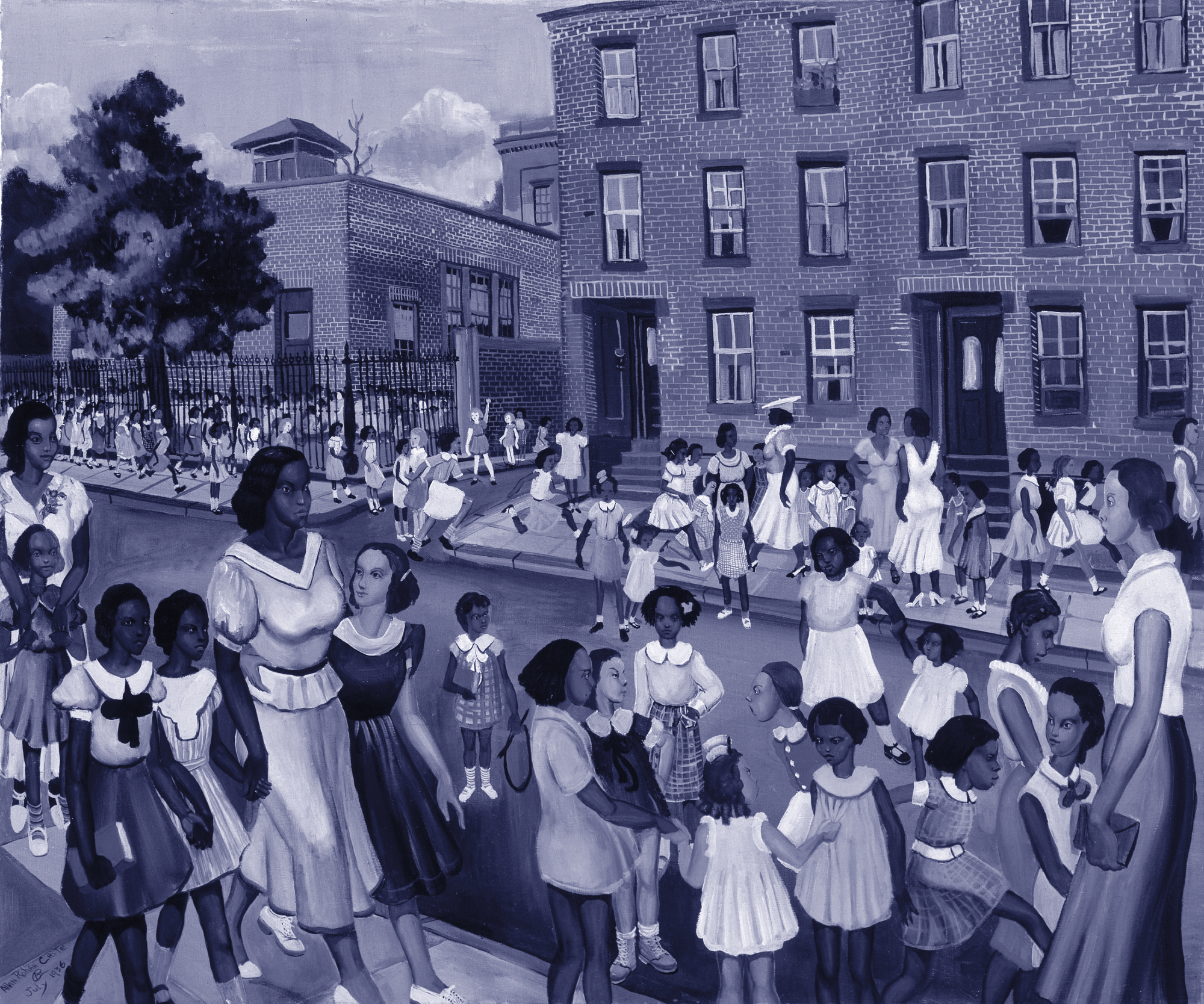
School’s Out by Allen Rohan Crite is an image used in the VTS curriculum.
As a clinician who makes house calls, Assistant Professor Mariah Robertson spends a lot of time in her patients’ homes. Early on, she realized that seeing individuals in their own environments requires different skills than seeing them in an exam room. “The home is an incredibly rich sensory and emotional experience for doctors,” says Robertson, “and especially when I was doing this as a new faculty member, [I saw] that learners have a robust emotional experience to home visits.” The human tendency to bring unconscious biases to interactions with others becomes more important to unpack when you’re going into the living space of someone who needs your care. “You start to realize,” Robertson says, “that you just don’t have a clue about what people are going through. My lens as someone who came from my perspective and my lived experience is a very narrow one.”
 Mariah Robertson
Seeing her students face the same challenges she did led her to seek out a new way of teaching them. As Robertson does often in her life, she turned to art for inspiration and found arts and humanities frameworks that she thought could help. That’s how she ended up a practitioner of Visual Thinking Strategies (VTS), an evidence-based tool for using the same skills a person can apply to looking at a painting or reading a book and turning them to medical work.
Created in the 1990s by Philip Yenawine, then art educator of New York City’s Museum of Modern Art, and Abigail Housen, a cognitive psychologist, VTS was initially for museumgoers. As an educator, Robertson knew she could use it to help her learners expand their sense of their patients and those patients’ communities. With VTS, Robertson centers on curiosity, empathy and a tolerance for ambiguity, stressing the fact that she isn’t interested in giving an art history lesson or interpreting an artist’s intentions when she and her students look at a piece together. “It’s about using art to help us connect with one another around our own reflections and interpretations,” she says.
Imagining the Possibilities
Robertson spent a year building the curriculum, attending training to become a certified VTS facilitator and coach, and completing a museum fellowship at Harvard University thanks to division and federal funding. The 2025 fellowship class was the first for which she formally studied how using VTS affected her learners. She says, “It was important that we not just ask fellows what they thought and felt, but also that we examine the way they wrote about and reflected on the patients they saw. What we found was that from the beginning to the end of the year, they had much more curiosity, much more ability to appreciate nuance and hold multiple possibilities about what might be going on for a patient. In the beginning of the year, they might write conclusive statements like, ‘This is a messy house,’ ‘This is X, Y, Z,’ not providing supportive evidence but also not holding possibilities that there could be other things at play. But by the end of the year, they were able to be less conclusive in their statements. The fellows were able to bring questions that they didn’t know the answers to, and that changed the way they clinically cared for their patients.”
While including arts and humanities curricula in medical training is growing more popular, it’s not usually a longitudinal practice, nor is it required. Robertson hopes that will change and appreciates the relative ease of building such a curriculum at Johns Hopkins, which has some leaders in this space, such as Meg Chisholm and Kamna Balhara. “People here knew and respected this work in a way that allowed me to get creative,” she says.
“It’s about using art to help us connect with one another around our own reflections and interpretations.”
— Mariah Robertson
From the Museum to the Home
Robertson conducts this teaching in two places: in the art museum and classroom, which function together as a campus even though the locations change, and in the patients’ homes, which represent the individual patient and also their community. As she continues teaching with VTS, she’d like to measure the patient’s experience with their health care team when that team has been VTS trained, as well as the team’s experiences. Each person having a better idea of others’ stories has the potential to make the patient’s care transformative rather than rote.
“We know that in medicine, some of what we do is pattern recognition,” she says. “That’s an important skill set. But [you should] always hold the possibility that you might not know exactly what’s going on. There’s really good evidence that VTS is useful in diagnostic reasoning, like, ‘How can I be more curious to make sure I’m not missing anything?’” Having this kind of skill set is a crucial part of treating people in their homes, and of being a geriatrician in general.