
From Survival to ‘Thrival’: Meet Tiny Baby Cash
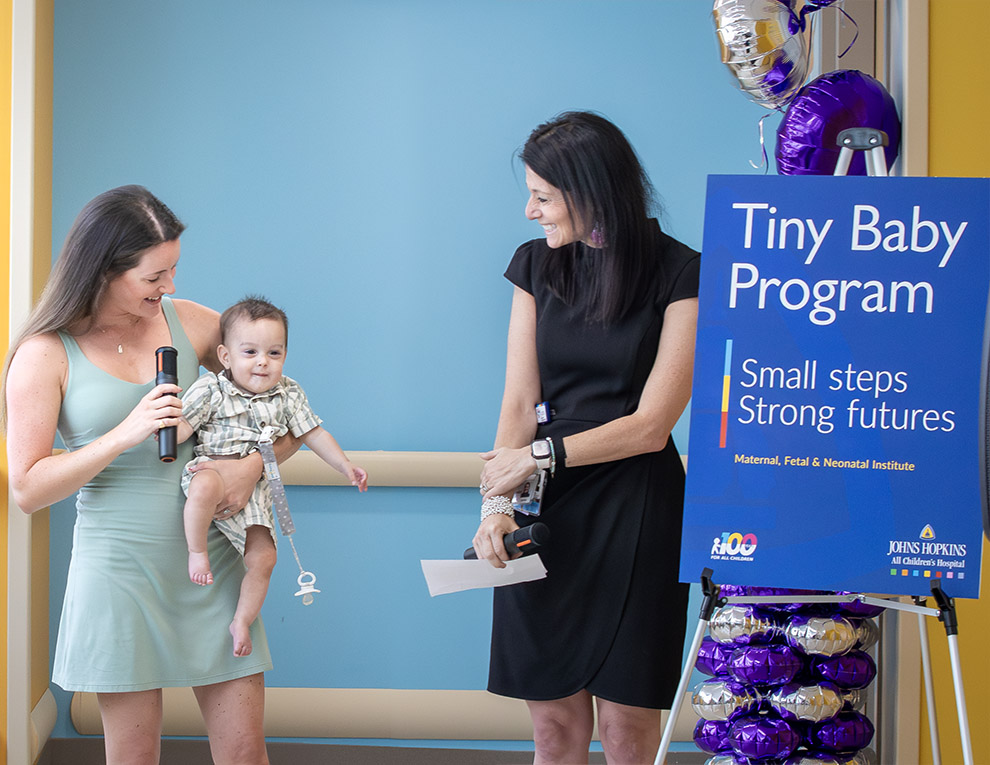
Kelsi was a healthy first-time mom-to-be and having what she describes a perfect pregnancy. Until week 24 came — and everything quickly changed.
Kelsi was at work when she began noticing subtle, but concerning symptoms — light cramping, low energy, spotting that increased and a feeling of pelvic pressure that didn’t feel quite right. Even with rest and hydration, she knew something wasn’t right.
“I work in anesthesia, and I was in the operating room. My cervix just basically gave out,” Kelsi explains. “I was 4 centimeters dilated and 70% effaced. It was just kind of surreal.”
Within hours, she was transferred to Orlando Health Bayfront Hospital Center for Women and Babies, and evaluated by the Johns Hopkins All Children’s Hospital Maternal-Fetal Medicine (MFM) team and closely monitored by gynecologist-obstetrician Tess Chase, M.D.
“She basically told me, ‘I estimate within the next five days that you’ll deliver.’ They told me what to expect from head to toe. It was very reassuring,” Kelsi recalls. “They were very calm and confident in their skills and resources there, it was just like a regular conversation.”
Baby Cash stayed in utero for four more days — then decided it was his birthday, so Kelsi delivered her baby boy 16 weeks (almost four months) prematurely.
“It was Dr. Chase that delivered because she was on service at that time, so she was fantastic,” Kelsi says. “They kept me updated throughout the delivery process — and I was able to touch him before going up to the NICU — it was a very positive experience.”
Cash was born weighing just 1 pound, 12 ounces. His early days were not easy — needing breathing support and IV nutrition in the neonatal intensive care unit (NICU) at Johns Hopkins All Children’s Hospital in St. Petersburg, Florida. He also had challenges with a brain bleed, his eyes and feeding aversion.
Cash kept making progress. His stay in the NICU was 129 days. He was released right before Thanksgiving last year — weighing a whopping 10 pounds.
Johns Hopkins All Children’s Hospital Understands Tiny Babies
Inside the NICU is a special area called Tiny Baby Avenue, serving as the home of the newly launched Tiny Baby Program, which focuses on babies like Cash born between 22 weeks 0 days and 25 weeks 6 days, at Johns Hopkins All Children’s, which was recognized and celebrated on June 2, 2026. Kelsi graciously and gratefully shared their family’s journey and experience at the ribbon cutting.
“There has been a national and international movement toward more specialized care for our tiniest and most vulnerable patients,” says Mara DiBartolomeo, D.O., a neonatologist at Johns Hopkins All Children’s Hospital. “The recognition is that babies like Cash aren’t simply smaller versions of older infants. They have unique physiology and unique needs, and providing the best care means understanding those differences, respecting them, and continually learning from them.”
The program means the NICU is part of the Tiny Baby Collaborative, which is an international research group comprised of clinicians and researchers dedicated to tiny babies.
“The Collaborative reflects a shared commitment to continually improving care for our tiniest patients,” DiBartolomeo says. “We all share the same goal of improving care for these tiny babies. By learning from one another’s successes, challenges and experiences, we can continually refine our practices and provide better care for every infant.”
The Tiny Baby Program also emphasizes neurodevelopmental care from the very beginning. Physical, occupational, developmental and speech therapists are integral members of the team and partner with families throughout their NICU journey.
“Our neurodevelopmental team incorporates multiple experts,” DiBartolomeo says. “We recognize that these early experiences truly matter. From careful positioning to skin-to-skin time, we work to empower parents to participate in their baby’s care — through touch, comfort and bonding. Being supportive and purposeful supports their baby’s long-term development.”
For families, that means more than just advanced medical care — it means being supported through one of the most frightening experiences of their lives.
“Having a baby born this early is incredibly scary, stressful and overwhelming,” DiBartolomeo explains. “An important part of our job is to help families understand what to expect, answer their questions honestly and remind them that they aren’t facing this journey alone. We’re on the roller coaster with them every step of the way.”
Kelsi recalls that support.
“They were fantastic,” Kelsi says. “They made sure I knew what was happening, what the risks were, and what the plan was. It was reassuring because I felt like I could be an active participant in his care.”
She also credits the bedside team for the kindness and consistency that made the NICU feel a little less overwhelming. One nurse even dressed Cash in a Halloween outfit so he and his mom could match, a memory the family still treasures.
“She was so wonderful,” Kelsi says. “We actually nominated her for a DAISY Award.”
From Survival to “Thrival”
At Johns Hopkins All Children’s, the goal for these smallest patients goes beyond survival. The NICU cares for about 12-15 tiny babies each year.
“We have been taking care of babies this small for decades,” DiBartolomeo says. “We’re proud of the survival outcomes we’ve achieved, and now we’re building on that success by focusing on how these babies can truly thrive. This means continually improving every aspect of their care — from protecting the developing brain and lungs to optimizing nutrition, cardiovascular health, and long-term neurodevelopment.”
That commitment to thriving after birth is what makes the Tiny Baby Program so important. It brings together experts in neonatology, neurology, developmental care, therapists, nurses, social work and outpatient follow-up to deliver coordinated, evidence-based care from the earliest moments of life to give these babies the best possible start.
For Cash, that coordinated care has continued even after discharge. His family continues to see the same pulmonologist, eye doctor, occupational therapy team, and NICU follow-up providers — a continuity that has made a lasting difference.
“We’re local, so it’s been great seeing the continuity of care from inpatient to outpatient,” Kelsi says.
Cash on the Move
Today, Cash is doing great. He’s currently around 14 pounds and continuing to grow, eat and hit milestones. He no longer needs many of the supports he once required, his eye exams have cleared, and his feeding aversion has improved significantly.
“He’s eating solids and loving avocado, salmon, eggs and peanut butter,” Kelsi says. “He’s been crazy since conception. So, that has not slowed down.”
For Cash’s family, the journey has been overwhelming at times — but also full of gratitude, hope, and a deep appreciation for the team that helped carry them — becoming like family, along the way.
It even inspired Kelsi’s sister, Alexus Mitchell, R.N., to move to St. Petersburg and start her career as a NICU nurse at Johns Hopkins All Children’s Hospital, to help babies like her nephew, not only survive, but continue to thrive.
“I carry Cash’s story with me every time I walk into the NICU,” Mitchell shares. “His journey has shaped the kind of nurse I strive to be because I know firsthand that the little details matter. I’ll never forget what this team did for my family, and it’s an honor to now be a part of that same mission.”