
Building the Future of Geriatrics
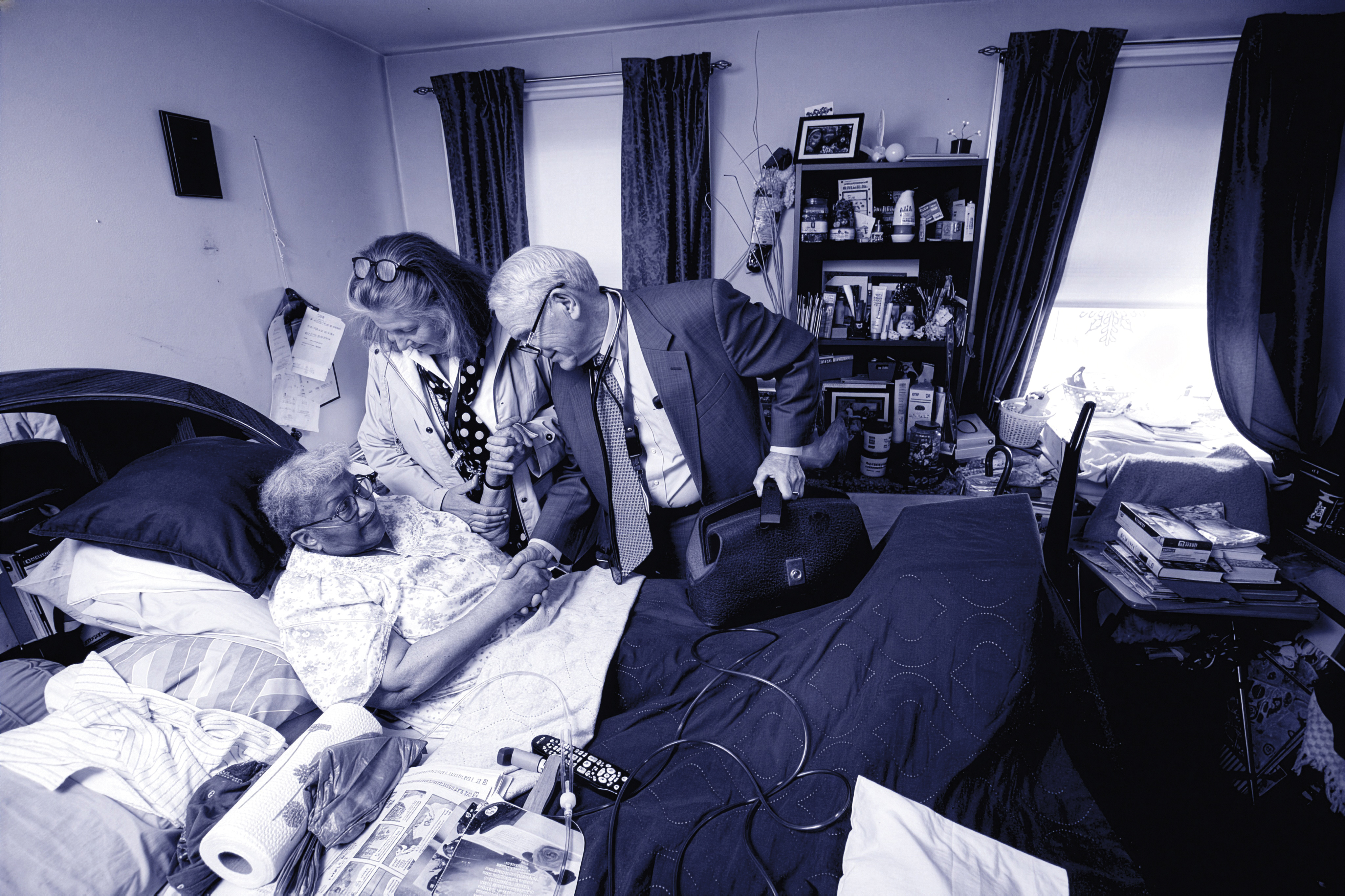
John Burton and Jane Marks care for a patient at home.
 Jessica Colburn
Education has long been Associate Professor Jessica Colburn’s passion. Before she went to medical school, she taught third grade, and once she joined the Division of Geriatric Medicine and Gerontology faculty, she loved stepping in to teach sessions for the fellows as often as possible. Eventually, this led to her becoming the director of the fellowship program, which she calls “the best job I didn’t know I wanted.”
Colburn’s work as an educator extends beyond the fellowship program. After teaming up with John Burton at the Geriatric Education Center (now called the Geriatric Workforce Enhancement Program, or GWEP), she discovered that she also enjoyed community-based, geriatrics-focused education. She started with the GWEP as assistant director, alongside Burton and head nurse Jane Marks, and took over as director when Burton retired. In this role, she’s seen the GWEP through several iterations; currently, it focuses on directly improving the quality of geriatrics education in primary care.
Why We Need GWEPs
GWEPs are entirely federally funded by the Health Resources and Services Administration (HRSA) and exist in 44 states. Their mission is to partner with primary care, nursing home, long-term care and community-based organizations that serve older adults to educate them on how to provide high-quality geriatric care. Colburn says, “Because there are not enough geriatricians or geriatrics NPs or RNs, a lot of older adults are receiving their care from people who have generalist experience but not geriatrics training. Our job is to bring the geriatrics training.” For one example, she notes that internal medicine residents can leave residency without being able to diagnose dementia, which is increasingly problematic given the rising number of older adults in the U.S. “The premise of the GWEP is that yes, we need to train more geriatricians, but knowing that we won’t have enough geriatricians in the next few decades, it is essential for the geriatricians who exist to provide widespread education to health care professionals who are on the front lines in our communities, caring for older adults and their families.”
The HRSA grant that funds the GWEP is unique for both its size ($1 million a year for five years, ending in 2029) and its education-based approach. “We have partners we fund with that money,” Colburn says. “[We provide funding to] the Living Well Center of Excellence (an Area Agency on Aging on the Maryland Eastern Shore), the University of Maryland School of Pharmacy and School of Nursing, Johns Hopkins Community Physicians at Keswick, and then there are smaller stipends we provide to people who participate in our courses.”
The catch with federal funding is that Congress must approve it each year. In 2025, there was a delay to the funding for Alzheimer’s disease and dementia-related work that paused some programs, although eventually the money was released. “With our population growing older, this funding is essential,” Colburn says. “So hopefully for next year, it will ultimately get approved as well.”
What Defines GWEP Success
The way the GWEP’s training works in practice varies depending on the primary care site, but one example is that the GWEP can find a health care team member at a site who wants to be a “dementia care champion.” Those people then meet with Colburn regularly to grow their skills in providing this care. Additionally, they have the opportunity to participate in a GWEP-provided, certified dementia care practitioner program. Colburn says, “I think that [these practitioners] and their skills in being able to identify dementia and respond to it have increased. That’s what we’re trying to replicate in internal medicine resident clinics, too, so the residents learn how to assess if someone comes and says they have memory problems, and then what to do with the diagnosis. We make sure people have information about where to refer people, what kinds of pharmacologic and non-pharmacologic options exist, what kind of community resources exist.”
Although the Johns Hopkins legacy in geriatrics has helped Colburn’s work, division leadership has also played a huge role in its success. “The role of education has historically been thought of as something that anyone can do on the side as opposed to its own skill set in academics,” Colburn says. “In this division, under Chris Durso’s and Cynthia Boyd’s leadership, [we’ve] seen the value of educators as their own skill set, which has allowed us to grow. We’re always asking questions about how we can do the work better, who’s being left out, whether we’re really serving our neighbors and communities the way they deserve and need. This is a place where my work feels meaningful.”