
Age-Friendly Health Care: 'It's a Movement'
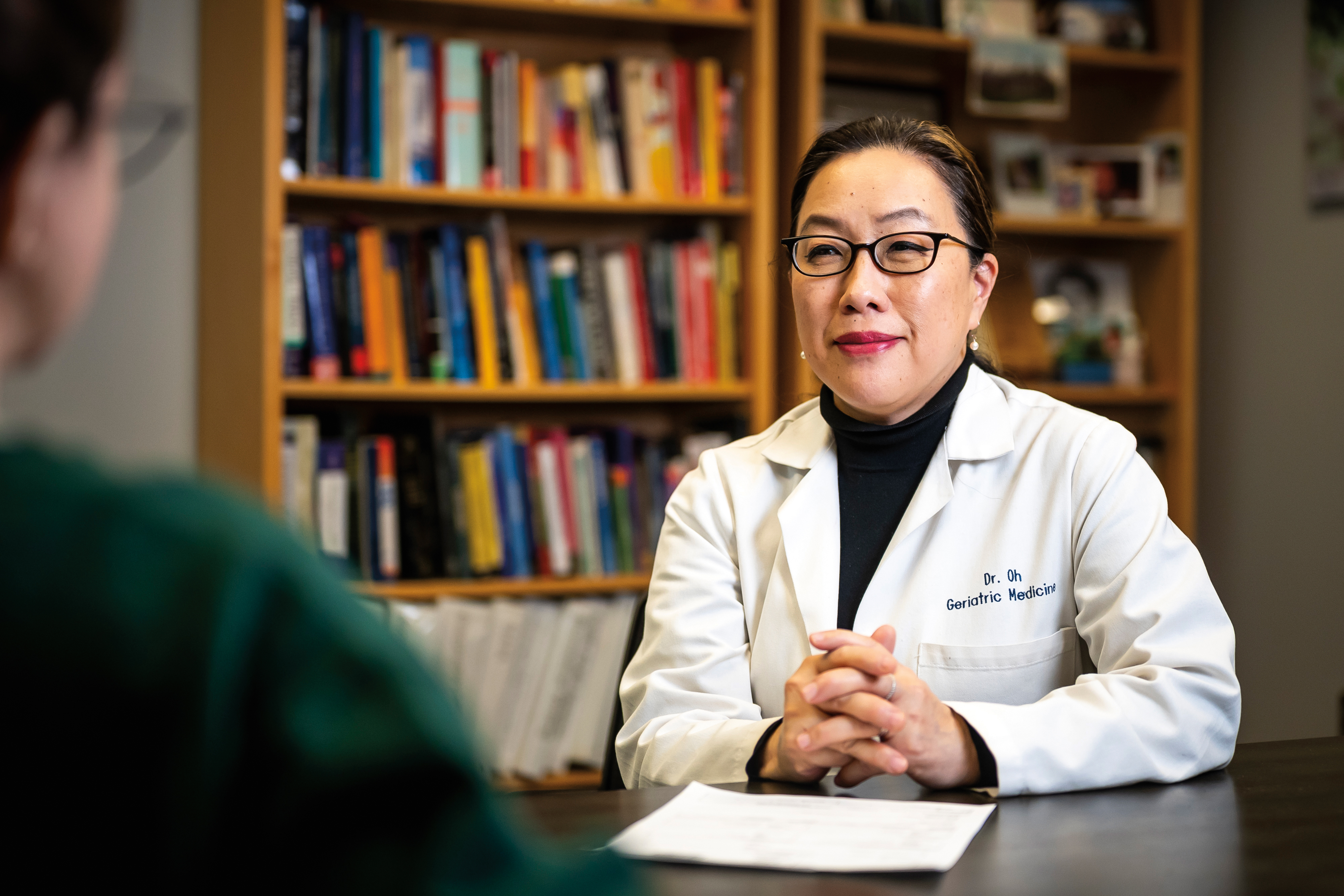
Esther Oh shares her goals for an Age-Friendly Health System.
Photo credit: Larry Canner
Professor of Medicine Esther Oh’s work is quietly revolutionary. Whether in clinic, teaching fellows or doing research, she’s focused on creating an Age-Friendly Health System specifically focused on dementia and delirium. An Age-Friendly Health System aims to deliver safe, evidence-based care to older adults that aligns with the four Ms: mobility, mentation, medication and what matters. “It’s a social movement,” says Oh, co-director of the Johns Hopkins Memory and Alzheimer’s Treatment Center.
From her days as an undergraduate, Oh always had an interest in neuroscience and contemplated a career in research. Her career trajectory changed when she met geriatrician William Greenough. Although she was still an undergraduate student, he offered her a prestigious fellowship through the Hartford Foundation on the condition that she attend Grand Rounds in the Division of Geriatric Medicine and Gerontology and see patients with him at the nursing home then on the Bayview campus. It was transformative for Oh. She says, “I still remember one patient, a woman who had been in a nursing home for many years, and her family rarely visited her. She had a G-tube and was a double amputee. And Dr. Greenough had the most gentle, compassionate approach, taking care of her in the most loving way. And I remember thinking, ‘If this is what a geriatrician is, this is what I want to do.’”
“What the age-friendly health system is trying to understand is the patient at the center.”
— Esther Oh
Oh went on to medical school, completing an internal medicine residency and the geriatrics fellowship and working with pioneers of Alzheimer’s disease research across departments, such as Kostas Lyketsos, Juan Troncoso, Donald Price and David Borchelt. Her passion for lab work continued, but because she also cherished her time as a clinician, she saw patients as much as possible. Then she treated a man in a nursing home with end-stage Alzheimer’s disease who’d stopped eating; daily, after her other work was complete, she’d return to his bedside to encourage him to eat. “Then one day, it occurred to me that there’s one of me and there’s hundreds, thousands of patients like my patient,” she says. Realizing that she may be able to help a greater number of patients through her research, she refocused her research in dementia.
Understanding Dementia and Delirium
Oh’s current research on the connection between dementia and delirium, or an acute confusional state, has long been at the heart of her work. Delirium is a very common condition, affecting 2.6 million older adults each year. While delirium often occurs in patients with underlying dementia, there is mounting evidence that delirium itself may in turn cause dementia in the future. Oh has seen it happen numerous times that an older adult goes into the hospital for an acute illness or a surgery, then has an episode of delirium and emerges with worsening cognitive function. “Prevention is more effective than treatment,” Oh says of delirium, especially since older adults’ medical issues are rarely just one thing and can set off a cascade of problems that become more difficult to treat.
Since a true understanding of delirium could help prevent it in about 30-40% of the cases, the implications for better understanding a complex syndrome such as delirium and warding off other downstream complications, from cognitive impairments to falls, are significant. “What geriatricians do best,” Oh says, “is taking a step back and looking at the whole person, the family, the hospital, the caregivers and the environment. And what the Age-Friendly Health System is trying to understand is the patient at the center.”
“What geriatricians do best is taking a step back and looking at the whole person, the family, the hospital, the caregivers and the environment.”
— Esther Oh
The Necessity of Collaboration
Oh has collaborated with many researchers and clinicians nationally and internationally to address delirium. She’s currently working with delirium researchers from academic centers across the United States through NIDUS (Network for Investigation of Delirium: Unifying Scientists), a collaborative, multidisciplinary network with the goal of accelerating scientific discovery in delirium research. In 2023, she co-led the U.S. delirium screening effort as part of the largest worldwide delirium point prevalence study where health care providers from 44+ countries collected delirium data on over 36,000 patients in one day. Her most recent collaborators in this work have been emergency departments (EDs) and their clinicians and nursing staff, all working together to institute regular screening protocols so that instances of delirium are caught early or, hopefully, avoided completely. In an ideal world, that would be easy to set up throughout the health care system. But that isn’t the case. Add to that the fact that non-pharmacological methods that require more staff often work better than medications, and it becomes clearer how big the challenge of addressing delirium is. Nonetheless, more EDs are striving these days to do better by their older adult patients. Today, over 5,900 health systems are recognized as age-friendly, thanks in part to the Centers for Medicare and Medicaid Services requiring them to be deemed age-friendly to get their full reimbursements for services.
“Ultimately, it’s about how we tailor the system to help our patients,” Oh says. “It’s really important to consider what the patient wishes, in consultation with their doctors. That’s the heart of the Age-Friendly Health System.”