
Acute Myeloid Leukemia: Valentina’s Story
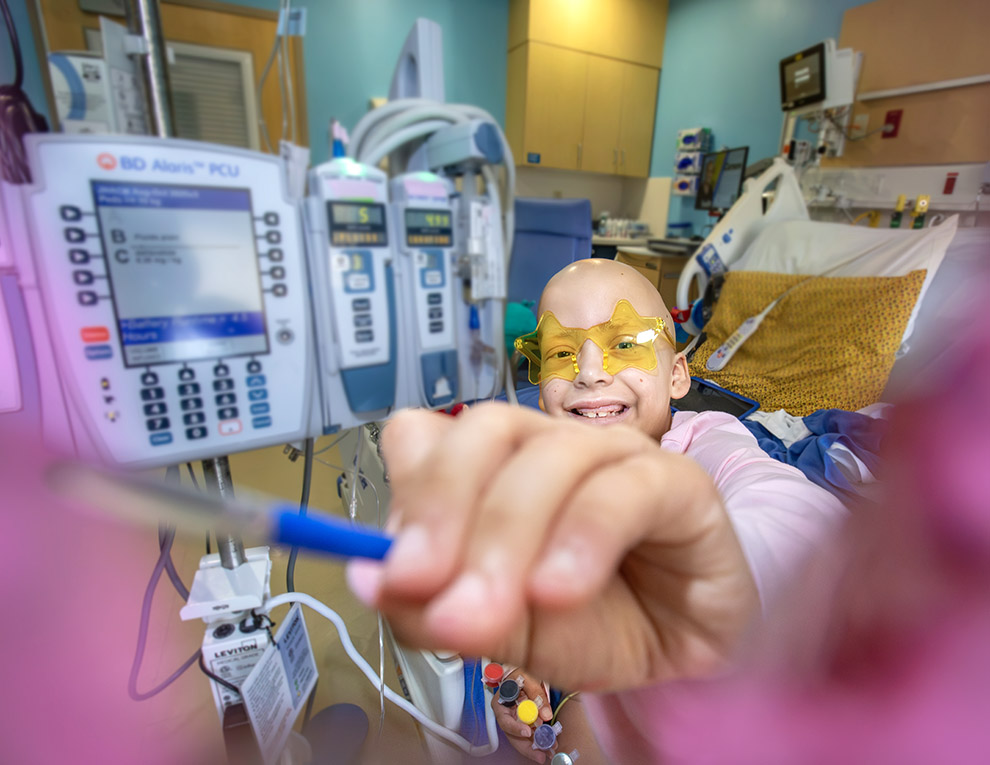
“Hi Valentina! It’s so good to see you!”
Dressed in a purple butterfly shirt and matching purple Crocs, 10-year-old Valentina chats with a favorite nurse in the Infusion Center at Johns Hopkins All Children’s Hospital in St. Petersburg, Florida.
“Are you ready?” her nurse asks gently, when it’s time for her treatment.
“Just do it,” Valentina says with a smile. She turns in her chair to reach for her mom’s hand, locking eyes with her for a moment as the nurse administers the powerful injection into her left arm.
Not every 10-year-old could handle a needle the way this little girl does.
But not every 10-year-old is Valentina.
The past year has proven to be the most challenging of this child’s life — a year in which she would show others what it means to be resilient, battle-tested and brave.
Staggering News
Leading into the spring of 2025, life in Wesley Chapel had been sweet for Valentina, her parents, and her younger sisters, Isabella and Ariana.
The family was growing together in a thriving community, with the loving support of extended family nearby.
But in April, their mom, Alma, was troubled by some health changes in her oldest child. Valentina was repeatedly getting ear infections. Strangely, her gums had begun to swell. One day in early May, after she got a high fever, her mother rushed her child to an emergency department in North Tampa.
That was the day life changed forever.
There were scans and lab tests.
Hushed voices of concern.
Alma was ultimately ushered into a private room and given the news: Valentina had leukemia.
Leukemia? It was incomprehensible.
“When you hear the word ‘cancer,’ ” Alma says, “you think of adults, but not a child, and never your own.”
When the emergency medicine doctor told Alma she had arranged for an ambulance to transport Valentina to a hospital, she thought it might be to one in Tampa.
“No,” the doctor explained. “We’re sending her to Johns Hopkins All Children’s in St. Petersburg.”
Alma rode with her child in the ambulance to the hospital’s Emergency Department.
Valentina’s dad was notified. Kalym is in the Air Force Reserves and was on a remote assignment in the Galapagos Islands in South America when he received the news. He rushed to take the three flights necessary to get back to his daughter’s side. They felt like the longest flights of his life.
Kalym recalls a vivid memory, before this news, of watching a TV commercial for a children’s hospital one afternoon while his girls were playing outside.
“I looked at those kids in the commercial with no hair,” Kalym says, “and I remember thinking I would die if that ever happened to one of my kids.”
But here they were.
Doctors and nurses in the Emergency Department of Johns Hopkins All Children’s took good care of Valentina when she arrived. More tests confirmed the diagnosis: acute myeloid leukemia (AML), a fast-growing cancer of the blood and bone marrow.
Prompt treatment was critical for this child to have the best chance for a long and beautiful life.
Treating Valentina’s AML
Valentina was admitted to the cancer unit at the hospital and began to meet the care team who would guide her through her treatment.
Pediatric oncologist Brian Guedes, M.D., says he often describes leukemia to families as something like weeds growing in a garden.
“Your bone marrow is like the garden,” Guedes says. “That’s where blood cells get made. They grow up and mature and move out into the bloodstream. But with leukemia, there are abnormal cells that have taken over and are crowding out the normal, healthy cells, like weeds in a garden.”
Because AML is considered to be a more aggressive type of cancer, the treatment must also be more intensive.
The initial treatment plan called for several rounds of strong chemotherapy over five to six months, each round with a long hospital stay to ensure Valentina’s well-being and to monitor her progress.
It would be a daunting prospect for any child and family. As they adjusted to this new reality, they took comfort in the fact that Valentina was being cared for at the number one pediatric hospital in Florida, with highly specialized experts in hematology and oncology — a program that ranks among the top 50 cancer programs in the United States for 2025-2026, according to U.S. News & World Report.
Families who have been through the journey of a child’s cancer treatment will testify that it’s filled with highs and lows. While chemotherapy can be lifesaving, the medications, by necessity, weaken the immune system, making the patient more vulnerable to complications, including infections. During her time in the hospital, Valentina powered through many challenges, including some fungal infections, and even an emergency gall bladder surgery.
The staff came to know and love this young patient and took time to lift her spirits.
“Valentina is very smart and has a great sense of humor,” Guedes says. “I learned a lot about K-Pop Demon Hunters (animated film about a music trio) and also about her favorite pro wrestling characters.”
More than anything, Valentina loved music — and a good dance party.
“The nurses would have dance parties with Valentina at 10 in the morning or 10 at night,” Alma says. “They celebrated her in any way they could.”
Change of Plans
Several weeks into her treatment, additional genetic testing results gave oncologists more insight into this young patient’s disease.
Valentina had a gene abnormality called KMT2A rearrangement. KMT2A is a gene that acts like a control switch for blood cell development. But if it becomes rearranged, blood cells may not mature and can grow when they should not.
This development would come with both good news and bad news for Valentina.
The difficult news — she would need a bone marrow transplant (BMT) as soon as possible.
But the hopeful news was that a BMT could make all of the difference for a child who was already fighting her disease so valiantly.
“Typically, AML in these patients can be harder to treat and harder to get into remission,” says Natalie Booth, D.O., a physician with the hospital’s Stem Cell and Bone Marrow Transplant Program.
“But finding that gene rearrangement confirmed that moving forward with a bone marrow transplant would give Valentina the very best chance for a durable remission and cure.”
Bone Marrow Transplant
The hunt was on to find a stem cell donor who would be the best match for Valentina. Family members were tested. The BMT team also scoured the National Marrow Donor Program registry. There was no 100% match. But her mom, a 50% match, proved to be a strong option for her.
After a brief break at home, Valentina was readmitted into the hospital to prepare for her transplant.
Alma was excited to donate stem cells that could help heal her child.
“It felt like a chance to give birth to her all over again,” Alma says. “This is new life. I went in with a positive mind and shared that positivity with my daughter. She held onto me. She was happy.”
With a mother’s loving gift of stem cells, the transplant was carried out smoothly.
Next, a waiting game to see if the donated stem cells would take root in Valentina.
Signs of New Life
Gradually, over the next couple of weeks, Alma’s stem cells made their journey to Valentina’s bone marrow and began to make healthy new blood cells.
It felt miraculous to those who loved her.
On an October day, joined by family, friends, and the medical staff who cared for her, Valentina rang the ceremonial bell that symbolized a major milestone in her care — the end of one chapter and the start of a new one. She was going home.
“The doctors and nurses and staff have meant so much to our family,” Alma says. “They gave us hope and compassionate care. They are all heroes.”
“It’s so important to have a medical team like we’ve had,” Kalym says. “Her journey is not over, but now we’re on the other side of the curve.”
The months following Valentina’s BMT provided different challenges.
Valentina had environmental and dietary restrictions at first, to keep her as healthy as possible so that her immune system could continue to rebuild.
In March, she began to venture out more, even serving as an honored guest at a ceremony marking a milestone in the construction of a brand-new Johns Hopkins All Children’s Hospital, right in her own community of Wesley Chapel.
“It will be so convenient and bring such hope to this community,” Alma says. “Now other kids in this area will soon have access to the same great care.”
Valentina Today
On this day, in her treatment room in the Infusion Center, Valentina can exhale. She’s powered through another injection. The little girl breaks into a grin as the nurse places a bandage on her arm.
For right now, this is part of her routine. For several days of each month, she travels to the Infusion Center for a chemotherapy injection to help keep her leukemia in remission.
She doesn’t have many more of these to go. And that is something to celebrate.
As she leaves the treatment room and moves into the hallway, she hears music playing.
It’s Taylor Swift’s newest song, “I Knew It, I Knew You.”
The nurses have lined up for her and are dancing and singing. They know what their girl likes.
One nurse takes her hand and twirls her around.
Valentina is beaming. She’s finding her way to wellness, one dance party at a time.
Perhaps Taylor’s latest lyrics say it best:
Love has ways of bringing things back to life.