
Weekend Wellness: Interventional Radiology Pilots Saturday Hours for Select Inpatient Procedures
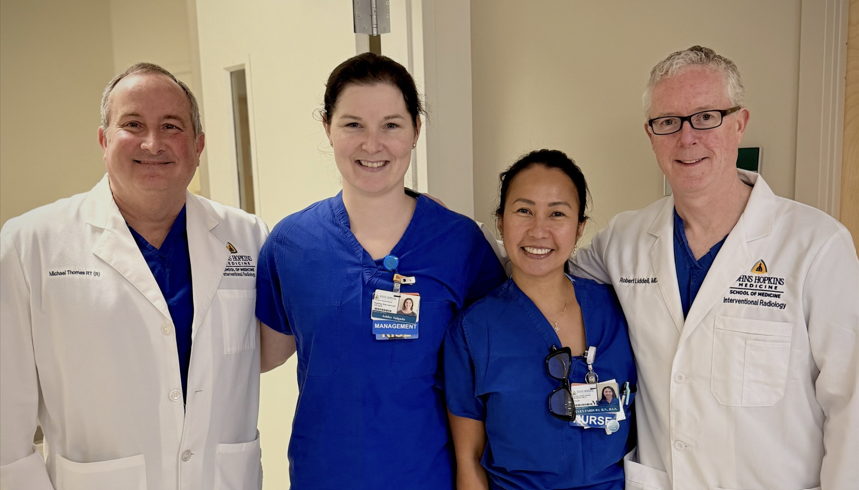 The Radiology IR leadership team includes (from left) Mike Thomas, Ashley Salgado, Wowie Parduba, and Dr. Robert Liddell.
For many patients at The Johns Hopkins Hospital, receiving care from the Interventional Radiology (IR) team is a vital part of their healthcare journey. Now, in a move to offer more timely care to patients, the IR team is offering weekend hours for select inpatient procedures.
Interventional radiology is a minimally invasive specialty in which imaging modalities like X-ray, CT and ultrasound are used to guide medical procedures inside the human body without the need for large incisions. At Johns Hopkins, the interventional radiology division operates as an independent team within the Department of Radiology and Radiological Science and includes specialized technologists, nurses and radiologists who are dedicated solely to working in IR.
As Robert “Bud” Liddell, chief of interventional radiology, recalls, he was first approached by hospital leadership in fall 2025 about instituting Saturday hours. Traditionally, IR procedures for both inpatients and outpatients are performed on weekdays during regular business hours.
However, this workflow created a weekend lull. Although on-call IR staff were available for emergencies, inpatients requiring routine procedures — such as feeding tube replacements or port placements — often had to wait until Monday. As a result, hospital stays were prolonged, care could be delayed and weekday caseloads increased.
Seeing the need, Liddell took immediate action. He called on his colleagues Mike Thomas, IR radiology technical and project manager; Wowie Parduba, IR interim nurse manager; and Ashley Salgado, interventional operations supervisor, for assistance. The team quickly developed a plan and began recruiting staff volunteers for the new project. By December 2025, IR was ready to accept their first Saturday patients for a six-month pilot.
The new biweekly Saturday procedures are currently reserved for inpatients requiring less complex interventions.
“We look for inpatients who are stable enough to come to the IR suite, receive the procedure and then return to their room without needing to recover in the post-anesthesia care unit,” Liddell explains. “These involve fairly straightforward cases like lines for long-term antibiotics or catheters for hemodialysis.”
According to Mike Thomas, the technologists were quick to volunteer for the extra shift. Participation in the expanded hours is strictly voluntary and additional to staffers’ regular shifts.
“We spent time talking to staff, gauging their interest, and outlining our goal,” Thomas says, noting, “We didn’t want to surprise them; we wanted their buy-in as well. They were very receptive, and recognized the patient need.”
Parduba’s nursing staff was also enthusiastic about the enhanced service. Right now, she says, there are enough nursing volunteers to keep the biweekly Saturday hours fully staffed.
She also notes that the new procedure hours do not take any resources away from existing services.
“There is nothing taken away from existing daily weekday or emergency on-call operational hours in terms of staffing or procedure availability,” Parduba says. “The Saturday service helps clear backlogs of cases, allowing for clearer schedules during the weekdays.”
The new biweekly weekend hours also help free up the on-call emergency IR team, as patients who come to the emergency department on a weekend with a less complex or emergent issue can be treated on Saturday by the elective procedure team, freeing up the on-call team to focus on urgent cases.
The success of the venture quickly became apparent as patients treated during the new weekend hours were either discharged soon after their procedures or able to continue with treatments that would otherwise have waited until a weekday.
“On average, we see or perform between five and eight cases during Saturday hours,” Lidell explains, adding, “Of those cases, about 35% of patients get discharged within 48 hours of the procedure, and a higher percentage of patients initiate treatment sooner than they would have if they had to wait until Monday.”
“Not all of the patients treated are being discharged right away, but performing the IR procedures on Saturday helps initiate treatment sooner and, in the long run, shortens their length of stay and improves treatment outcomes,” he says.
Though the pilot was slated to run through May, plans are already in the works to continue the project long-term.
“Looking to the future, we are planning to continue and perhaps expand the service,” Liddell explains. He notes that there is currently no timeframe or details on how the weekend service may evolve.
“We are evaluating our staffing, including nursing and patient transport resources,” he says.
“The additional Saturdays are very pleasant,” he notes. “Our patients appreciate not having to wait until Monday, and hospital leadership also appreciates our efforts. It has overall been a positive experience.”
He credits the entire IR team for their dedication to ensuring patients receive the highest-quality care on a timely basis.
“Doing these cases on a Saturday really calls for tremendous teamwork,” he says, concluding, “From performing the cases to transporting patients, we work as a team.”
More information on interventional radiology at Johns Hopkins
For Clinicians Clinical Connection
Clinicians, discover the latest in research and clinical innovation from Johns Hopkins experts. Access educational videos, articles, CME courses and other resources from our world-renowned institution.