
Science, Food and a Friendship that Spans the Globe
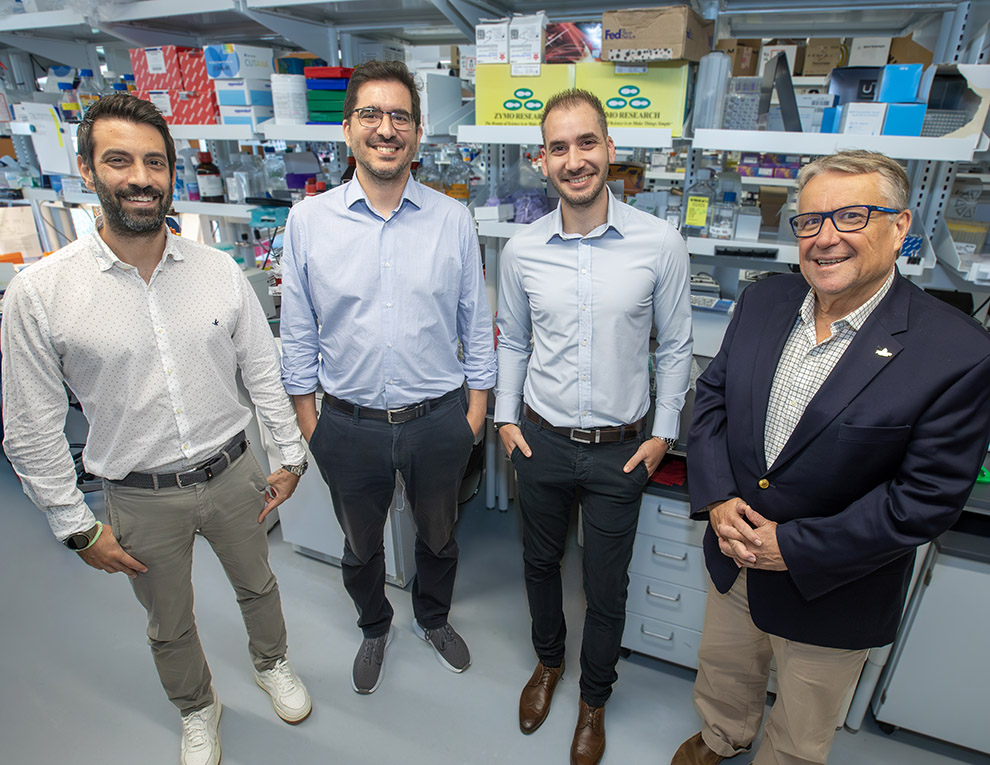
When Petros Tzerpos first encountered Andreas Patsalos, Ph.D., he saw potential.
“He was just starting his laboratory life but with a big thirst to learn things and absorb anything from us and our supervisor,” says Tzerpos, who was a doctoral student at the time. “I could tell back then he already had a strong aptitude for computer programming and using scientific software and hardware for advanced data analysis that later helped him in his scientific endeavors.”
Tzerpos, Patsalos and a third biomedical science enthusiast, Michalis Sarris, Ph.D., all met as they pursued their studies in the 2009-2010 academic year at the Institute of Molecular Biology & Biotechnology at Heraklion in Crete, Greece. Now, after following different paths, they are all working together in the Johns Hopkins All Children’s Institute for Fundamental Biomedical Research (IFBR) in St. Petersburg, Florida. They all share a common mentor, Laszlo Nagy, Ph.D., M.D., co-director of the IFBR and professor of medicine, biological chemistry and biomedical engineering in the Division of Endocrinology, Diabetes and Metabolism in the Johns Hopkins University School of Medicine.
“We share a deep connection and mutual respect, and we often understand each other even without saying much,” Sarris says. “One of the most remarkable things is that our perspectives and abilities complement each other, which makes us a strong team. The Johns Hopkins environment, combined with Dr. Nagy’s mentorship and the scientific freedom he provides, has created an ideal setting for us to grow scientifically, develop new ideas, and work together in a meaningful and productive way.”
A Fast Friendship
In Crete, each was at a different stage of his academic career, but they were members of the Spilianakis lab. As Tzerpos was working on his doctorate, Sarris was pursuing his master’s and Patsalos a bachelor’s thesis.
“We became very close friends,” Patsalos says. “It was not just a typical lab-acquaintance relationship. We spent a lot of time together, supported each other, and built a friendship that lasted well beyond those early years.”
The three young academics often bonded over food, coffee and discussion of their scientific goals and futures.
“One thing that captures our friendship is that when we go out for dinner, we usually order almost the whole menu,” Patsalos says. “Food has always been part of our friendship. … We grew up scientifically together, we know each other very well, and we have stayed connected through many transitions in life and science.”
Different Paths
As each of the three completed their time in the Spilianakis lab, they moved in different directions, but their bond remained.
When Patsalos told Tzerpos he had an offer in 2013 to pursue his doctoral degree in Debrecen, Hungary, Tzerpos was hesitant. He had never heard of Debrecen and thought Patsalos had better opportunities.
“Who knew that a few years later I was going to join the same lab and stay there for more than 10 years!” Tzerpos says. “Only after he shared his email exchange with Laszlo about the Ph.D. project, including the possibility of doing research in Laszlo’s U.S. lab, did I become enthusiastic about his choice. And he did very well, I can tell now!”
Tzerpos joined Nagy’s lab at the University of Debrecen in 2015, living in a building one floor below where Patsalos lived. In 2017, Patsalos joined Nagy’s U.S. lab, which then was based near Orlando before Nagy joined The Johns Hopkins University in 2018 and moved to St. Petersburg with Patsalos following. Tzerpos visited the lab in both U.S. locations for month-long research visits, staying with Patsalos each time.
After he earned his Ph.D., Sarris’ career took a turn out of academia, but the trio stayed in touch through a messaging app called Viber, which is similar to WhatsApp and Signal. They also saw each other during holidays and other big life events.
Sarris knew Nagy through a scientific consortium and other conferences and met him at Patsalos’ wedding in 2023 in Cyprus. The next year, around the time Tzerpos’ child was being baptized, Sarris decided to return to academic science as a career. He asked Tzerpos to see if Nagy might know of opportunities in Europe. Tzerpos told him Nagy thought highly of him and had opportunities in his lab in St. Petersburg, describing the environment.
“Michalis was captivated,” Tzerpos says. “He gave it thought for a few days and he applied. He started his postdoc at Laszlo's lab just a few months later.”
Sarris joined the Nagy lab on April 1, 2025, adding expertise in how immune cells within tumors influence cancer growth, invasion and response to therapy to the lab’s focus on macrophage biology and the role it plays in tissue repair and regeneration.
Patsalos, an assistant professor in the Johns Hopkins School of Medicine, recently moved out of the Nagy lab to start a lab of his own within the IFBR.
“I am very excited about building my own lab at Johns Hopkins All Children’s because the environment is unusually strong for the type of work I want to do,” Patsalos says. “We have access to excellent expertise in immunology, metabolism, imaging, genomics, spatial biology, and disease modeling. For me, this is an opportunity to build an independent research program that connects fundamental mechanisms of immune regulation with therapeutic opportunities for muscle injuries and diseases.”
Sarris and Tzerpos are confident in Patsalos’ future success.
“He is adventurous and courageous enough and I think his future is bright,” Tzerpos says.
Together Again
Although Patsalos and Sarris work in St. Petersburg full time, Tzerpos is only here temporarily as a visiting research scientist from the lab in Hungary where he is a senior research fellow. On this visit, he is staying with Sarris, and the trio is happy to be together again. They still enjoy getting together for food when they can with Sarris often grilling or cooking.
“We met as young scientists in Crete, followed very different paths across Europe and the United States, and now find ourselves working together again at Johns Hopkins All Children’s,” Patsalos says. “That is unusual and meaningful. It also reflects the kind of scientific environment Dr. Nagy and the Institute have built, one that attracts people with shared scientific values, long-term commitment, and genuine personal connections.”
Even with Tzerpos departing soon, their bond means they are never very far apart.