
Quiet, at Last
Brain surgery was the last thing Kylie Myles expected when she visited urgent care and was diagnosed with pink eye. But testing at the Wilmer Eye Institute suggested a deeper issue.
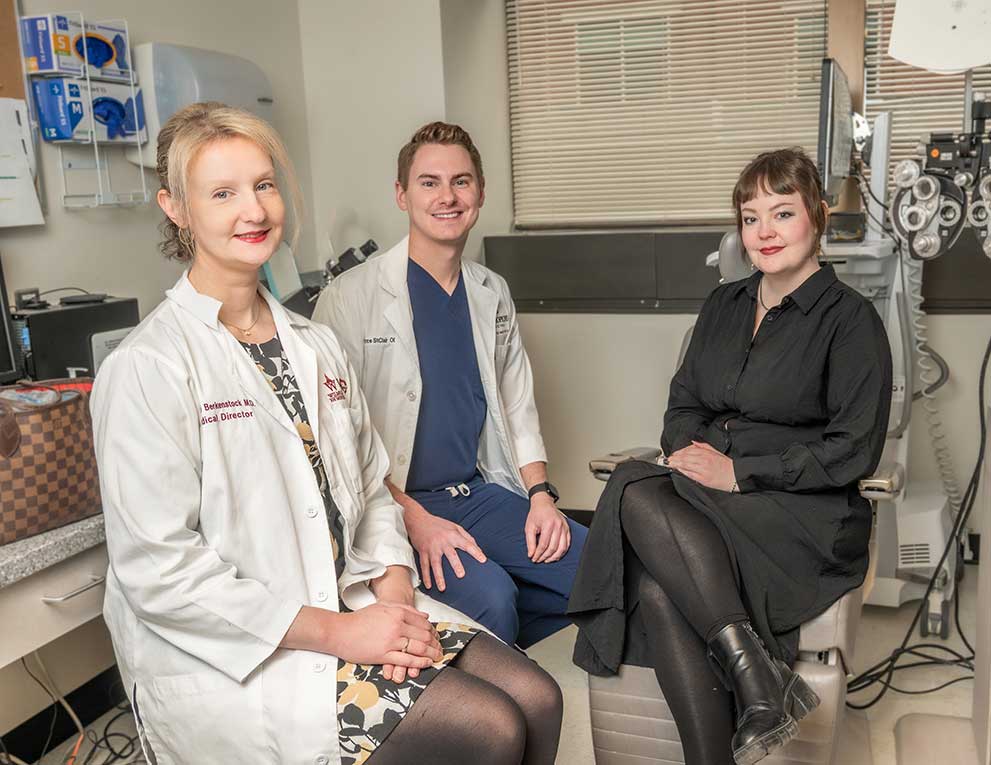
Meghan Berkenstock, Bryce St. Clair, Kylie Myles
Brain surgery was the last thing Kylie Myles expected when she visited urgent care and was diagnosed with pink eye in March 2023. Her left eye was red, painful and light sensitive, and her vision was blurry. When antibiotics didn’t help, a co-worker urged her to get a second opinion at the Wilmer Eye Institute, Johns Hopkins Medicine. Myles scheduled a same-day appointment with optometrist Bryce St. Clair, O.D., M.P.H.
St. Clair diagnosed Myles with uveitis — an inflammation of the eye’s middle layer — and ordered an imaging test, which showed the optic nerve was swollen, suggesting a deeper issue. He sent Myles to the emergency department.
Further testing, including a spinal tap, revealed high pressure in the brain and swelling of the optic nerve head. Myles’ cerebrospinal fluid pressure also was elevated. Imaging showed severe narrowing of the vein that helps drain blood from the brain — which can slow blood flow and raise pressure inside the skull and, in turn, at the optic disc. “Her brain was not able to drain fluid appropriately,” St. Clair says.
He referred Myles to Wilmer uveitis specialist Meghan Berkenstock, M.D., for follow-up. “When uveitis is recurrent or needs systemic therapy, we’re fortunate at Johns Hopkins to have a dedicated uveitis clinic,” St. Clair says. “Collaborating with specialists like Dr. Berkenstock ensures patients get subspecialty expertise when it’s needed.”
When Myles developed persistent headaches and tinnitus, Berkenstock referred her to Johns Hopkins neurologist Abhay R. Moghekar, M.B.B.S. Medication provided some relief, but caused significant side effects, including dehydration, fatigue and tingling sensations in Myles’ hands and feet. To relieve symptoms, Moghekar recommended surgery to insert a stent in the venous sinus. “The thought of brain surgery was really scary, but I thought if I don’t have to be on this medication, maybe it’s worth it,” Myles says.
In April 2024, Johns Hopkins interventional neuroradiologist Philippe Gailloud, M.D., placed two stents inside Myles’ narrowed transverse venous sinus to widen it and improve drainage, which helped lower intracranial pressure.
Immediately, the tinnitus stopped, and the pressure in Myles’ head, neck and eyes eased. Before, everything had felt loud and oppressive. Now, it was finally quiet. “As scary as it was, I’d do it all over again if I had to,” she says.
Today, Myles’ vision is back to normal. Her uveitis flares have recurred two to three times per year but are milder and treated promptly. Their origin remains unclear (Berkenstock notes that the cause of about 50% of uveitis cases is unknown). Berkenstock continues to monitor Myles for systemic diseases that can be associated with uveitis, such as multiple sclerosis.
“I’ve never had care that is so insistent on not just fixing the symptoms, but really trying to understand the reasons behind it,” Myles says.
“Wilmer’s same-day appointment policy has been in place for years now,” says Peter J. McDonnell, M.D., the Alan and Marlene Norton Director of the Wilmer Eye Institute and the William Holland Wilmer Professor of Ophthalmology. “We see more than 13,000 patients for same-day appointments each year. While rare, this is not the first time a patient seen the same day for an apparent ‘eye problem’ has been scheduled for surgery by one of our outstanding Johns Hopkins neurosurgeons because the underlying problem was lurking in the brain. This access has clearly resulted in instances where Wilmer doctors were able to prevent permanent vision loss.”
For Clinicians Clinical Connection
Clinicians, discover the latest in research and clinical innovation from Johns Hopkins experts. Access educational videos, articles, CME courses and other resources from our world-renowned institution.