
Johns Hopkins University School of Medicine Students Provide Outreach to Baltimore’s Homeless
Volunteering in the local Baltimore community gives school of medicine students the opportunity to understand the broader social context that affects their future patients.
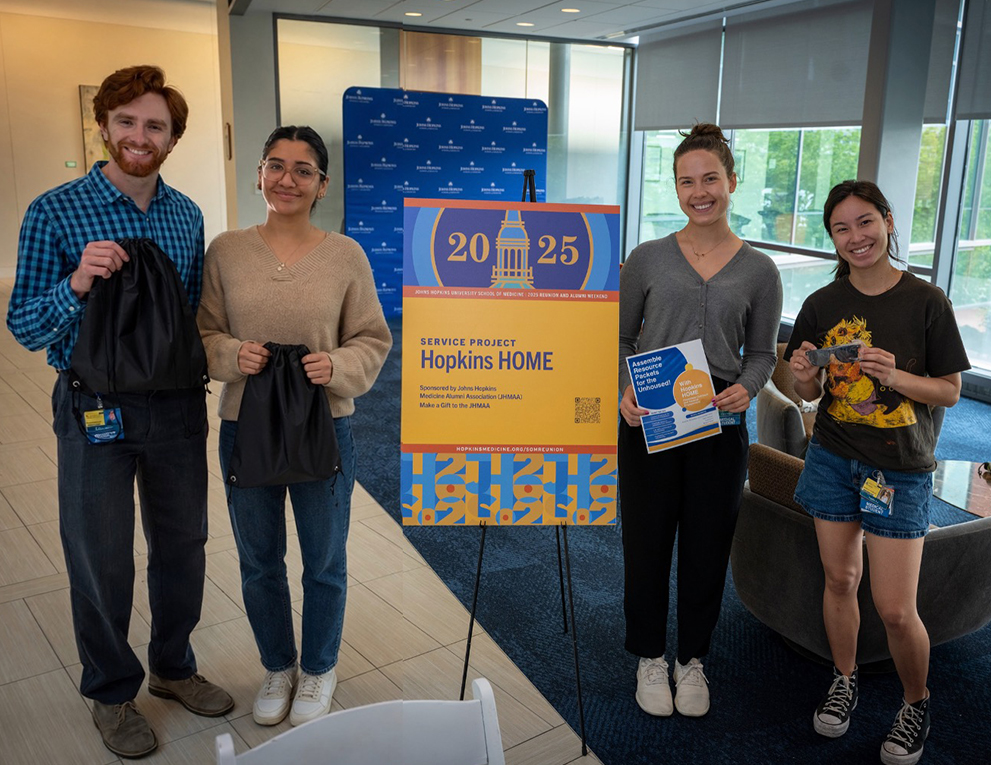
Gathered together in The Baltimore Station’s kitchen, Johns Hopkins University School of Medicine students worked with 25 veterans to make healthy chicken salad sandwiches. The students, part of a service club called Hopkins Homeless Outreach and Medical Engagement, provided the recipes, and The Baltimore Station, a therapeutic residential treatment and transitional housing program that supports veterans, provided the groceries.
“It was a skill-building opportunity for our veterans,” says The Baltimore Station’s volunteer coordinator Pete Crispino. “Some already love to cook and were uplifted by being able to chop vegetables and make their own food. After our healthy-cooking classes, there’s an energy that’s still in the room. It leaves an indelible mark on our clients. There’s a positivity that’s in the station for the rest of the day.”
Hopkins Homeless Outreach and Medical Engagement (HOME) volunteers engage with the community on multiple fronts. Some of the current initiatives involve the Baltimore Station partnership, where they lead interactive health workshops tailored to residents’ health needs; the Healthcare for the Homeless partnership, which involves volunteering directly with a mobile health clinic; and the Safe Exit Initiative kit-making events, during which HOME organized a large-scale service initiative to assemble over 500 outreach kits based on shelter residents’ needs.
“The students who make up HOME are all medical students at the Johns Hopkins University School of Medicine,” says HOME board student leader Vika Szymkiewicz. “Students have joined as early as their first year to get involved with the community, and they continue to contribute valuably until they graduate.”
In May, the HOME group received a SOURCE Community Service Award. SOURCE is the community engagement and service-learning center for the Johns Hopkins University Schools of Public Health, Nursing and Medicine.
“This recognition and our recent grants are a testament to our long-standing group dedication, but we are most proud of our hands-on work within the community,” says Szymkiewicz. “Directly engaging with and contributing to our community members is what brings us the most gratitude.”
HOME volunteer Anahita Nimbalkar is in her second year of medical school. She is interested in plastic and reconstructive surgery.
“I have always had an affinity for advocating for food insecurity,” says Nimbalkar. “I worked at a local shelter during my undergrad, and I wanted to find a way to continue that in medical school. HOME combines medical education and some of the same causes I’m passionate about.”
So far, the HOME group has led five educational workshops at Baltimore Station. Besides the healthy eating class, they have also facilitated classes on hypertension, mental health and diabetes education.
“We always try to include a hands-on component in the workshops,” says Nimbalkar. “For the blood pressure workshop, we took participants’ blood pressure and explained what that number means. We want to help them understand so they can ask their own physicians questions.”
Nimbalkar recalls that the first time the group walked into Baltimore Station, they didn’t see much enthusiasm.
“It took a little bit of effort to get them interested in what we were doing,” she says. “We were coming into a place where people were facing big personal problems. We wanted to show that we are there to support them and tailor activities to things they wanted to learn more about. The workshops are very collaborative, and we see the same residents each time. We worked to build relationships and trust. It’s a very eye-opening experience.”
HOME volunteer Claire Wilson says the experience is teaching her how to be a better physician educator.
“I’m learning how to engage with people,” says Wilson, in her second year of medical school. “This is teaching me to disseminate information in a way that’s easy for everyone to understand. I’ve learned that information is received much better if you have something to give. It takes a lot of time to form trusting relationships. I learned not to start with the medicine, but to get to know the human in front of me. You have to earn the right to give advice. It should be 90% listening, 10% talking.”
Wilson recalls the clients’ hesitancy when the HOME group led a mental health workshop.
"The participants were more reserved at first, but as the workshop progressed, they became more comfortable engaging with the activities. Several told us that the meditation and aromatherapy helped them feel calmer and more present.”
Wilson says the experience has definitely strengthened her interest in primary care.
“I can see a path forward. Working at The Baltimore Station has made community health education a real interest for me,” says Wilson.
Crispino notes the positive changes the students’ workshops have had on the clients.
“When they were here last month, they did a diabetes education seminar and presented important information to our clients,” he says. “I heard universally positive things. The biggest thing I noticed was better choices in our dining room. When they were offered juice or sugary beverages, they sometimes chose water. They were listening. Whatever leads our clients to drink less-sugary drinks is worth its weight in gold. They’ve made a real impact.”
For more information about HOME, visit https://jhu.campusgroups.com/homeoutreach/home/