
John Campo Changed Lives and Psychiatry
An innovator who integrated mental health services into medical care, Campo helped colleagues, mentees and patients be their best selves.
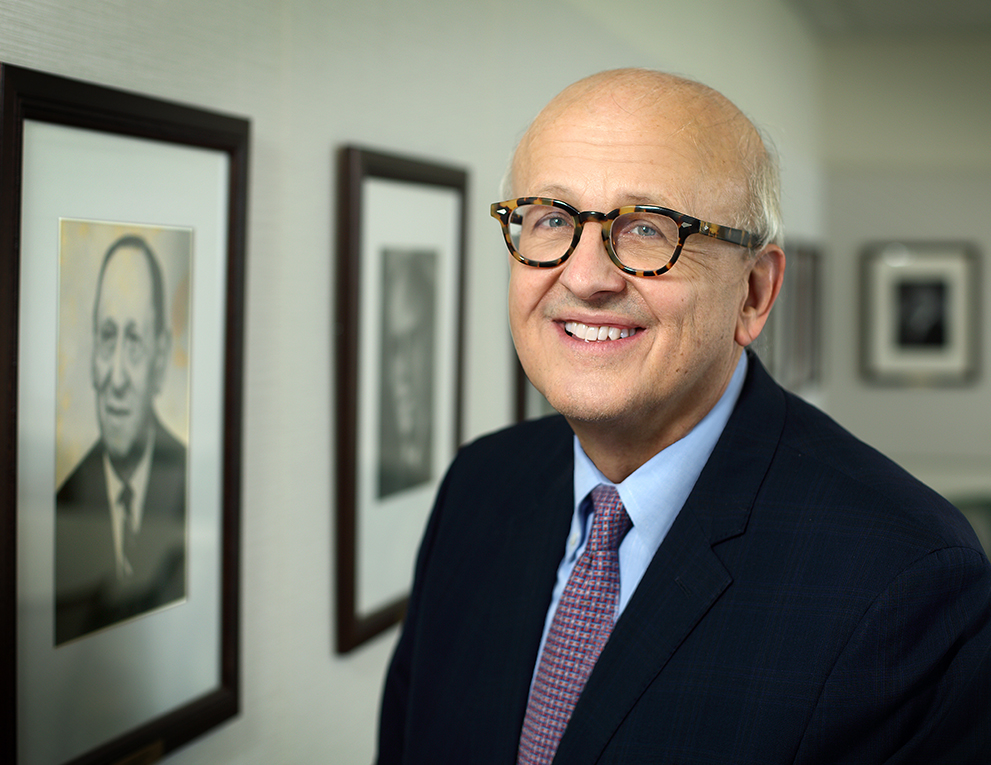
John Campo, a giant in the field of pediatric psychiatry, recently stepped down from his post as director of the Division of Child and Adolescent Psychiatry due to medical reasons.
Campo is internationally known for integrating mental health services into medical settings, and for his care of and research into children and adolescents with comorbid medical and psychiatric conditions, especially those with “medically unexplained” somatic symptoms. He is also a leader in suicide prevention and refractory mood and anxiety disorders in youth and young adults.
A beloved mentor, he has contributed his expertise as a clinical teacher, supervisor and international lecturer. He’s also a highly published researcher, having authored more than 120 papers and book chapters, and edited the Handbook of Pediatric Psychology and Psychiatry. He has been honored with the American Academy of Child and Adolescent Psychiatry Simon Wile Leadership in Consultation Award, and the National Alliance on Mental Illness Exemplary Psychiatrist Award.
Inspired at a Young Age
Campo traces his interest in medicine to a childhood tragedy — the sudden loss of his 4-month-old baby brother due to bronchiolitis. He was 8, the oldest of four siblings, and remembers the doctor assuring his mother that her baby would be OK as he wrote her a prescription for valium. She insisted that something was seriously wrong, and unfortunately, she was right.
The incident inspired him to want to protect people. He gravitated toward science in school, and graduated from medical school at the University of Pennsylvania in 1982. He completed a residency in pediatrics at the Children’s Hospital of Philadelphia in 1985, followed by an adolescent psychiatry residency and fellowship at the University of Pittsburgh Medical Center, completed in 1988. He joined the Pittsburgh faculty the following year and served in various attending psychiatrist and director positions for pediatric psychiatry programs.
In Pittsburgh, Campo was troubled by what he considered a false dichotomy built into the healthcare system, between physical and mental health. He worked to integrate mental health services into general medical settings, and developed a practice-based research network in primary care for kids with anxiety and depression.
Alarmed by the fact that suicide is the second-leading cause of death among 10- to 24-year-olds, killing more than twice as many young people in that age group as cancer, he began focusing his attention on the connection between suicide and lack of access to mental health services.
In 2006, Campo left Pittsburgh to join The Ohio State University and Nationwide Children’s Hospital as chief of the Department of Psychiatry and the Division of Child and Adolescent Psychiatry. At Ohio State, he revamped the child and adolescent psychiatry fellowship, which was at risk for probation, expanded the psychiatry residency, and added four subspecialty fellowships, a psychology internship and a neuropsychology postdoctoral fellowship.
He also led efforts to incorporate mental health care and suicide prevention into pediatric primary care. Clinicians began asking children directly if they were thinking of harming themselves or had thoughts of wishing to be dead, and systems were designed to respond to their answers. He created numerous mental health and crisis programs and protocols, including a crisis intervention model for the emergency department, and developed a pediatric medical psychiatry inpatient unit.
Campo left Ohio State in 2018, and spent two years at West Virginia University and the Rockefeller Neuroscience Institute as dean for behavioral health, chief behavioral wellness officer and professor of behavioral medicine and psychiatry.
In 2020, he joined Johns Hopkins as the Leonard and Helen R. Stulman Professor and Director of Child and Adolescent Psychiatry and vice chair of the Department of Psychiatry and Behavioral Sciences, director of mental health at Johns Hopkins Children’s Center and vice president of psychiatric services at Kennedy Krieger Institute.
“Johns Hopkins psychiatry has a reputation as a great collaborative place to be if you are presented with complex or refractory problems, yet at the same time is intently focused on population health,” Campo said in a 2020 interview. “We’re going to take you seriously, do an in-depth evaluation that considers the problem from multiple perspectives, and be really dogged in coming up with a way to get you better.”
Campo supported and mentored clinicians and researchers who created the Johns Hopkins Center for Suicide Prevention, and he served as a senior adviser. The center works to prevent suicide through population-based and individual approaches, with research and training opportunities.
“John’s eye has always been on improving the standard of care for the most vulnerable of vulnerable youth seen in our healthcare system,” says center director and founder Holly Wilcox.
“John was very much of the mindset that if we can’t do it at Hopkins, who can do it? He felt that we should be able to care for the most complex and challenging patients.”
Elizabeth Reynolds
‘He Really Cares’
To his colleagues, mentees and patients, Campo is rare gem of a clinician, educator and administrator — one whose work is built on investing in personal relationships, fostering collaborations across specialties and institutions, and seeing the potential of individuals and the importance of their respective disciplines.
Even though he was division director, “He gave just as much to the work and cared just as much about it as we do,” says Hal Kronsberg, program director for the Child and Adolescent Psychiatry Fellowship. “He always had the interest of the patient in mind and your interest in mind. He was always going to be there for you.”
Kronsberg, a psychiatrist who does community-based work, says Campo inspired more faculty investment in the Child and Adolescent Psychiatry Fellowship, with advanced practice providers working closer with trainees, including in the emergency department. Campo also sought funding for trainees to present at conferences, and was instrumental in helping the fellowship program expand from six fellows to seven.
“He really cares about the trainees. He loves to meet with them one on one to talk about careers,” Kronsberg says. “And there is generosity to his approach with mentees and trainees, one that is without any agenda on his part.”
When a fellow had to leave the program for family reasons — leaving a fellowship can be devastating early in a career — Campo didn’t write them off, he offered to reach out to people he knew in the fellow’s home state to try to help them land on their feet, Kronsberg says. He recalls several of the fellows becoming quite emotional when he told them Campo was stepping down.
Aaron Hauptman, associate director of neuropsychiatry at Kennedy Krieger Institute, says it’s all about the relationships for Campo.
“John is so deeply interested in people,” Hauptman says. “He’s someone for whom the relationship comes first. … John balances support and the push to improve and work toward a shared mission. He can somehow be both a leader and a friend, a colleague and a supporter.”
Elizabeth Reynolds, director of Pediatric Medical Psychology in the Division of Child and Adolescent Psychiatry, says Campo treated psychology as an essential part of the team, helping expand its role into different medical subspecialties. He also helped grow the Center for Developmental Behavioral Health at Kennedy Krieger, a multidisciplinary outpatient mental health program that can treat complex patients, and helped facilitate closer care coordination between the Children’s Center and Kennedy Krieger.
“He pushed us to be able to do more and do better by our patients,” she says. “He was very much of the mindset that if we can’t do it at Hopkins, who can do it? He felt that we should be able to care for the most complex and challenging patients.”
A Personal Touch
Campo didn’t just leave an imprint on his colleagues and mentees — he changed the lives of his patients. Pete, a patient now in his early 20s, was so inspired by Campo that he became a nurse. (Pete is a pseudonym to protect the patient’s identity.)
After Pete had bouts of depression and several suicide attempts in his teenage years, Campo became his psychiatrist. Campo helped Pete work through his depression and suicidal ideation, treated him with electroconvulsive therapy and helped him wean off medication when he was feeling more stable.
Working with a translator, Campo patiently explained to Pete’s parents what was going on, and made sure they understood that it was not the patient’s fault.
“My parents to this day talk about how great he is,” Pete says. “They attribute a lot of why I’m here today to how much he cared. I’m doing great. I never could imagine that I would be doing this well.”
When Pete was searching for meaning at a low point, Campo discussed his spiritual beliefs and recommended the book Man’s Search for Meaning by Viktor Frankl, which the patient says had a major impact on his personal philosophy.
Pete was so inspired by Campo’s treatment that he now works as a registered nurse, and has his sights set on earning an advanced degree in the future.
“Working in healthcare is a profound part of my identity, and I owe it to him for picking me up when I was at my lowest, and for inspiring me to channel my experiences into empathy,” he says. “I don't know where I’m going, but I can confidently say that I will treat my patients with the same dedication and compassion that he’s shown me. … I hope that I can carry on his legacy as a healer.”
Tributes Pour In
On a recent, nearly two-hour Zoom tribute, Campo heard colleague after colleague express sentiments that echoed Pete’s experience — that Campo spent a career helping people and institutions be their best.
Dozens of colleagues from Johns Hopkins and beyond told stories of his selflessness, his sense of humor, his ability to uplift those around him personally and professionally, and how he had the ability to bring everyone together in the spirit of collaboration. Nearly all closed by saying “I love you,” which he enthusiastically said back.
“It’s your openness and connectedness, John, that has allowed all of us to show up more fully — being our full selves and our true selves,” said Roma Vasa, interim vice president of psychiatric services at Kennedy Krieger. “And it’s created a trust and a connectedness. I think that’s the gift that you have brought to our division and across our two institutions.”
Smiling ear to ear, Campo addressed the group just before the event wrapped up, summing up what guided him throughout his career.
“What brought us together, it was two things. The first was love and the second was purpose,” he said. “How do we partner with God, with what’s good in the universe, to bring healing to a world that we know there’s something the matter with, that we know is broken in a meaningful way. And how do we come together to do our part?”