
A New Professorship Commemorates Outstanding Patient Care
Ashley Behrens, chief of the Division of Comprehensive Eye Care at the Wilmer Eye Institute, is the inaugural recipient of the Edward St. John Professorship in Ophthalmology.
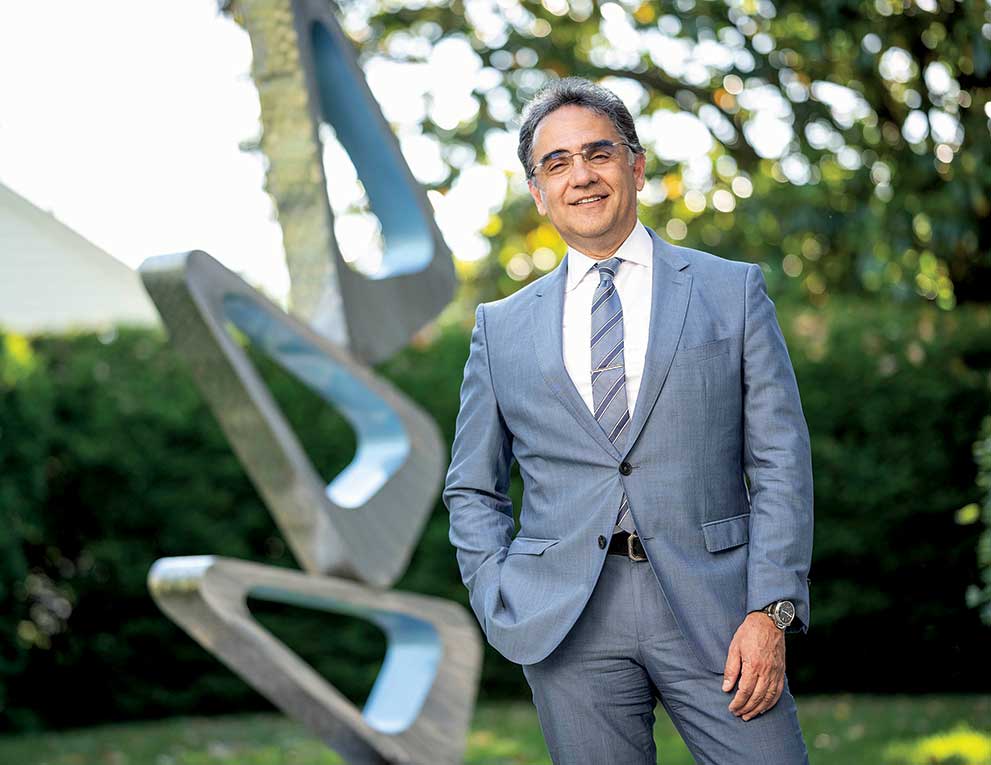
Ashley Behrens
On Nov. 5, 2025, Ashley Behrens, M.D., chief of the Division of Comprehensive Eye Care at the Wilmer Eye Institute, Johns Hopkins Medicine, was celebrated at a dedication ceremony as the inaugural recipient of the Edward St. John Professorship in Ophthalmology. This endowed professorship was made possible by St. John, founder and chairman of commercial real estate firm St. John Properties and a longtime patient of Behrens.
“Professorships allow us to recruit and retain outstanding faculty like Ashley Behrens and perpetuate the excellence and preeminence that is Johns Hopkins,” said Theodore DeWeese, M.D., the Frances Watt Baker, M.D., and Lenox D. Baker Jr., M.D., Dean of the Medical Faculty and chief executive officer at Johns Hopkins Medicine, during the ceremony.
“Ashley and Ed represent a remarkable continuation of the partnership between philanthropic and clinical vision that has supported this institute and its faculty’s impact since its founding — a legacy of focused impact that changes and improves patients’ lives in perpetuity,” said Johns Hopkins University President Ronald J. Daniels, J.D., LL.M.
 Lawrence Maykrantz, president & CEO chairman, Edward St. John Foundation; Lori Rice, executive vice president, CFO treasurer, Edward St. John Foundation; Sharon Akers, president, Edward St. John Foundation; Kellay St. John, vice president, Edward St. John Foundation; Jennifer and Edward St. John; Ashley Behrens with family members Jessica, Nicole, Nathalie, and Ash
St. John first connected with Behrens, who has served on the Wilmer faculty since 2003, after extensively researching cataract surgeons. At the time, St. John, who had LASIK surgery at Wilmer several years earlier, was suffering from deteriorating night vision due to cataracts. “When the lights of oncoming cars blinded me to the point I had to pull over, I sought out Wilmer again,” he says.
Shortly after, in 2019, Behrens performed cataract surgery on both of St. John’s eyes. The procedure was slightly more complicated due to St. John’s previous LASIK surgery, which reshapes the curvature of the corneas to correct vision. As a result, Behrens had to calculate precise measurements of the size and shape of the altered corneas to determine the power of St. John’s new artificial lenses, which are needed to replace the natural lenses removed during cataract surgery. The surgery was successful, leaving St. John with perfect 20/20 vision.
“The results were life-changing. I no longer rely on glasses and enjoy clear, trouble-free sight. I have the world’s greatest doctor in Dr. Behrens,” says St. John, who has supported Behrens’ research since 2021. “Now, this endowed professorship will allow Dr. Behrens to spend more time focused on research so that others can have the opportunity to experience the same care and outcomes to problems that affect our everyday lives, including possibly no longer needing glasses.
“To have my name associated with Johns Hopkins through this professorship is a privilege. I am especially proud that Dr. Behrens holds the title and am excited to see discoveries emerge under his leadership.”
Behrens’ research centers on refining an innovative antimicrobial therapy for corneal infections. These infections, known as keratitis, can be caused by bacterial, fungal, viral or parasitic sources and are currently treated with repeated applications of antibiotics over an extended period of time or, in the case of parasitic infections, antiseptic cleaners, all in eye drop form. The challenge is that patients need to administer the eye drops every hour or more around the clock. “Patients are basically linked to their bottles,” Behrens says. “It’s horrible because of the dedication they need to treat the disease, and that may be for days and even weeks.”
The antimicrobial therapy, which Behrens has been working on for many years, would reduce this time commitment by treating these infections with ultraviolet light and vitamin B2 in a short clinical session, most likely followed by eye drops administered with less frequency and for a shorter period of time. “The novelty of this is that we could do a treatment that lasts 30 minutes in the clinic with relatively simple instrumentation and certain chemicals that we’re developing to kill the microbial component,” Behrens says. “In certain cases, we could repeat the treatment and cure the disease without requiring eye drops, which is a big improvement.”
In 2009, Behrens published a study in the journal Ophthalmology about a version of this treatment, which was administered to three patients who had Acanthamoeba keratitis, a rare parasitic corneal infection contracted from an amoeba that can cause eye damage and blindness. These patients, who were unresponsive to other treatments, were successfully treated with the therapy, which involved a topical application of vitamin B2 as well as a 30-minute ultraviolet light treatment directed at the corneal ulcer that results from this infection.
Now, Behrens has restarted his corneal infection research, in part with the help of the professorship. “We’ve been trying to refine, to improve, and to make a more efficient treatment,” says Behrens. “Mr. St. John is so generous to provide us with this professorship, which is going to enable me to find people to work in the lab and to cover part of the work that I need to do for research.”
“Johns Hopkins is famous around the world for its researchers coming up with better treatments for diseases, and Dr. Behrens certainly qualifies, with about 100 papers that he’s published in medical journals,” adds Peter J. McDonnell, M.D., the Alan and Marlene Norton Director of the Wilmer Eye Institute and the William Holland Wilmer Professor of Ophthalmology. “Mr. St. John and his colleagues shared with me that the main motivation for creating this professorship for Dr. Behrens was to recognize his outstanding patient care and enable additional opportunities for research and discovery. To me, that’s a wonderful compliment and recognition of a great doctor and a gifted surgeon, and I’m very proud that we have people at Wilmer like Dr. Behrens who combine scientific knowledge with clinical expertise.”