
New Global Center Lights the Way to Reduce Vision Loss
A pilot project to reduce the magnitude of a major cause of blindness in babies in Thailand is the impetus for a new endowed center at the Wilmer Eye Institute dedicated to advanced innovations in retina research and education worldwide.

Jun Kong, Chalerm Yoovidhya, Neil Bressler
Each year, premature infants develop retinopathy of prematurity (ROP) which, if left untreated, often leads to blindness. In Thailand, where 1 out of 1,000 children are blind, fully two-thirds of these cases are due to ROP.
ROP is a condition in premature babies that affects the retina — the tissue responsible for sensing light and sending vision signals to the brain. In ROP, abnormal blood vessels and scar tissue can grow on the surface of the retina, which can bleed into the middle cavity of the eye, or cause the retina to detach, causing irreversible vision damage. Detecting the onset of ROP is crucial, as quick intervention often can prevent these complications and preserve vision.
While ROP can be treated if detected before substantial damage has occurred, management often depends on specialized retinal imaging devices, which do not exist in many places around the world.
“These treatments are effective only if you know which infants need treatment,” says Neil Bressler, M.D., the James P. Gills Professor of Ophthalmology at the Wilmer Eye Institute, Johns Hopkins Medicine. Bressler led a collaboration between physician-scientists at The Johns Hopkins University, Chiang Mai University in Thailand, and Xinhua Hospital affiliated with Shanghai Jiao Tong University School of Medicine in China, to improve diagnosis and outcomes for at-risk babies.
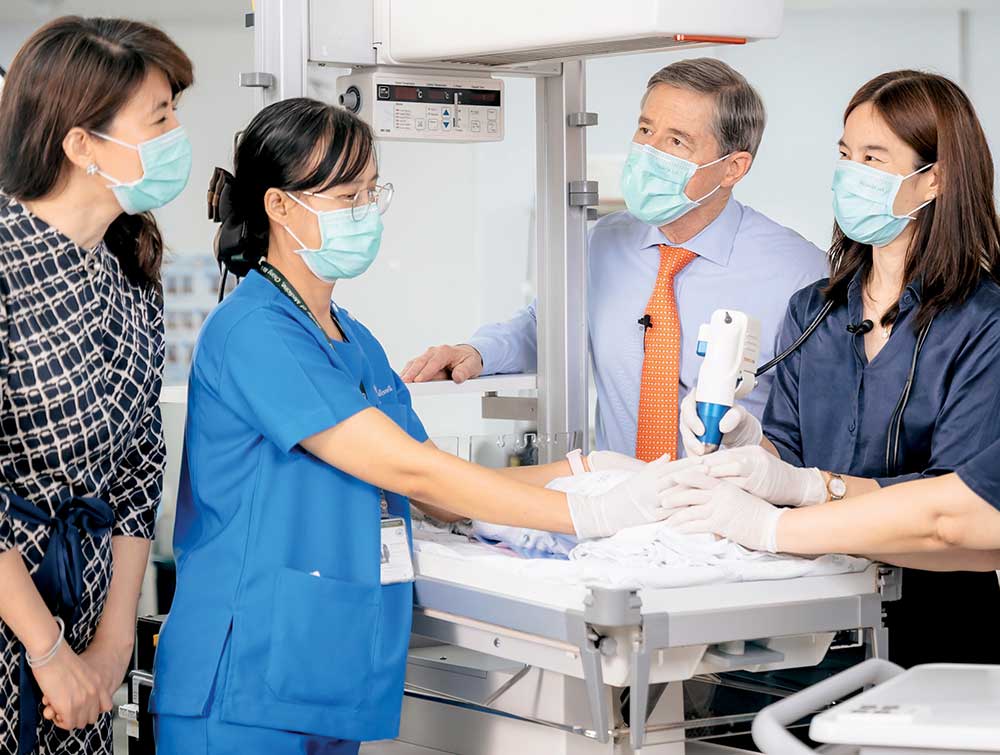 Neil Bressler, second from right, discusses retina images being obtained in a premature infant by Thailand study leader Atchareeya Wiwatwongwana, M.D., right, while the baby is soothed by neonatal nurse specialist Kwanhathai Kantaroj, left center, as Jun Kong, far left, prepares communication with retina experts in Shanghai.
In 2024, with support from prominent Thai businessman Chalerm Yoovidhya, Bressler’s team launched a study to determine if providers, given appropriate equipment and training, could create systems aimed at reducing childhood blindness from ROP.
To facilitate the study, the researchers purchased and installed state-of-the-art camera systems in Chiang Mai University’s neonatal intensive care unit and trained Thai providers to obtain high-quality retina images, in coordination with ROP experts in Shanghai. Thai physicians shared anonymized retinal images of premature infants with Shanghai ROP experts, coordinated via Johns Hopkins.
Jun Kong, M.D., Ph.D., assistant professor of ophthalmology at Wilmer and co-investigator on the project, was instrumental in facilitating collaboration across Wilmer, Chiang Mai and Xinhua Hospital.
Bressler says the project, now in its second year, has been a resounding success. “We have been able to identify every single child, confidently, that needed treatment. Of the 120 eyes of 60 infants followed with over 6,000 images, 23 infants developed ROP; all were managed with careful observation, state-of-the-art treatment with laser to the retina, or anti-vascular endothelial growth factors. Only one eye required surgery,” says Bressler.
“It is exciting to see the remarkable success of the initial study and to know that that these investments can really have an influence over the lifetime of these infants,” says Yoovidhya.
Already, that work has inspired an anonymous donor to support Bressler and his team in replicating the model in the Borneo region of Malaysia, where a research team is determining which lessons learned within the Thailand project might apply, and how to adapt their approach to different local contexts.
Says Kong, “Programs such as these not only could reduce childhood blindness but also lay the groundwork for local site investigators to develop their own future research and educational opportunities based on their experiences participating in these research projects.”
These projects also provide clinical research fellows with advanced training at Wilmer with the opportunity to transfer the experience and expertise acquired at Johns Hopkins to areas where they return for their careers.
For example, Wendy See, a retina specialist from Malaysia, worked as a clinical research fellow with Bressler and Kong and then returned to the Borneo region as one of its first retina specialists. Subsequently, when an anonymous donor approached Bressler to determine whether programs like the one in Thailand might be pursued elsewhere, such as in Malaysia, Bressler already had a connection there via See.
After learning about the early success of the project in Thailand and how it served as a catalyst to set up similar programs elsewhere, Yoovidhya has made a transformative new gift to the Wilmer Eye Institute to establish a center at Johns Hopkins dedicated to innovation, research and education to continue to pursue such projects worldwide.
The Yoovidhya Global Advanced Innovation in Retinal Research and Education (AIRRE) Center at the Wilmer Eye Institute will build on previous work by Bressler, Kong and their international collaborators to establish permanent, scalable research and education systems aimed at improving retinal care around the world. Bressler serves as director of the center, and Kong as associate director.
The Global AIRRE Center’s scientists plan to leverage innovative technologies, including artificial intelligence applications and advanced retinal imaging tools, working in conjunction with regional universities, industry, government and foundations, to identify projects that address retinal diseases that ideally have substantial public health impact on different regions of the world.
“It’s tremendously satisfying to know that our work in Thailand is already encouraging others to give in order to save the sight of infants in other locations where these programs are needed around the world,” says Yoovidhya. “Partnering with Johns Hopkins to create the Global AIRRE Center at the Wilmer Eye Institute ensures that these programs can continue to reduce the risk of vision loss from retinal diseases at all ages for decades to come.”