
A Bequest for Optometry
When Karen Lanno began having vision problems, her experience at Wilmer gave her a new appreciation for the role of optometrists. Now Karen and her husband, Ken, have chosen to support Wilmer with a bequest dedicated in part to optometry.
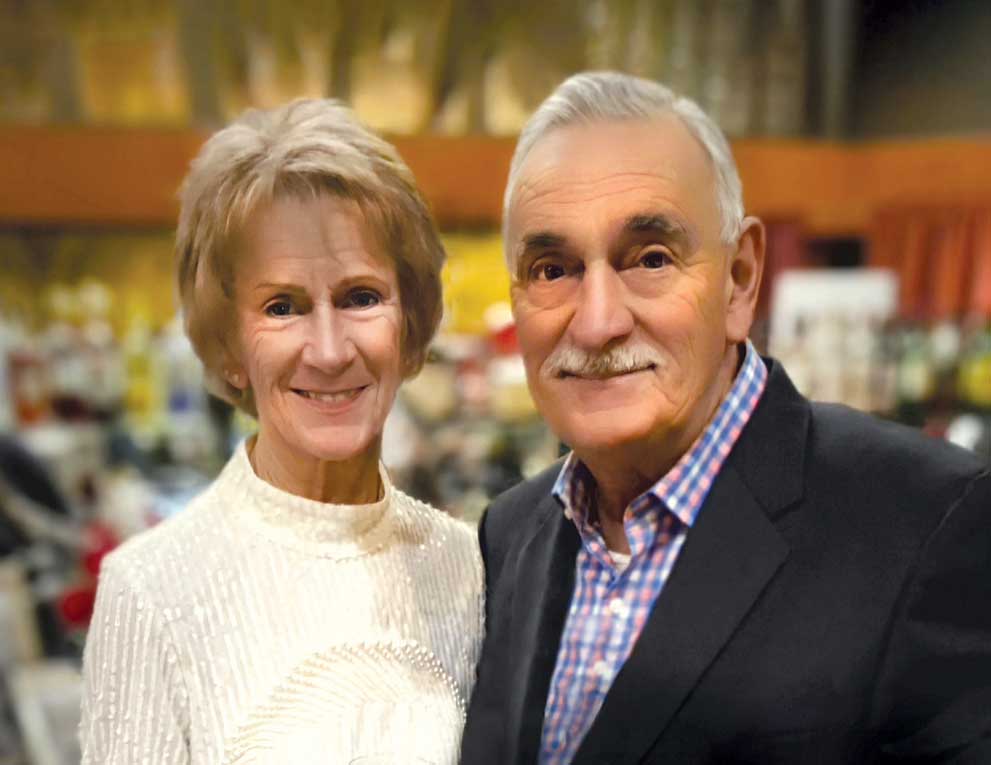
Karen and Ken Lanno
Last year, Karen Lanno noticed her vision was getting foggy — the first issue she’d experienced with her sight since having multifocal intraocular lenses implanted 15 years before. “I play a lot of golf, and I couldn’t see where the ball was going,” she says, adding that she also struggled to read road signs at night.
“It definitely changed her ability to get around and do her daily activities,” says Ken Lanno, Karen’s husband.
After Karen visited one doctor without finding relief, Ken suggested going to Johns Hopkins, where he had a successful bone marrow transplant several years prior. In April 2024, the Lannos met with Laura Di Meglio, O.D., a comprehensive optometrist at the Wilmer Eye Institute, Johns Hopkins Medicine, who collaborated across divisions and subspecialties throughout Karen’s care.
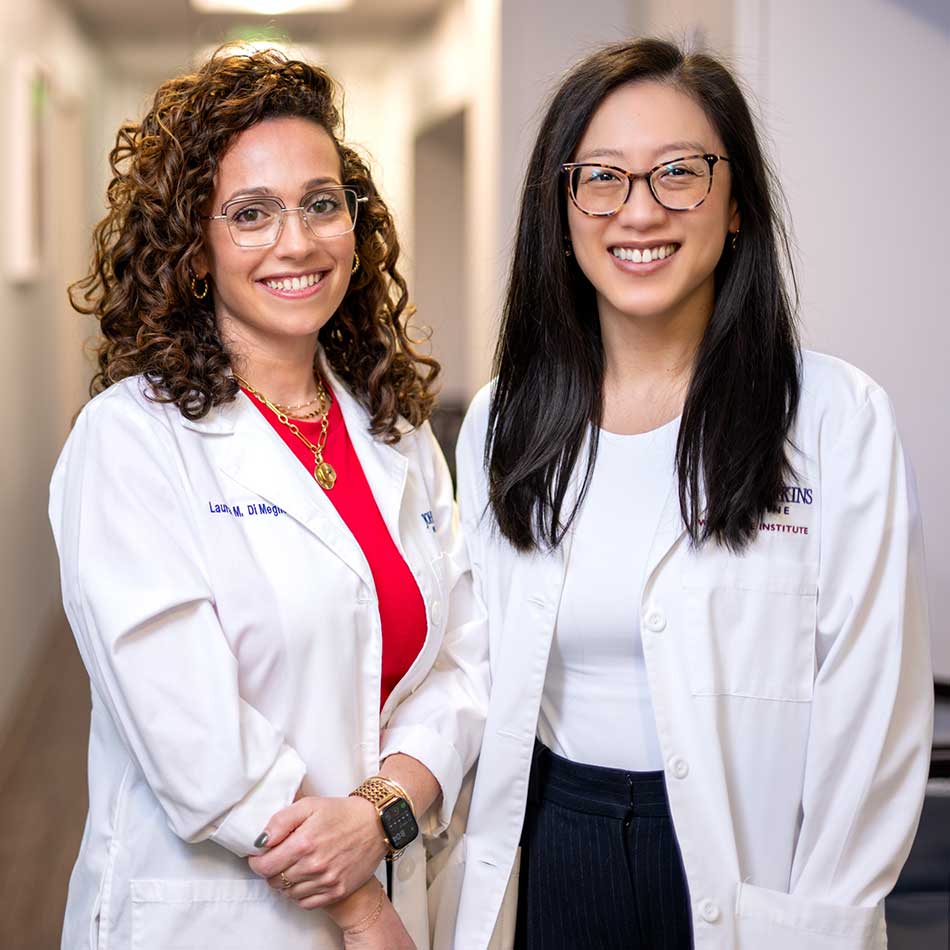 Laura Di Meglio and Cindy Cai
Di Meglio performed a thorough eye exam to begin to identify the source of Karen’s cloudy vision. When she examined Karen’s right eye, Di Meglio found a film behind the lens implant that had developed after a previous cataract surgery and an epiretinal membrane — a layer of scar tissue — on her retina. After a prescription for new glasses didn’t significantly improve Karen’s vision, Di Meglio referred her to Uri Soiberman, M.D., a cornea specialist, to be assessed for a laser procedure to remove the film on her lens implant, and Cindy Cai, M.D., the Jonathan and Marcia Javitt Rising Professor of Ophthalmology, a retina specialist, for further evaluation of the epiretinal membrane.
Using a YAG laser, Soiberman created an opening in the cloudy lens so light could pass through to the retina. Cai confirmed Di Meglio’s diagnosis of an epiretinal membrane, also known as a macular pucker, which can wrinkle the retina and cause vision impairment.
“The big question I had is whether or not the macular pucker was responsible for the decreased vision that Mrs. Lanno was experiencing,” Cai says. “We don’t want to do surgery unnecessarily and have patients not get an improvement in vision.”
Since it was challenging to determine definitively if the epiretinal membrane was the issue, Cai sent Karen back to Di Meglio to first look for a nonsurgical solution. This time, because the film on Karen’s lens had been addressed, Di Meglio found a prescription for glasses that proved effective, giving Karen 20/25 vision in her right eye.
“For somebody my age to have 20/25 vision, I’m very lucky,” says Karen. “I’m going to keep following up with Dr. Di Meglio for the rest of my life.”
The Lannos have chosen to support Wilmer through their estate with a bequest dedicated in part to optometry. “Optometrists are the front line: They make or break the whole relationship with patients. That’s why we’re trying to make a difference there,” says Ken, who also supports the Sidney Kimmel Comprehensive Cancer Center and the Johns Hopkins Heart and Vascular Institute.
Di Meglio is thrilled that the Lannos, whose bequest will also support retina research, have chosen to support optometry. “Our role is not only to improve sight with glasses or contact lenses but also to evaluate the health of the eye, identify underlying causes and connect patients with the right care when needed,” she says.
Di Meglio continues, “This gift is a meaningful contribution to optometry at Wilmer and one of the first of its kind. For optometrists in full-time clinical roles, finding the support to start research and academic projects can be challenging. In the long term, such support can lead to innovation and better outcomes for our patients.”