
The Gift of Canine Comfort
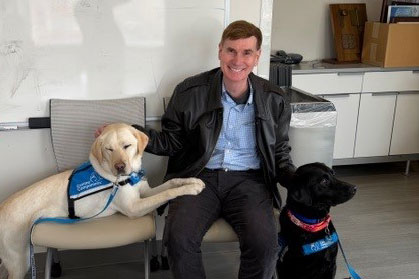 Francis Crotty with Yoda, left, and Rosalina
Francis Crotty spent decades building a career in finance, working with multinational corporations and high net worth individuals. He’d built a comfortable life for himself, but as he got older, he often asked himself a question: “Did I do anything important or worthwhile?”
“The harsh answer was, ‘Not really,’” Crotty recalls.
A chance to change that story arrived one afternoon in a waiting room at The Johns Hopkins Hospital. As he waited for a friend to finish an appointment, Crotty saw some information about Johns Hopkins Children’s Center. He walked over and asked for a tour.
There, Crotty met Leticia Ryan, director of pediatric emergency medicine, who mentioned that pediatric patients often spend long periods of time in the hospital for treatment. The image that formed in Crotty’s mind tugged at his heart and prompted a new question: Did the Children’s Center have a facility dog program?
“The doctors and nurses at Hopkins are very good at their jobs of helping kids get medically well, but they’re busy and have lots of patients to attend to,” Crotty says. A specially trained dog could give patients calming, unconditional love during the time between interactions with their care teams. “If you’re scared or angry or in pain, things can seem a little better if you have a golden retriever’s head in your lap, looking up at you with their big, puppy-dog eyes,” he adds.
Crotty learned that the Child Life Department, directed by Patrice Brylske, had been working to build a program for several years. They’d secured funding for one handler position from the Dunkin’ Joy in Childhood Foundation, establishing the Hopkins Paws for Healing Dog Program at Johns Hopkins Children’s Center. But Brylske’s team believed that having a second handler and dog would help to more fully cover the Children’s Center’s enormous footprint. Crotty stepped up to help.
“His singular gift made it possible for us to apply for the second dog faster than we ever imagined,” Brylske says. “This program is 100% philanthropy-supported, so Mr. Crotty and donors like him are incredibly important to us.”
The two dogs, Rosalina “Rosie” and Yoda, arrived at the Children’s Center on Feb. 2. They began a two-week on-site training program with their handlers, Molly Trippe-Gallagher and Carrie Potter, as well as a senior trainer from Canine Companions, a nationwide nonprofit organization that trains and provides assistant dogs to individuals and facilities. Already, Brylske says, Rosie and Yoda are making a tangible difference in the lives of pediatric patients.
And now, Crotty can confidently say he’s done something important and worthwhile. “You don’t have unlimited time to do good deeds,” he says of the gift. “This was an opportunity that presented itself to me, and it was an impactful one.”