
So Cool!
For infants who experience brain injury at birth, immediate treatment with therapeutic hypothermia proves vital to limit lasting damage and promote healing.

Raul Chavez-Valdez (left) and Frances Northington.
Photos by Jennifer Bishop
Emily Stanley went to her community hospital expecting a normal delivery. But her baby was in distress during labor. Weston Summers was born with his umbilical cord wrapped twice around his neck, and at first, he wasn’t breathing.
The on-call pediatrician who assessed Weston was concerned he exhibited signs of hypoxic-ischemic encephalopathy (HIE), a type of brain injury that results from insufficient flows of blood and oxygen. The doctor called Johns Hopkins Children’s Center, which sent a transport team to pick up Weston. The team immediately initiated therapeutic hypothermia, or cooling therapy. The treatment involves wrapping infants in a water-filled blanket to cool their core body temperature to 92.3 degrees Fahrenheit for 72 hours, then gradually rewarming them. The concept behind the strategy is that cooling slows down brain metabolism, allowing time for repair and protecting as many neurons as possible.
“He was born at 9:12 p.m., and he was in an ambulance getting cooled down on the way to Hopkins a little after midnight,” Stanley recalls. The Maryland Regional Neonatal Transport team “was phenomenal.”
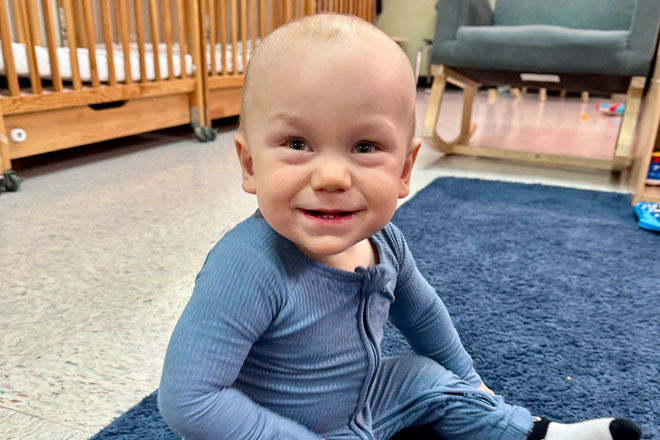 Weston Summers ‘“overcame all of the odds,” says his mother.
As with patients who have strokes, time is of the essence in treating HIE to minimize brain damage, and treatment ideally should begin within the first six hours of life, explains neonatologist Frances Northington, co-director of the neurosciences intensive care nursery (NICN) at the Children’s Center, with neonatologist Raul Chavez-Valdez. The Children’s Center has had a cooling protocol in place since 2007. Since 2009, the NICN has followed the progress of more than 500 of these infants — about 25 to 50 cases per year.
Weston’s grandparents followed the ambulance to the Children’s Center. During Weston’s first three days at Johns Hopkins, NICN experts monitored not only his temperature but also all other vital signs and brain function, including seizure development. Patrick McGrath, one of the nurses who cared for Weston, spoke to him quietly and established a calming environment by lowering the lights and playing classical music.
Weston stayed in the hospital for eight days: seven in the NICU and one on a general pediatric ward. Stanley says the care teams calmed her during the darkest time of her life. “I remember either the first or second day we were there, one of the doctors saying that they couldn’t rule out mortality, so I wasn’t sure if I would leave the hospital with a baby,” she says, tearing up. “The nurses and the doctors there were so incredible — I couldn’t have asked for better people to take care of my baby. I will forever be grateful to them.”
Aiding in Injury Repair
HIE, which affects about 1 to 3 per 1,000 newborns in the U.S., can result from several types of injuries, most commonly when the placenta detaches from the uterus, a condition known as abruption.
“When that happens, the exchange of blood, nutrition and oxygen toward the fetus decreases, and that is a very clear indication for a quick delivery,” says Chavez-Valdez. Other infants have come to the Children’s Center with HIE following a uterus rupture or diabetes in the mother, from placental insufficiency (where the fetus doesn’t grow well), or as a result of a motor vehicle accident or gunshot wound.
“The impact of cooling cannot be overstated,” Chavez-Valdez says, calling it one of the top five developments in neonatal care.
McGrath, a NICU nurse for 26 years, agrees. “Before, with any kind of hypoxic event, there wasn’t anything that we were able to do in the NICU, which was devastating, except waiting for milestones of babies,” he says. “I remember us doing pilots [of cooling] and I simply was amazed — it’s almost like with every baby, there was a difference.”
Each cell in the body has a power factory known as mitochondria, Northington explains. When the mitochondria are attacked by low oxygen and glucose — such as during HIE — the cell gets depleted of energy and tries to make more. But, like a power plant on the fritz, it begins to emit toxic substances, including free radicals — unstable molecules that cause damage and disease. “If you can slow that production of toxins and actually save those mitochondria, then that cell has a chance to recover,” she says.
Therapeutic hypothermia works because it attacks multiple mechanisms of injury, Northington says. “The reason that things go so wrong in the brain following this lack of energy, oxygen and glucose supply, is because many injurious mechanisms are induced,” she says. “[Cooling] blocks the excitotoxicity. It helps mitochondria recover and repair. It blocks free radicals. It blocks release of the injurious cytokine chemicals that cause ongoing inflammation. It may even help with preventing biochemical processes where chemical groups are added to DNA molecules, influencing how genes are expressed.”
Doctors have known for centuries that cooling can help in injury repair, dating back to the 1870–71 Franco-Prussian War, when injured military leaders placed near fires to stay warm fared worse than lower-ranking soldiers located further away, in the cold. More modern-day cooling has its basis in Russian research from the 1950s, and in neonatology and perinatal medicine, work emerged between the 1980s to the early 2000s. Experts with the Children’s Center NICU participated in the early clinical trials. Currently, therapeutic hypothermia is the only U.S. Food and Drug Administration-approved treatment for HIE in newborns.
"The nurses and the doctors there were so incredible — I couldn’t have asked for better people to take care of my baby. I will forever be grateful to them."
Emily Stanley
Developing New Therapies
As much as hypothermia treatment has been beneficial, there is still room for improved outcomes, says Chavez-Valdez. An estimated 75% to 95% of patients who survive may have some degree of cognitive impairment. “As a community, we still need to work hard to develop new therapies to be added,” he says. He and other NICN experts who are actively involved in research in this field are hosting the international Hershey Conference on Developmental Brain Injury in June, which Chavez-Valdez is chairing.
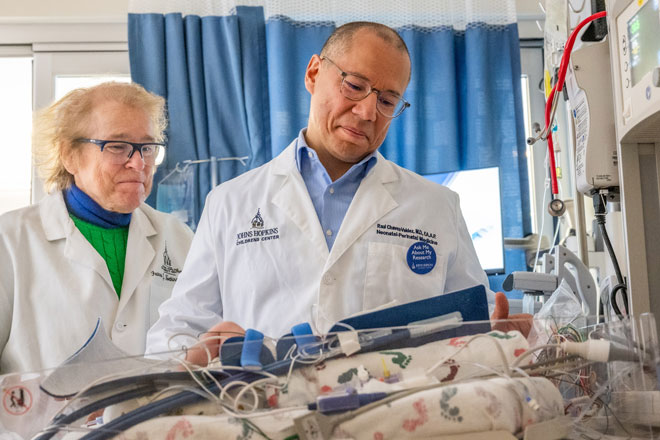 "The impact of cooling cannot be overstated," says Chavez-Valdez, right, at the bedside with Northington.
One big question is how seizures— which are more common in babies with HIE — may add to brain injury that happens before and during birth. “A seizure, abnormal brain electrical activity, adds a lot of stress to the neurons and all the cells in the brain,” he says. “Therefore, we expect that these injuries are going to be worse.” Chavez-Valdez was the senior author of a study from the Children’s Center NICN group published last spring in Pediatric Neurology, which found that levels of the proteins NF-L and Tau were higher in neonates developing seizures. This suggested that seizures might worsen brain injury even with therapeutic hypothermia.
The study is just one of several ongoing biomarker studies that the Johns Hopkins NICN research team has embarked upon by using a biobank of blood samples collected from their tiny patients. These samples have been collected since 2009, with families’ consent, in work encouraged by cardiology and maternal-fetal medicine experts Allen Everett and Ernie Graham.
“Those samples hold so much information,” says Northington. “Using these tiny little drops of blood, we can now probe proteins, metabolites and many more things, and really understand what’s going on throughout the time of the injury as the treatment is applied.”
The research could help identify which babies with HIE will get maximum benefit from cooling therapy, who may benefit from additional therapies, and inform what those treatments might be. The implications for families and the greater U.S. health care system are significant, since many children with severe HIE require costly lifelong therapies (including physical therapy, occupational therapy, speech therapy and special education services).
HIE, Northington notes, “is an insult to the baby’s whole body. Biomarkers are being released from the heart, the lung, the kidneys, and so it complicates the situation.” One of their goals is to garner continuous funding for the biomarker studies, she says, “because there’s so much more to learn. We owe it to Weston, his family, and all the other babies who have contributed in this way.”
Northington has turned some of her attention to the plights of babies with HIE born in low- and middle-income countries, where neonatal encephalopathy (brain dysfunction) is the second-leading cause of infant deaths. An international study called HELIX (for Hypothermia for Encephalopathy in Low- and Middle-Income Countries), conducted between 2015 and 2019, found that even when therapeutic hypothermia was done well in these countries, it did not provide the anticipated level of protection. In fact, mortality was higher in the cooled group compared with the non-cooled group of infants.
“That’s crushing,” says Northington, who was not involved in that study, “because people spent a long time designing and carrying out this study in just the right way.”
She adds, “We need a therapy that does not depend on changing the baby’s temperature, and we need a therapy that can be initiated at later time points and perhaps for an extended period of time.”
Even with therapeutic hypothermia, the cell’s mitochondria don’t recover completely, and inflammation continues to play a role. A number of treatments currently being developed in animal laboratories including at Johns Hopkins could target aspects of the injury that are not temperature-dependent, she says.
A recent review article she co-authored in Neural Regeneration Research highlighted some therapies in development using stem cells, growth factors or other substances with therapeutic potential that can be delivered intranasally, such as through nose drops, making them potentially available to all babies with HIE everywhere.
A Happy Toddler
Now 20 months old and walking, Weston Summers has a slight motor delay and is being monitored by a specialist at Kennedy Krieger Institute for epilepsy, which may or may not relate to his HIE. He is meeting all his other milestones, talks a lot, and enjoys playing with balls and dancing to music.
His father, Logan Summers, nicknamed him “Wild West.” Says Weston’s mom, “He's like a little rodeo star who overcame all of the odds.”
"Those samples hold so much information. Using these tiny little drops of blood, we can now probe proteins, metabolites and many more things, and really understand what’s going on throughout the time of the injury as the treatment is applied.”
Frances Northington