
Heart Repaired, A Family Made Whole: Kyra’s Path Home

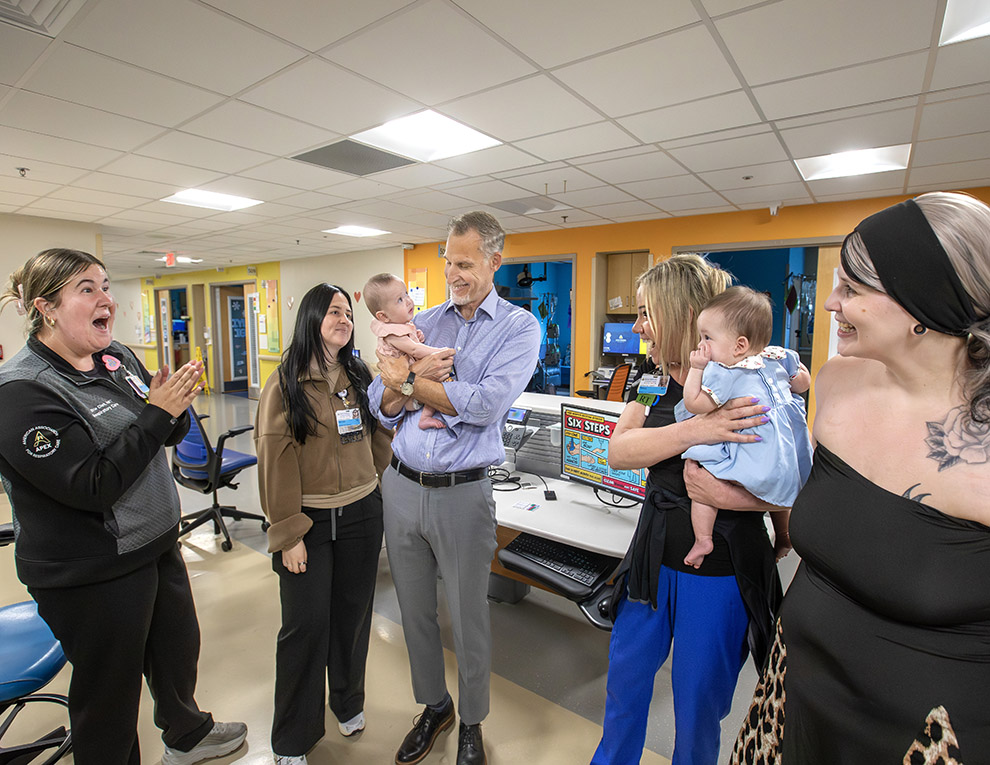
Jasmine, Makara and their 8-month-old twin daughters Kira and Kyra walked back into the cardiovascular intensive care unit (CVICU) at Johns Hopkins All Children’s Hospital in St. Petersburg, Florida, and were met with gasps of: “Oh my gosh! How is she so big?” from several nurses. For the first time since they were born, Kyra and Kira look like twins. Kyra has nearly caught up to her sister in height and is much closer in weight. She flashes the sweetest smile at Michael Puchalski, M.D., whom her parents credit for saving Kyra’s life.
An Early Diagnosis
It was a pregnancy ultrasound that led Jasmine to Puchalski’s office. The scans discovered an irregular heartbeat in one of her twins.
“When the parents come to us, usually around 20 to 24 weeks gestation, we do complete ultrasounds on both twins,” explains Puchalski, a cardiologist and co-director of the Johns Hopkins All Children’s Heart Institute. “In Kyra's case, she had something called transposition of the great arteries with a ventricular septal defect. That is a congenital heart defect where the two main arteries leaving the heart are swapped, and there is a hole in the wall separating the heart's lower chambers.”
The heart defect prevents oxygen-rich and oxygen-poor blood from mixing and sends the oxygen-rich blood the wrong way, pumping it back to the lungs — instead of out to the body, the way blood normally circulates.
“I remember telling Jasmine and Makara that we're going to be with them every step of the way, and the surgery is going to go great because our surgeons are great,” Puchalski explains.
“I was really terrified to hear about Kyra’s heart issues, but I felt confident in her medical team,” Jasmine recalls.
Kyra and Kira Make Their Grand Entrance
When a baby is born with transposition of the great arteries, the process moves very quickly. An interventional cardiology team was ready the moment Kyra and Kira were born. It can make a critical difference. Within five minutes of her birth, Kyra was profoundly cyanotic, which is when babies turn blue or purple signaling a critical lack of oxygenated blood. “So when your saturations are that low, you can get significant damage to organs including the brain, so you have to be ready to move pretty quickly to the cath lab to get a catheter up into the heart and create a hole between the upper heart chambers, allowing oxygen-rich and oxygen-poor blood to mix.” Puchalski says.
The lifesaving, minimally invasive procedure works immediately, allowing more oxygenated blood to flow to the brain and body and ensuring Kyra is stable until she grows strong enough for corrective open-heart surgery.
“That’s the difference between delivering in an institution that can manage complex cardiology cases versus a community hospital where the baby is born and immediately needs to be transferred by helicopter to a specialty hospital,” Puchalski explains.
Days later, Kyra (weighing in at just 4 pounds), was deemed strong enough for surgery and Puchalski turned to James Quintessenza, M.D., who has refined complex neonatal heart surgery since joining Johns Hopkins All Children’s Hospital in 1988.
“It’s a complex surgery,” Puchalski says. “Historically, they did not perform this surgery because you must move the coronary arteries. When I was in training, the books still described a different type of operation, which had less successful outcomes.”
The surgery Kyra had involves carefully removing the coronary arteries from the aorta as small buttons of tissue and replanting them into the correct position.
“You have to ensure they are in the right position so that when the heart grows three, four times the size over the patient's lifetime, they don't kink,” Puchalski added. “So, it’s a really big deal and a huge operation.”
The surgery allows patients to live long lives, with fewer complications, and in Kyra’s case it was a major success.
Recovery
Jasmine will never forget seeing Kyra after her surgery and hearing the doctor’s reassuring message that surgery went flawlessly. “They saved my baby,” she explains. “Recovery was a little difficult, because no parent wants to see a scar on their child’s chest, all these IVs, it's heartbreaking, but at the end of the day, teamwork saved her. It's really cool to think about everything that she has overcome. I wish my baby didn't have to go through this, but the fact she made it, and she's flourishing. I am so proud.”
Home and Together, At Last
For Jasmine and Makara the best part was getting both twins home. Kira spent some time in the neonatal intensive care unit (NICU), but for Kyra, getting home was a much longer process.
“It definitely fulfilled everything in me, it felt like when Kyra was in the hospital, there was a piece of me missing, and Kira seemed to sense it too,” Jasmine adds. “When Kyra came home, everything felt right.”
“It's such a blessing,” Makara says. “They love being around each other. Once one is gone, the other can't function. When one is upset, the other will step in to comfort her by grabbing her foot. When one smiles, the other follows. They make my life so much better.”
Jasmine says the experience has made her a better mom too and taught her to appreciate the little things … even baby spit up.
“The fact that Kyra is doing so great, I don’t even mind when she spits up on me because it’s another reminder that she’s healthy.” She says that’s only possible because of excellent medical care. “The whole team, they were there for me, from beginning to end, from the most critical time to the best time,” she says. “Any questions I had, they answered promptly. There was no second guessing, and they told me how it was. Like, they didn't sugarcoat anything. If I had to do it all over again, I'm glad I chose here and nowhere else. It's like one big family here and it was a second home for us,” she adds.
One Final Surgery
Kyra has just one additional surgery to power through on her route to preschool, which is not related to her prior heart surgery. Kyra’s aortic arch — a section of the main artery that carries blood away from the heart — is formed to the right but then switches back to the left. “It’s something called a circumflex arch, which is really rare and even more rare that it causes problems,” Puchalski explains.
In Kyra’s case, the aortic arch passes behind her esophagus and trachea, which makes it harder for her to breathe and swallow. Soon, surgeons will perform an aortic uncrossing procedure to ensure her esophagus and trachea have more room.
“Our hope is that if you met Kyra and Kira for the first time, you wouldn’t be able to tell that Kyra had heart disease. She will be able to keep up with her sister and live a wonderful life,” Puchalski adds. “Having the opportunity to make a difference in their lives is special. Those first visits during pregnancy when you're talking to the parents about heart disease, you sort of form a trauma bond. Then you're guiding them along this path and showing them that we will be there every step of the way. It’s an incredible journey alongside them, supporting them and celebrating along the way.”
Future Plans
Jasmine and Makara, like most parents, wonder what their daughters’ futures will hold. Will they do gymnastics? Basketball? Ballet? Volleyball? Debate team? Jasmine adds, “I can’t wait to see what they’ll accomplish, but I'm also hoping, when Kyra’s older, that she can relate to someone going through something difficult. I hope she’ll be the one to say, ‘Hey, you're not alone. You got this. We got this.’”