
A Team Approach to Respiratory Health
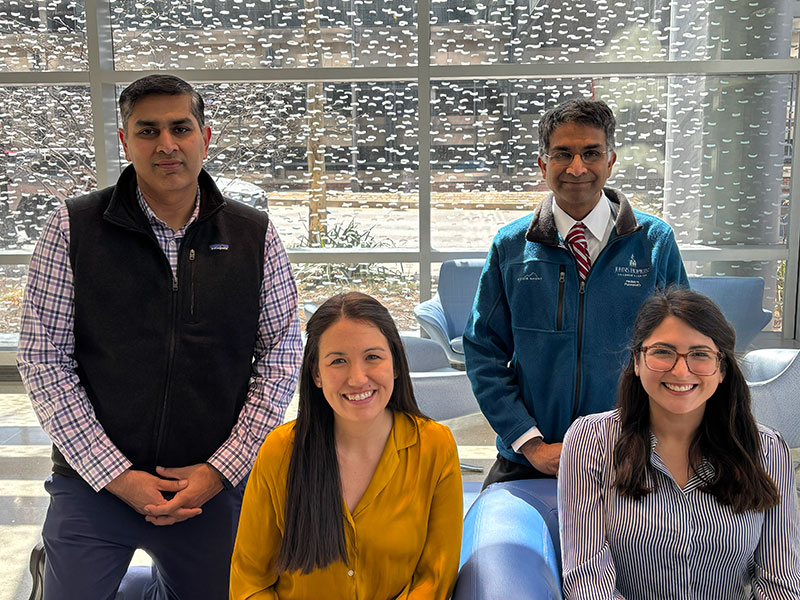
BPD Center team members (l to r): Kartikeya Makker, Brianna Aoyama, J. Michael Collaco and Samar Atteih.
It takes a team effort to limit the effects of bronchopulmonary dysplasia (BPD), a serious lung condition resulting from a baby’s lungs not developing properly in the womb or after premature birth.
This is where the Children’s Center's Bronchopulmonary Dysplasia Center team comes in.
The BPD Center provides specialized inpatient respiratory care for infants born prematurely with breathing issues, and outpatient support for children and adolescents already diagnosed with BPD. The team also offers bedside consultation at partner locations Mt. Washington Pediatric Hospital and Kennedy Krieger Institute.
Each year, an estimated 50,000 babies in the United States develop BPD, also known as chronic lung disease of prematurity. It’s the most common complication of premature birth. Risk factors show before birth, but a diagnosis of BPD is not made unless the child still needs breathing support at 36 weeks gestation. Given the urgency, it’s complicated timing that requires planning ahead of the diagnosis.
“There is a lag time before the formal diagnosis is made,” says pediatric pulmonologist J. Michael Collaco. “Our goal is to intervene in the window that we have before that point. Then, once the disease is established, we try to minimize the severity of it and manage the long-term consequences.”
For inpatient care, the team meets babies at high risk of BPD in the NICU within the first month of life to understand the baby’s condition.
“We focus on optimizing lung health and nutrition early on, even before a formal diagnosis of BPD,” says pediatric pulmonologist Samar Atteih, whose team supports babies, families and primary teams in decisions on respiratory and ventilation strategies, nutritional support and medication needs.
“Meeting the families that early is important,” says neonatologist Kartikeya Makker. “We can say, ‘Your baby has a high risk of developing BPD. This is what it means now, and this is what it means years down the line.’ That level of preparing families for the long term is very meaningful to them.”
"There is a lag time before the formal diagnosis is made. Our goal is to intervene in the window that we have before that point. Then, once the disease is established, we try to minimize the severity of it and manage the long term consequences."
J. Michael Collaco
To maintain continuity of the child’s care, the pulmonology team follows these children from the NICU to the pediatric unit. The team also helps develop a care plan for when the baby goes home, as babies with BPD often continue to have breathing problems at home and can require respiratory medications or home oxygen equipment.
Since the outlook for long-term lung function can be lower in children and adults with a history of BPD, the team may continue to follow patients for care up to age 22, and work with adult clinics at Johns Hopkins in transitioning them to adult care.
We provide really nice continuity for these kids who are very vulnerable,” says pediatric pulmonologist Brianna Aoyama.