
Vision Lost, Hockey Found

John O’Connell was sitting in the office of Robert Chun, O.D., then a low-vision specialist at the Lions Vision Research and Rehabilitation Center at Wilmer Eye Institute, Johns Hopkins Medicine, when he saw a photo of the United States Blind Hockey Team. Hockey was the sport O’Connell had played starting at age 6 and through his time in the military in his 20s, but he stopped playing when he became a pilot because he was concerned about getting an eye injury that could end his career.
It had been many years since O’Connell laced up his skates and played competitively, but ironically, it was an eye disease that led him back to the ice.
In 2013, then a commercial pilot, O’Connell noticed that when someone offered him a handshake, he couldn’t see the hand. He realized something was going on with his peripheral vision. After bouncing around to local doctors near his New Jersey home who didn’t have the proper equipment to evaluate him nor gave him referrals to see other providers, he learned about Wilmer online and drove to Baltimore to see a retina specialist.
As O’Connell described it, that trip to Wilmer was “sweet and sour.” He got his answers, but it was a life-changing appointment. He was diagnosed with retinitis pigmentosa, a disease caused by a genetic mutation that results in a slow decline in his field of vision and overall eyesight. Despite his peripheral vision dropping, his central vision remained stellar, with his central visual acuity measuring 20/16. Nonetheless, he lost his job the day he was diagnosed. Three days prior, he had flown a transatlantic flight.
While there is no cure for retinitis pigmentosa, O’Connell wanted to continue to be seen at Wilmer because of the care he received. “It was a breath of fresh air,” he said about his appointment, adding he felt cared for and well informed.
Since 2016, O’Connell has seen retina specialist Mandeep Singh, M.D., Ph.D., the Andreas C. Dracopoulos Professor of Ophthalmology. O’Connell says he appreciates Singh’s whole-health approach to patient care. After O’Connell mentioned his bad hearing at an appointment, Singh encouraged him to get checked by an audiologist and do genetic testing for Usher syndrome, an inherited genetic disorder characterized by combined deafness or hearing loss and progressive vision loss. Testing confirmed USH2A-associated retinitis pigmentosa in 2019. While he may never know how much of his hearing loss is due to experiencing loud noises over the course of his military career — a common occurrence — and how much is due to Usher syndrome, the diagnosis was a wake-up call for O’Connell to pay closer attention to his hearing and plan for living his best life.
Singh, who co-directs Wilmer’s Genetic Eye Diseases Center, says many patients have been told they have a particular diagnosis based on clinical features alone, yet without genetic confirmation, the diagnoses are not certain. He advocates for getting genetic testing because it empowers patients with precise information about their condition and what treatments are being developed for it. It can also align patients with research and potential clinical trials relevant to their specific gene. “Knowing the precise gene can be both grounding and hopeful,” says Singh. “Patients often feel better informed and better able to seek opportunities.”
As O’Connell coped with retinitis pigmentosa, his vision continued to decline. He began seeing Chun at Wilmer’s low vision clinic in 2018. After O’Connell pointed out the hockey team photo, Chun told him that he certified paralympic athletes and encouraged O’Connell to return to the rink to get moving and relieve stress.
After watching videos of blind hockey during the COVID pandemic, O’Connell started playing the sport himself in 2022. To accommodate players with limited vision, the sport is played with a larger puck made of metal with ball bearings, so it is noisy while it’s moving, and it’s slower than the traditional rubber hockey puck — “It sounds like a cowbell,” O’Connell says. With few blind hockey teams in the region, he would take Amtrak trains to Washington, D.C., to play, using a white cane — which Chun encouraged him to use — to help navigate train stations and streets.
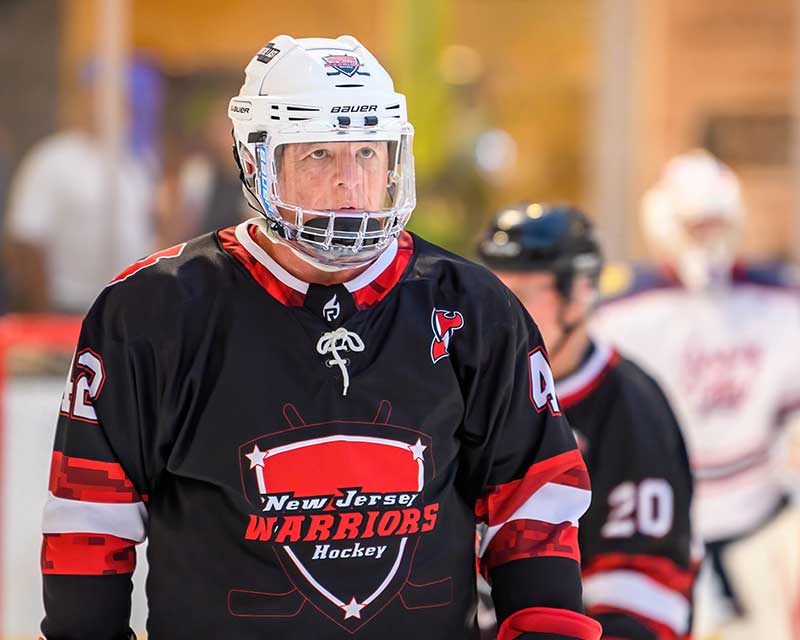
O’Connell credits hockey for giving him health, purpose, connection and community. His continued love for the game inspired him to join the New Jersey Warriors, a hockey team created for disabled military veterans, where he plays left wing. In 2025, O’Connell was named USA Hockey Disabled Athlete of the Year. He sees this recognition as an honor that grew out of his involvement in the sport both on and off the rink. With the Warriors, he’s been involved in charity events where he’s interacted with younger blind hockey players who were excited to meet another visually impaired player.
Today, O’Connell’s field of vision has worsened, as has his central vision, and he no longer drives. His care team at Wilmer now includes low vision specialist Dominic Brown, O.D., who O’Connell describes as an advocate. O’Connell is in the process of getting a guide dog to help with travel, and Brown was essential in pursuing the opportunity. “I needed that little push, but I never told him that I was looking at guide dogs,” he says. “He just knew.”
Through the Guide Dog Foundation, a New York-based nonprofit that provides guide dogs to individuals who are blind or visually impaired, O’Connell has been matched with Butchie, a yellow Labrador retriever that has been raised by the New York Islanders National Hockey League team as part of their Puppy with a Purpose program. O’Connell hopes to get Butchie in the coming weeks, as the dog will graduate guide dog training in May.
O’Connell says he’s appreciative of the care that Wilmer clinicians have given him over the years. “The thing about Wilmer is I’m not spending five minutes with a doctor and they’re rushing me out because they have another patient,” he says. “They actually care, they actually talk to you, and they actually know who you are as a person.”