
One Hand at a Time: Luke's Journey to Independence
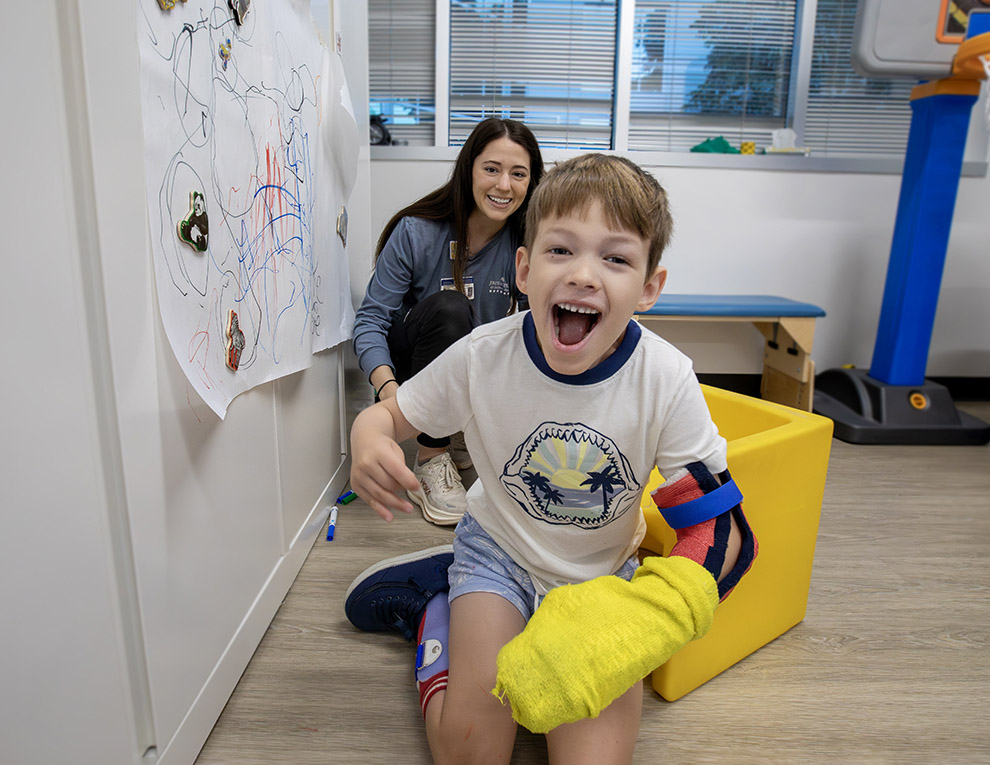
Six-year-old Luke is ambitious with a smile and laugh that’s hard to miss. “His laugh is infectious,” Luke’s dad, Matthew, says with pride.
On this day, Luke works to grab small plastic ducks spinning around on a wheel. He yells out an enthusiastic “yeah” each time he grabs one before lifting it up to reveal a colored dot. From there, he sets the duck down on a matching hand-colored piece of notebook paper. This task would have seemed impossible to Luke just a few weeks ago.
Luke was born with spastic hemiplegia cerebral palsy, which caused the right side of his body to be weaker than his left. Yet Luke is quickly learning how to build up the muscles on the right side of his body.
Intense Therapy
Luke is showing immense progress in an intense occupational therapy program called constraint-induced movement therapy (CIMT). First, therapists at Johns Hopkins All Children’s Occupational Therapy Program in St. Petersburg, Florida, fitted Luke for a cast to be worn on his dominant arm. “We make kids like Luke two casts, because although they are removable, the idea is to wear it all of the time,” Roseann Profumo, OTR/L, explains. “Then they are in therapy with us for three hours, five days a week, for three weeks, and the child does almost everything with that un-casted, weaker arm.”
The idea is to take away the ability to use the stronger arm, which forces the child to re-learn how to do tasks like getting dressed, feeding themselves, and playing using their weaker, less dominant arm.
“It’s difficult at first because we take away the part of their body that is helping them accomplish all of these tasks more independently, but they're so resilient, and I love seeing the confidence and the new independence that they achieve,” Profumo explains.
Profumo adds it can help kids with cerebral palsy and other conditions to regain use of their other arm. “Often, with the weaker arm, kids avoid using it. They don’t have the confidence or movement in that arm, so they don’t use it, and then they lose function in it. With this therapy, they’re able to build new pathways in the brain and make those movement patterns easier.”
Noticeable Progress
In less than two weeks, Luke’s therapy seems to be making a big difference. He’s using his right hand to scoop food into a spoon and feed himself. He’s grasping for toys and holding them up high.
“When he started, he could sort of use a spoon if we loaded it up,” Profumo says. “He could get it up there, but his head would tilt over. Now, he’s able to do this mostly on his own. It’s super inspiring.”
Matthew says this therapy has helped his son immensely. “He's eating with his right hand. He's playing with his right hand. He's dressing with his right hand. He's doing sign language with his right hand,” Matthew says. “It’s incredible and emotional. It's like watching your kid take their first step. It is a big deal. We’re very thankful for this program.”
Matthew adds the best part is watching as his curious first grader interacts with the world around him in new ways. “His curiosity, and the fact that he's so happy all the time, he lights up the room, and to see him explore now with his right hand is so awesome,” he explains.
Doing the Homework
Profumo adds a large part of the process is allowing kids to make progress on their own. “When kids have one side that’s weaker than the other, the parent is often stepping in, and the biggest thing is to encourage intense practice with that other arm. It may take longer and it may not be pretty at first, but it’s important to keep it up.”
Matthew encourages his son to use his right side at every opportunity.
“At first the progress seemed slow, but as Luke gained more confidence, I’ve watched his successes pile up,” he adds.
At the end of the intense therapy program, parents are encouraged to keep up with daily cast wear while incorporating rehabilitation strategies they have learned at home.
“I love working here at Johns Hopkins All Children’s Hospital,” Profumo says. “I get to work with some of the best families. They are fully invested in advocating for the best care that they can find for their child. So, I'm thrilled to be a part of it. It’s emotional to see kids like Luke become independent.”
Matthew hopes his son will inspire others to overcome any obstacles in their path. “I just want him to affect the world in a positive way,” he says.