
Nobel Laureate Adventurer
Hamilton Smith’s discoveries sparked a revolution in genetics.
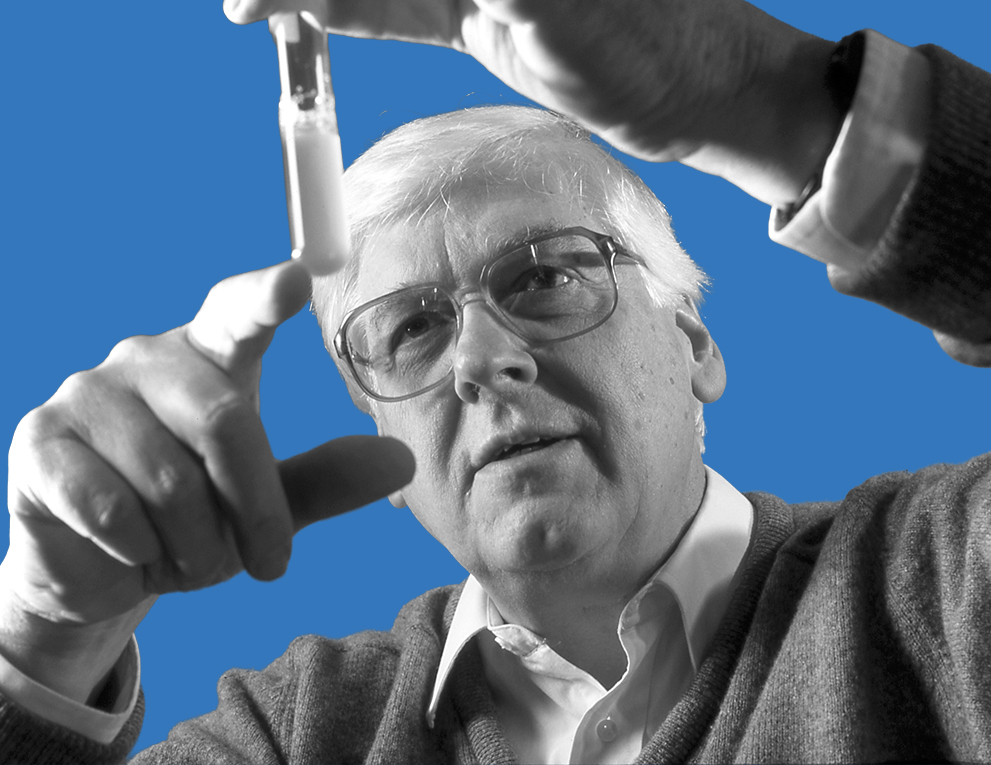
Scientist Hamilton “Ham” O. Smith ’56, who earned the Nobel Prize in 1978 after discovering the world’s first gene-cutting tools, called restriction enzymes, died Oct. 25 at his son’s home in Ellicott City, Maryland. He was 94.
The discovery of restriction enzymes — molecular “scissors” for cutting DNA — laid the foundation for advances in biotechnology, including genome sequencing and genetic recombination. Smith’s co-winners of the Nobel Prize were Johns Hopkins geneticist and microbiologist Daniel Nathans, who died in 1999, and Swiss researcher Werner Arber.
“Ham embodied a spirit of adventure in science,” says Jeremy Nathans, professor of molecular biology and genetics at Johns Hopkins, who followed his father to a career in biomedical research.
After medical school and residency training in internal medicine at Johns Hopkins, Smith served as a physician in the Navy for two years and developed an interest in genetics.
In 1962, Smith began a postdoctoral fellowship in genetics at the University of Michigan, and he joined the Johns Hopkins faculty in 1967 as an assistant professor in what is now the Department of Molecular Biology and Genetics.
In his early days at Johns Hopkins, Smith focused on genetic recombination — when different segments of DNA are swapped. Such genetic switching occurs in nature, often to gain a survival advantage, such as drug resistance in bacteria.
His search for enzymes that could chop up DNA within bacteria culminated in two research papers published in 1970 on the first type II bacterial restriction enzyme, dubbed Hind II, which later earned him the Nobel.
Since then, thousands of restriction enzymes have been discovered, enabling scientists to clip DNA at precise points for analysis and further experiments. They have been used to insert the insulin gene into bacteria and make insulin for people with diabetes, and to diagnose genetic diseases, such as sickle cell anemia.
Biomedical researchers continue to use restriction enzymes, as well as modern DNA cutting tools such as CRISPR.
After Smith retired from Johns Hopkins in 1998, he continued working on genome sequencing advances, making major contributions to the sequencing of the human genome.
In 2015, Johns Hopkins established the Hamilton Smith Award for Innovative Research, which has since supported 13 early-career scientists in the Institute for Basic Biomedical Sciences.