
Lighting the Dome
Electrical engineer David Nelson, who manages the colorful lights of the iconic Johns Hopkins dome, will retire later this year.

Photo by Sara Feldman
In a common area on the fourth floor of The Johns Hopkins Hospital’s Billings Administration Building, David Nelson unlocks a door that leads to what looks like an unfinished basement, with dusty wooden floors and exposed brick walls. To the left, natural light spills into an open room with tall ceilings. This is the bottom of the iconic Johns Hopkins dome.
Nelson, an electrical engineer, has been responsible for lighting the dome — which is illuminated every night of the year — since 2018, when he redesigned the lighting system to use energy-efficient LED lights.
He lights it in different colors for all sorts of holidays and events: red for American Heart Month in February; blue and green for Neurofibromatosis Month in May; pink, green, blue and purple for Rare Disease Day in February; and purple or orange when the Baltimore Ravens or Orioles are in the playoffs. For Esophageal Cancer Awareness Month in April, Nelson figured out a combination that could create the month’s color, periwinkle.
The dome is one of dozens of lighting and electrical projects around Johns Hopkins that Nelson, senior engineering project manager for the Johns Hopkins Health System, has designed.
Back inside the dome, through a narrow passageway with exposed pipes and cables, dozens of blue ethernet cables are hooked into the server that allows Nelson to remotely control the lights that illuminate the dome. On the other side of the window-lit room, up a short ladder, a series of narrow staircases climb up the rest of the dome — not a journey for the acrophobic. At the top, Nelson’s keychain jingles as he shuffles through it to find the one that opens the metal door at the top of the last set of stairs. Sunlight pours in as he opens the shaft and climbs up to the terrace at the top of the dome. From here, Nelson enjoys a 360-degree view of Baltimore, including the campus that he has helped power and light for 35 years.
Nelson, 64, is retiring later this year. Though he works without fanfare, the results of his efforts are highly visible, literally bringing light to Johns Hopkins and its mission.
His lighting and electrical work shaped the Sheikh Zayed Tower and the Johns Hopkins biocontainment unit, which became a crucial part of the hospital’s COVID-19 response. He helped redesign Ben Carson’s operating room in 1995, and he’s responsible for the designs that illuminate the hospital’s main loop and several conference rooms and executive suites.
He also helped create the system that monitors electrical power at The Johns Hopkins Hospital, Johns Hopkins Bayview Medical Center, Green Spring Station and other locations.
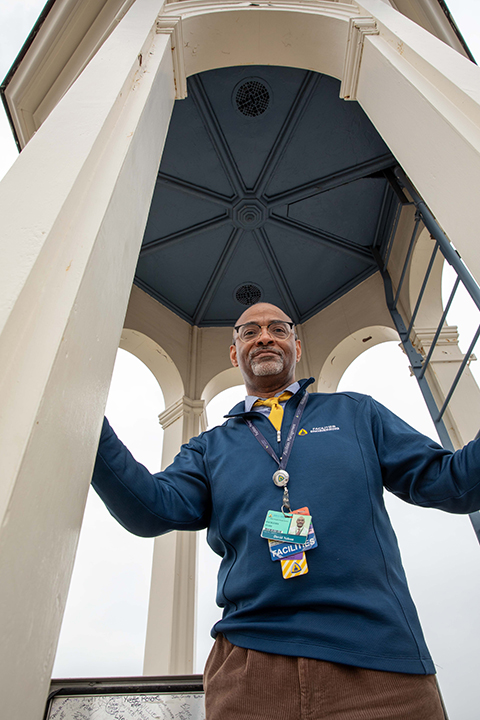 Photo by Marc Shapiro
His dome responsibilities, though, may be his career highlight. “I’m a Baltimore guy,” he says. “I went to Baltimore Polytechnic, I went to Johns Hopkins. For me, this is a big deal.”
The Iconic Dome
When The Johns Hopkins Hospital opened its doors in 1889, one of its 17 original buildings was named for John Shaw Billings, a Union Army battlefield surgeon and one of the country’s foremost experts on hospital design and management. Billings had been in charge of the hospital’s construction since 1876, dictating meticulous instructions, including for the Queen Anne-style architecture and iconic dome of the building that would bear his name.
There are 41 light fixtures on and inside Billings that light the outside of the dome and its windows — 10 inside the windows, seven on the terrace and 24 inside the cupola, the peak above the terrace. Another three LED panels across the street on the roof of the Levi Watkins, Jr., M.D., Outpatient Center light the dome’s gray cap from about 500 feet away, and more than 60 fixtures light the interior of the dome, which can be seen from inside Billings.
When Nelson joined Johns Hopkins as an electrical designer in 1991, the dome was lit with incandescent and halogen lighting. That meant that maintenance workers, carrying whatever equipment they needed, would have to climb that series of narrow staircases to the top of the dome — as well as the roofs of the outpatient center and the former Reed Hall (now the construction site of the future Life Sciences building) — to swap film colors or change out bulbs, like when medical students or residents would accidently kick and break them during photos from the dome’s terrace.
In 2018, when dome lighting became part of his job responsibilities, Nelson introduced a new system with energy efficient, color-changing LED light panels. It was the first major renovation to the dome’s lighting system since 1981, when floodlights were first installed on the roofs of the two buildings across the street, lighting the dome as it is lit today.
These days, Nelson can control the lighting remotely through software that allows him to create preset colors, change brightness and easily try new color combinations. He rarely climbs into the dome, unless there is an issue with the electronic controls.
The challenge, he says, is getting the color right, taking into account the green and gray of the dome and the red bricks surrounding it. “A lot of times, I’ll turn it on the day before the event so I can see if I need to tweak it,” he says.
One Oct. 15, he lit the dome in pink and blue to observe Pregnancy and Infant Loss Remembrance Day. A woman saw it and asked a nearby doctor about the significance of the colors.
“She became very emotional because she had lost someone,” Nelson says. “I’ve had family members and friends die of cancer, sickle cell disease and gun violence, so I can truly relate to the impact these observances have on people.”
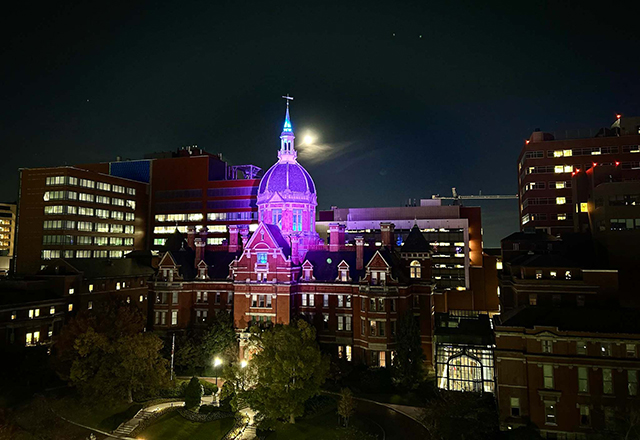 The dome is lit in different colors for a variety of holidays events: red for American Heart Month in February; blue and green for Neurofibromatosis Month in May; pink, green, blue and purple for Rare Disease Day in February; and purple or orange when the Baltimore Ravens or Orioles are in the playoffs. (Photo by Sara Feldman)
Nelson plans to retire to South Carolina and build a house on property that his grandparents own. He’ll golf and travel, he says, including to Germany, where he was born, as his father was stationed there at the time.
An Art and a Science
A lighting designer through and through, Nelson proudly shows off the shields he designed for the overhead lighting to keep video cameras glare-free in the conference room of Wilmer Eye Institute’s Friedenwald-Romano Library. When he walks down a hospital hallway, he notices every detail of how it is illuminated.
But lighting wasn’t his original plan. At Baltimore Polytechnic Institute (Poly), an engineering high school, Nelson thought he wanted to be an architect. When he graduated in 1980, he began consulting for a firm led by three Poly graduates. Since he didn’t have a bachelor’s degree at the time, they gave him lighting work instead of engineering or architecture.
“It turns out I had a knack for it and got very good at it,” Nelson recalls. “It’s an art and a science, so it let me to tap into my creative side of wanting to be an architect, plus use my engineering knowledge.”
Over the next decade, he continued consulting and attended The Johns Hopkins University at night to earn his electrical engineering degree. In 1991, he joined Johns Hopkins as an electrical designer for new buildings and renovations.
In 1994, he won a design award from the Illuminating Engineering Society of North America for his work on the Mary Elizabeth Garrett Room in the Nelson/Harvey Building (no relation), including his use of energy-efficient fluorescent downlights to showcase the portraits around the room.
The following year, he participated in a $1.3 million operating room (OR) renovation overseen by pediatric neurosurgeon Ben Carson, which included fiber optic technology allowing for real-time MRI scans and patient history access, a 3D wand to help surgeons precisely locate neurological issues in the brain, and microscopic photo and video technology. Nelson and his colleagues were honored at a news conference when the OR was unveiled.
The neurosurgeon liked to listen to classical music during procedures, so Nelson and his colleagues added a wall-mounted boombox to the OR design.
As Nelson deepened his lighting skills and knowledge, he moved into project management, and became an expert in LEDs, working with the facilities team to replace incandescent and halogen lighting with the more efficient option when possible.
The LED lighting around The Johns Hopkins Hospital’s main loop, which dims at night and brightens as people walk through the corridors, was Nelson’s design. When the technology was still new, the cost of the lights and installation was often covered by energy credits from Baltimore Gas and Electric.
An Upgraded System
In 2018, a lighting distributor Nelson knew told him that he had a variety of LEDs left over from a project. Nelson credits former facilities management vice president Anatoly Gimburg with making the upgrades possible.
“Supporting our researchers, doctors and nurses really gives us a sense that what we’re doing is bigger than just making a salary or supporting our families,” says Gimburg, who retired in September 2025 and now consults on several projects. “For Dave and me and so many others, that’s what really makes us proud of what we do.”
Nelson supervised installation of all the new dome lights. While he is generally not afraid of heights, there was one less-than-ideal time that he climbed the 10-foot ladder from the dome’s terrace to go into the cupola as part of that project.
“The only time I got nervous was when I was up there on a windy day and it started swaying,” he says. “I completed my work very quickly to get out of there. The whole cupola was swaying.”
Early one morning shortly after installation, Nelson was bombarded with calls and texts. The LED lights were shining white at 100% brightness, “like the Bat-Signal,” he says. He quickly learned that he had to use percentages to turn brighter lights down to a more soothing level.
By now, Nelson is adept at adjusting brightness, and has started to preprogram the dome’s colors for different observances and holidays throughout the year. Full automation isn’t likely, he says, because new requests keep coming in.
Although it’s just one part of his job, lighting the dome is one of his proudest accomplishments.
“It’s historic, for one. Iconic, to use that cliché,” he says. “I understand the importance of Hopkins, the history of Hopkins. And for me to be the one to light it, it’s one of the highlights of my career.”
Lighting The Hopkins Dome
David Nelson and the Dome


