
Free Thinkers
Students in the XDBio Ph.D. program forge their own paths in choosing the classes and labs that will help them answer their research questions.
Illustration by Petra Eriksson
On a late-autumn Wednesday evening, Johns Hopkins students in the Cross-Disciplinary Graduate Program in Biomedical Sciences (XDBio) gathered in a small conference room in the 1830 Building to snack on pizza and hear Ariadne Sinnis-Bourozikas talk about hepatitis B.
For close to two hours, the third-year student, who is conducting her research in the lab of infectious diseases professor Justin Bailey, clicked through a PowerPoint. She explained that chronic hepatitis B, primarily transmitted from mother to child during or after birth, causes liver cancer and is responsible for more than 1 million deaths per year. She then described her research, aimed at understanding how the immune system interacts with the virus, which could lead to the development of better treatments for chronic hepatitis B.
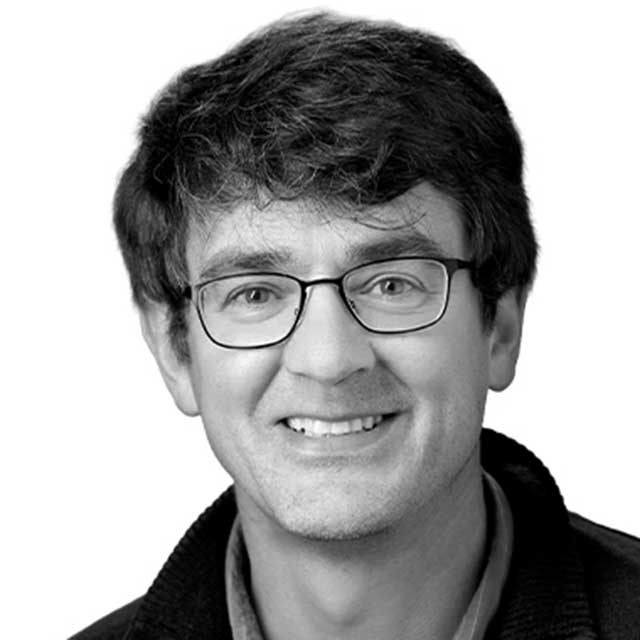
As Sinnis-Bourozikas spoke, XDBio co-director Brendan Cormack followed up with occasional questions about virus and antibody behavior. So did some of her fellow XDBio students, even though the presentation wasn’t connected at all to their own research.
But they are, by definition, a curious and driven bunch, and they wanted to learn about their colleague’s research. Plus, in a small program, they value this time together.
In fact, their paths rarely cross unless they make a specific effort, because each student is crafting his or her own academic journey based not on what is required but instead on what they need to know.
“In order to make transformational discoveries, you’re really doing a whole bunch of different approaches to get at a singular problem.”
Brendan Cormack, co-director, XD-Bio
Forging Their Own Paths
The roughly 30 graduate students who have been part of XDBio since the first cohort of three students enrolled in August 2019 are encouraged to tap into multiple disciplines, with many taking classes across schools at Johns Hopkins and conducting research in more than one lab.
Fellow student Grant Kroeschell, who is learning about visual neuroscience and imaging to study the retina and brain using a zebrafish model, says the get-togethers are an important part of the program.
“We’re not all taking the same classes, and we’re not working in labs that are all in the same department, so we have to put in that effort,” he says. “There’ll be a talk on campus, and someone will send a text saying, ‘Hey, I’m going to this. It seems interesting.’ Or we’ll meet up for lunch on campus.”
Like their program colleagues, Sinnis-Bourozikas and Kroeschell chose XDBio because it lets them select the classes and labs that help them answer their specific research questions as they pursue their Ph.D.s
Sinnis-Bourozikas, a Baltimore resident, graduated from Bard College in 2020 with a degree in computer science. “I did a lot of chemistry, a lot of other science, and I really liked lab work,” she says. Back in Baltimore — in the depths of the pandemic — she got a job as a technician in Bailey’s lab, looking at how the hepatitis C virus evolves within a person.
As Bailey expanded his research focus to include hepatitis B, she asked if she could stay in his lab while pursuing a doctoral degree.
“XDBio was my first choice for that reason. I already knew what project I wanted to work on and what classes I wanted to take,” Sinnis-Bourozikas says.
In a traditional bioscience graduate program, students spend a year or two working through a core curriculum and doing required lab rotations before settling into a single lab for their research. XD Bio is different. “You can really decide what path you’re going to be on,” says Sinnis-Bourozikas.
“When I joined, I wanted to learn about human anatomy because I wanted to understand how the diseases affected the physical body. I told Brendan this, and he suggested I take anatomy with the medical students.” She also took a statistics class in the Bloomberg School of Public Health, and was able to skip immunology classes because she’d already taken the hardest ones.
Erin Kavanagh agrees that the flexibility of the program is what made it her top choice. When she enrolled in XDBio in 2020, she knew she wanted to combine research in chemistry and in biomedical engineering in order to learn how nanoparticles could deliver medication for patients with cystic fibrosis.
“XDBio was the only program that advertised a unique cross-disciplinary nature,” she says. “I didn’t see that anywhere else. It was clear they did not want to silo themselves into one department.”

Ariadne Sinnis-Bourozikas, left, pictured here with infectious diseases professor Justin Bailey, is pursuing research into better treatments for hepatitis B.
The Future of Biomedical Research Training
The push for XDBio came from Paul Rothman, then dean of the medical faculty, who tasked Peter Espenshade, associate dean for graduate biomedical education, with creating a program that would free students from the boundaries and financial worries of more traditional biomedical doctoral pursuits.
Central to XDBio is its unconventional funding. The school of medicine pays students directly, so they’re not reliant on the usual combination of training grants and research funds. This structure gives students freedom to question and explore without worrying that their income is attached to a particular lab that is expected to support that student for five or more years. In the first years of the program, the funding was for five years; now it’s for three, partly so students feel more integrated into their labs as they progress on their research.
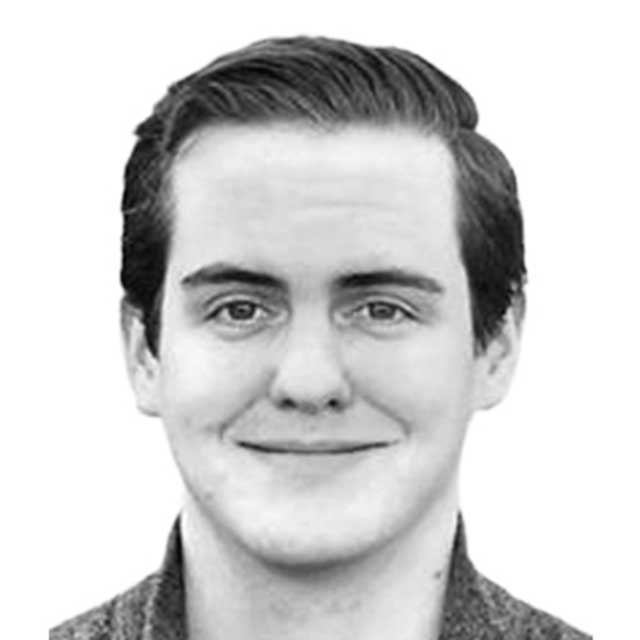
“This program is really envisioning the future of biomedical research training,” says Edward Twomey, assistant professor of biophysics and biophysical chemistry and XDBio program co-director with Cormack.
With rapid advances in artificial intelligence, genetic research, imaging equipment and more, students need to focus on the specific knowledge that will help them pursue their research.
“In order to make transformational discoveries, you’re really doing a whole bunch of different approaches to get at a singular problem,” says Cormack. “There is not enough time to teach everyone everything, so we prioritize what is best for a given student by essentially asking them and working with them.”
Graduate students who are particularly self-driven appreciate this approach.
Says Kavanagh: “When I came in, I had this specific idea to investigate nanoparticle delivery of cystic fibrosis therapies. [Brendan] asked about it in a way that was not intimidating. He wanted to know what I needed to put in place to make it work. He brought up the idea of buffing up my genetics knowledge, and for me to take biomedical engineering and chemistry classes to fill in any gaps.”
Says Kroeschell: “I’ve literally never heard Brendan say the word no. The worst he’ll say is, ‘Well, you can certainly try it.’”

Grant Kroeschell, left, in the lab with Wilmer’s Ji Yi, an optical engineer.
Partnership with Janelia
After their first year at Johns Hopkins, XDBio students can expand their knowledge quest even more, tapping into the labs and scholarship at the Janelia Research Campus of the Howard Hughes Medical Institute (HHMI), in Ashburn, Virginia.
The partnership, which started in 2024, gives students access to HHMI, a nonprofit biomedical research organization with a similarly cross-disciplinary culture, says Erik Snapp, Janelia’s director of student and postdoctoral programs, who pursued the partnership after reading about XDBio on a Johns Hopkins website.
“I realized the program encapsulated values and research goals that are highly compatible with Janelia’s,” he says. “The XDBio program enables many of our labs to host students with interest in the types of projects we do at Janelia. By this, I mean highly collaborative and cross-disciplinary projects that are not separated by departments, funding or even location. All labs are free to work together regardless of their research area; they are all HHMI labs with dedicated HHMI funding; and they are all housed in the same building. Practically, this means that it is exceptionally easy for individuals, labs and teams to work together.”
Theodore DeWeese, dean of the Johns Hopkins University School of Medicine and CEO of Johns Hopkins Medicine, has been a steadfast supporter of the program and praised the partnership when it was announced. “This innovative arrangement is one more pathway to ensure [students] are well prepared to make the kind of discoveries that advance our understanding of human health and disease,” he says.
That partnership has been a boon to Kroeschell, who graduated from Clemson University with a biology degree in 2021, followed by a postbaccalaureate fellowship in a lab at the National Institutes of Health. The lab where he conducted his two-year fellowship moved after his first year to Janelia, where he focused on using deep learning to improve fluorescence-based microscopic imaging.
As the fellowship ended, he began researching graduate programs and decided that XDBio was the only one with the flexibility he wanted. He saw a gap, he says, between optical engineers and biologists, one that he thought he could fill by learning to build sophisticated scopes with nanometer-level resolutions that were tailored to the needs of biologists. It also helped that Snapp spoke highly of the XDBio program.
“I’d been taking genetics and molecular biology classes for four years before I got to Johns Hopkins,” says Kroeschell, “so I wanted to emphasize that less in my coursework and emphasize more of the engineering and math that I didn’t get as an undergrad. The freedom in coursework was what really enticed me.”
He did a rotation in the lab of Johns Hopkins neuroscience professor Alex Kolodkin, and now divides his time between the Wilmer Eye Institute-based labs of Ji Yi (optical engineer) and Jeff Mumm (regenerative biologist focused on the retina). Kroeschell’s focus is on developing optical and genetic tools to study the retinas and brain activity of zebrafish to determine why they can regenerate some cells — such as ones that die with glaucoma —while humans cannot.
Kroeschell says the program isn’t for everyone. But the right students, he says, will thrive.
“It definitely requires a level of self-motivation and independence,” he says. “Having a good idea of your strengths and your weaknesses or the things that you like and you don’t like is helpful.
“This program is really envisioning the future of biomedical research training.”
Edward Twomey, co-director, XDBio
Ready to Take Risks
The XD-Bio program’s directors look for students who already have a fairly fixed idea of the question they want to answer, and how they are going to do it. “The students in this program are really ready to take risks and be on that more independent path sooner,” says Twomey.
Kavanagh certainly fits that description. She graduated from Carnegie Mellon University in 2019 with a degree in chemistry and biomedical engineering, and thought about pursuing an M.D./Ph.D. before deciding to focus on a Ph.D.
As it happens, she was already very familiar with Johns Hopkins because she had been a patient as an infant. “I was born two months early with a large spinal cord tumor,” she explains. “I sort of grew up around Hopkins and the idea of merging clinical care with research in order to better care for patients.”
She joined XDBio in August 2020, eventually working in two labs: the genetic medicine lab of Garry Cutting, professor of pediatrics and medicine, and the biomedical engineering lab of Jordan Green, professor of biomedical engineering.
“I came in with the project ready to go,” she says. “It requires a lot of self-direction, which also means a lot of flexibility. We get to choose all of our courses. I loved that.”
Kavanagh completed her doctorate this fall, and is beginning a postdoctoral Humboldt Research Fellowship, studying inherited cardiomyopathies at the Ludwig Maximilian University of Munich. She credits XDBio with allowing her to pursue exactly the academic foundation that she wanted.
“You have to be self-directed,” she says. “Freedom comes with a price, but freedom also has potentially great rewards.”