
Focused Ultrasound Offers New Option for Treating Essential Tremor
The FDA-approved procedure is less invasive than deep brain stimulation.
Key Points
- For patients with essential tremor that has not responded to two or more medications, MRI-guided focused ultrasound (FUS) can be an effective treatment that is less invasive than deep brain stimulation.
- The Johns Hopkins Hospital now offers FUS, which is approved by the Food and Drug Administration for treating essential tremor in patients age 22 and older who have tried medications without success.
- Randomized trials demonstrate 47%–73% tremor reduction sustained through five years, with significant quality-of-life improvements.
What is FUS?
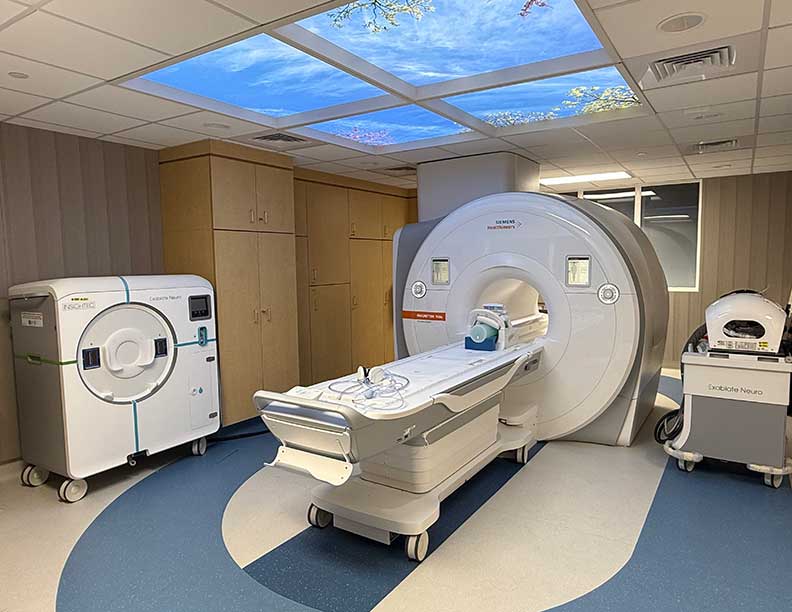
FUS uses converged ultrasound beams to create a precise thermal ablation on deep brain targets.
The procedure is performed with the patient awake inside an MRI scanner, allowing real-time imaging guidance, temperature monitoring and immediate clinical feedback to ensure safety and efficacy.
FUS can be a good option for patients who have severe tremors but are too elderly or medically complex to undergo the surgery required for deep brain stimulation (DBS), because FUS requires no incision, no implanted hardware and no device maintenance. It is also more convenient, as DBS generally requires at least one night in the hospital after implantation, and several appointments to program the device.
When and Who to Refer
Consider referring patients with:
- Disabling essential tremor causing functional disability (difficulty with eating, drinking, writing or other activities of daily living)
- Persistent symptoms despite treatment with at least two medications that failed to provide adequate relief
- Patient preference for an incisionless procedure without implanted hardware
What to Expect: The Procedure
FUS is performed as an outpatient procedure lasting 90 minutes to two hours. A stereotactic frame is secured to the skull, and patients remain awake in the MRI scanner throughout treatment. Multiple sonications progressively create the ablation while the team monitors tremor suppression and potential side effects in real time. Patients typically go home the same day.
Common intraprocedural effects include headache, dizziness and nausea, which resolve immediately post-treatment.
Post-procedural adverse events such as numbness, tingling, balance issues and gait irregularities occur in approximately 50% of patients, but typically resolve within 30 days.
FUS vs. DBS
- FUS: Incisionless, outpatient, no hardware, immediate effect, typically unilateral
- DBS: Adjustable/reversible, requires surgery/hospitalization, device programming needed
Both provide significant tremor reduction. Johns Hopkins neurologists can help patients choose a procedure based on tremor appearance, comorbidities and preference.
How to Refer
To find out if your patient is a candidate for FUS, call 410-502-0133 to make a referral to one of our neurologists.
Case Presentation: Focused Ultrasound for Essential Tremor
Neurologist Kelly Mills describes the case of an 80-year-old patient with long-standing essential tremor that resulted in difficulty independently performing activities of daily living and was refractory to multiple medications.
For Clinicians Clinical Connection
Clinicians, discover the latest in research and clinical innovation from Johns Hopkins experts. Access educational videos, articles, CME courses and other resources from our world-renowned institution.