
Engaging Interlocutor
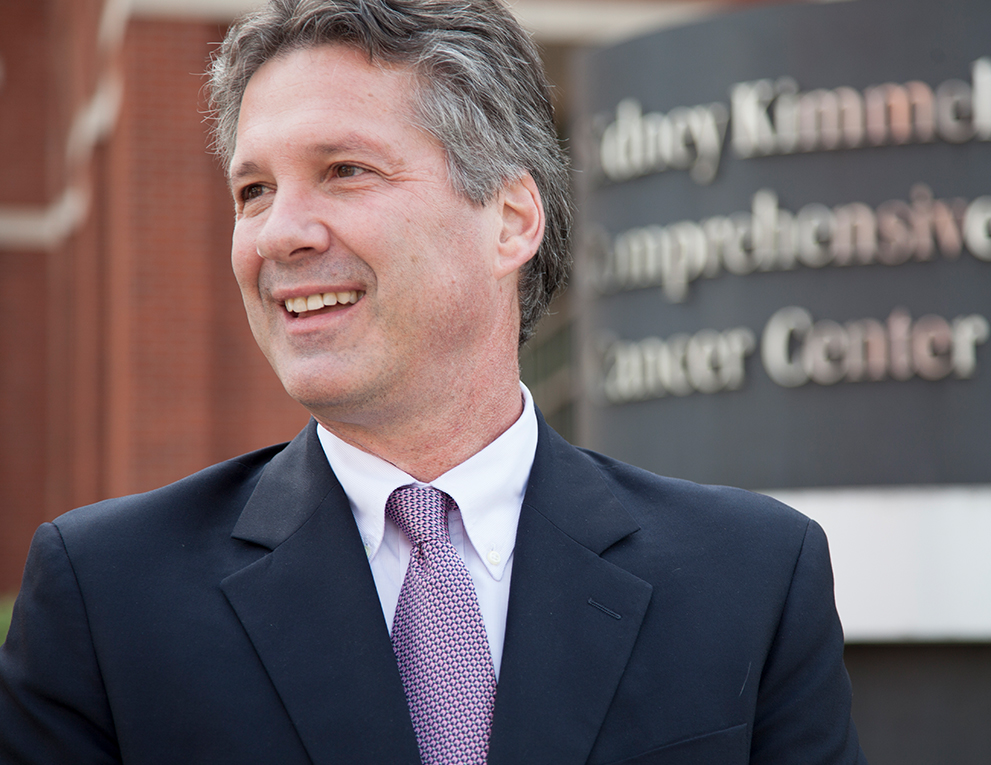
Why are people developing cancers earlier in life? What are the latest treatment options for prostate cancer? How does our microbiome impact cancer risk? Bill Nelson, director of the Johns Hopkins Kimmel Comprehensive Cancer Center, explores these topics and more in his Cancer Matters podcast.
What led to Cancer Matters?
I had gained comfort communicating with lay audiences dating back to the 1990’s, when I was working with Jonathan Simons and his team here at Hopkins to develop the first human gene therapy clinical trials for advanced prostate cancer. I was in the media quite frequently. I learned in the television space to talk in tight phrases so they can cut you off if they need to. After that I began working with Elizabeth Tracey, speaking on segments of her Johns Hopkins Health Newsfeed.
Around 2018, our public affairs folks at Kimmel suggested that we start the podcast. One of my earliest interviews was with Katie Couric [TV host and cancer prevention advocate]. I very unintentionally brought her to an emotional place about her husband Jay Monahan, who had died of colon cancer. That segment got us some ears early on. Since then we’ve done about 170 segments.
How do you choose which experts to interview and topics to cover?
I am in a great position to see what’s next in cancer treatment and care as scientific chair for Stand Up To Cancer, a program that funds collaborative cancer research [which Couric co-founded]. I am regularly reviewing a gazillion scientific papers. I learn something new all the time and am able to be out in front a bit, which is reflected in many of the guests we bring on — both experts from within Johns Hopkins and outside.
Clinton Petty, who directs our podcast network, really hustles to line up guests to talk with me. Sometimes we explore cancer-related issues that have been in the news, diving in a bit more fully. We end up with a segment around 15 minutes long.
How easily do your guests relate to a lay audience?
Our clinician-scientists tend to be very good teachers and explainers, particularly those who work directly with patients to explain their treatments and care. Sometimes a faculty member will be nervous and I reassure them: “Look, this is just a conversation. I’ll frame a question you can answer.” Most are innately polished in describing their work in a way the public can wrap their mind around.
How else do you share your insights with non-scientists?
Since 2015, I’ve served as editor-in-chief of Cancer Today, which is a free, quarterly magazine for cancer patients, survivors and their family members published by the American Association for Cancer Research. I write a column each issue where I try to provide some fun facts and interesting ways to look at things. It’s much different from writing a scientific article for a journal.
Listen to the podcast at: cancer-matters.blogs.hopkinsmedicine.org